
0 Intr oduction
Wind and solar power generation are inherent ly intermittent and unpredictable [1]. Their output fluctuations not only threaten the safe and stable operation of power systems but also increase power transmission costs, limiting the scale of new energy development and utilization capacity [2]. To ensure the large-scale grid integrationof variable wind and solar power plants, there is an urgent need to enhance power system flexibility for reliable power supply [3]. The stochastic nature of wind and solar generation dictates that their grid-connected operation relies on the auxiliary support of hydropower stations with regulatory capabilities. The complementary operation of windsolar and hydropower systems helps improve the absorption capacity of renewable energy in existing power grids.However, while hydropower regulation brings significant economic benefits to wind and solar power generation,it also exacerbates interest conflicts among different power generation entities. Existing studies have mostly focused solely on the overall economic analysis of hydro-windsolar configuration systems [4-6]. In reality, hydropower,wind power, and solar power are usually dominated by different stakeholders, leadi ng to a coexistence of multiple interest subjects [7]. For the economic benefit evaluation ofhydro-wind-solar complementary systems, it is not only necessary to scientifically define and accurately quantify the overall benefits but also, more critically, to fairly distribute the overall benefits in proportion to the contribution of each stakeholder. This ensures reasonable compensation and coordinated development among different interest subjects. The core of this process lies in converting the economic benefits brought by hydropower stations to stakeholders such as wind and solar power producers into their legitimate financial income, ultimately achieving multi-party win-win cooperation between hydropower stations and wind-solar stakeholders [8,9].Toincentivize renewable energy generation entities (including hydropower, wind power, and solar power) to realize the coupled utilization and coordinated operation ofheterogeneous energy sources, the incremental benefits generated by synergy must be allocated fairly, efficiently,and reasonably to all interest subjects. In view of this, it isessential to explore solutions to interest conflicts among renewable energy generation entities and develop scientific methods for distributing the synergistic benefits of hydrowind-solar hybrid power generation systems with hydropower participation.
Extensive research has been conducted on the operational mechanisms and benefit evaluation of multi-energy complem entary systems integrating hydropower, wind power, and solar power [10], with a primary focus on system ope rational characteristics and complementary values[11]. Ref.[12] highlights that hydropower can function as a natural energy storage resource for renewable energies.Leveraging its reservoir regulation capacity and cascaded joint dispatch capabilities, hydropower enab les the effective utilization of the spatiotemporal complementarity among hydropower, wind power, and solar power. Ref.[13] developed a two-player investment game model and evaluated equilibrium outcomes under different scenarios ofwind-hydro resource correlation. The study found that ahigh degree of negative correlation between resources helps enhance diversification and improve the returns of individual investors.For multi-park integrated energy systems (MPIES), Ref. [14] constructed an asymmetric Nash bargaining game model where participants negotiate over energy transactions. A joint optimization method for capacity configuration and operation of multiinterconnected energy hub (EH) integrated energy systems based on Nash bargaining game was proposed. Case studiesvalidated the effectiveness of the proposed method in reducing syst em operating costs and improving the profitability of energy storage equipment.Addressing the scale optimization challenge in the complementary operation of cascaded hydropower stations with wind and solar plants,Ref. [15] presented an approach that balances operational risks and benefits. A multi-scale nested joint operation model was established, which optimizes the configuration scale of wind and solar plants coop erating with hydropower stations through refined evaluation of the hybrid system’s operational risks and benefits.Ref.[16] developed athree-dimensional comprehensive evaluation framework for hydro-wind-solar hybrid systems, enabling a holistic assessment of complementary operational benefits and potential risks. The results demonstrated that the complementary mode significantly increases total system power generation, power generation profits,and transmission line utilization efficiency, with hydropower providing compensatory benefits to wind and solar power generation. Ref.[17] proposed an optimization planning model for multienergy complementary integrated energy systems based ongame theory. Targeting the maximization of system economic efficiency, the model takes the capacity of each participant as a decision variable an d designs five game modes to verify the existence of Nash equilibrium.Simulation experiments were conducted to solve the Nash equilibrium strategies for each mode.
With the formation of multi-stakeholder cooperation in hydro-wind-solar complementary systems, existing literature has focused on the synergistic benefit allocation mechanism of hydro-wind-solar integrated systems, exploring methods for the fair distribution of incremental benefits/-costs and the maintenance of alliance stabilit y under multi-agent cooperation models. Ref. [18] took largescale clean energy bases as the research object, constructing two scenarios: independent operation and complementary operation of hydropower stations with wind and solar plants. It quantified the interest relationships among different power generation entities and proposed an interest compensation mechanism between hydropower stations and wind-solar plants based on a contribution quantification model and compensated electricity contribution values. For hydro-wind-solar hy brid power generation systems incorporating cascaded hydropower, Ref. [19]established a cooperative game framework and adopted the Minimum Cost Remaining Surplus (MCRS) method asa synergistic benefit allocation scheme that balances fairness, rationality, and compu tational feasibility. Ref.[20] developed a cooperative game operation mechanism for hydro-wind-solar systems and proposed an improved Shapley value method integrated with comprehensive correction factors such as risk level and effort degree for benefit distribution, which can incentivize all entities to participate more actively in alliance cooperation. Addressing the incremental benefits generated by the joint operation of hydropower-participated hydro-wind-solar complementa ry power generation systems owned by multiple stakeholders,Ref.[21] conducted a quantitative analysisand employed various allocation methods—including the proportional allocation method, marginal benefit method, Shapley value method, and Aumann-Shapley value method, to calculate and measure the incremental benefi t distribution among all stakeholders.
Expanding to broader multi-energy complementary alliances, encompassing wind power, solar power, and other flexible regulatory resources, their synergistic benefit allocation mechanisms have emerged as a research focus[22,23]. Existing studies predominantly adopt gametheoretic approaches to explore multi-stakeho lder interest coordination and fair distribution.Ref.[24] focuses on the cooperative model of multi-virtual power plants (VPPs)integrated with wind-solar-storage systems. It establishes a multi-objective optimization model incorporating economic benefit maximization and carbon emission reduction. By quantifying the marginal contributions of each participant using the Shapley value method, the study achieves effective allocation of incremental alliance benefits, successfully addressing the design of collaborative operation mechanisms and reasonable interest distribution among VPPs.For cross-regional integrated energy systems involving electricity-heat-hydrogen multi-energy sharing,Ref. [25] constructs a cooperative game framework based on generalized Nash bargaining theory. The cooperative game process is decoupled into two sub-problems: alliance benefit maximization and benefit distribution equilibrium.The adaptive alternating direction method of multipliers(ADMM) is employed for model solution, providing an effective pathway for interest coordination in crossregional multi-energy synergy. Ref. [26] proposes a cooperative game-based model for large-scale multi-source joint outward transmission and benefit distribution, integrating wind power, solar power, and thermal power.It compares the system profit levels under joint transmission and independent transmission modes, and allocates the benefits generated by the tripartite joint operation using an improved Shapley value method. Ref. [27] focuses on integrated energy systems (IES) incorporating demand response, establishing a coordinated optimal operation model for multi-energy hubs. Leveraging time-of-us e(TOU) electricity price incentives, the model minimizes the total operating costs of multiple stakeho lders.Simultaneously, cooperative game theory is applied to distribute the cost savings and benefits derived from the collaborative operation of all participants.
Synthesizing the literature across the three aforementioned aspects, several research limitations remain evident:First, existing studies rarely conduct a coupled analysisof the complementary mechanisms and economic compensation mechanisms within hydro-wind-solar integrated renewable energy multi-energy complementary alliances.Second, regarding the research on interest coordination mechanisms, the bargaining transition relationship between non-cooperative and cooperative games is insuffi-ciently explored. Third, there is a lack of synergistic consideration of multiple value objectives involving the coupling of efficiency, participation and fairness, and the hierarchical relationships in the decision-making process of interest coordination mechanisms have not been thoroughly investigated. Against this backdrop, this study constructs a core framework for the interest coordination mechanism of hydro-wind-solar integrated systems: realizing the transition from individual rationality-based noncooperative games to collective rationality-based cooperative games through bargaining games. To address the multi-objective requirements of alliance collective rationality (efficiency), individual rationality (participation), and fair bargaining, a three-tier hierarchical system (primarysecondary-tertiary) is established. This system resolves three core issues: (1) determining the optimal installed capacity and scope of the alliance under the joint optimization of hydro-wind-solar multi-stakeholders; (2) optimizing individual optimal return rates and analyzing the motivation for alliance participation; and (3) fairly distributing the incremental benefits of wind and solar power participation in the alliance through bargaining. Specifically, the primary layer adopts a cooperative game approach to analyze the formation mechanism of the hydro-wind-solar integrated alliance and design an incentive-compatible mechanism. Based on the marginal contributions of each stakeholder to the alliance, it aims to maximize the overall alliance benefits and determines the installed capacity of each stakeholder. The secondary layer employs a non-cooperative game approach, with the installed capacity and scope defined by the primary layer as constraints, to solve for the investment strategy that maximizes individual benefits, namely the objective of participation based on individual rationality.If the benefits obtained by an individual under non-cooperative game conditions are lower than their contribution to the alliance when participating in it, enforceable agreements are established to convert individual strategic choices under non-cooperative games into joint actions under cooperative games. The tertiary layer adopts a fair bargaining game approach, taking the incremental FIRRof each individual in the alliance (determined by the primary layer)as the bargaining upper bound and the independent FIRR of each individual without alliance participation(determined by the secondary layer) as the negotiation breakdown point. Through communication and negotiation,the game structure is optimized,and a fair bargaining solution is derived to achieve the equitable distributionof alliance benefits.
1 M ethodology
1.1 Logical relationships of the three-tier game model system
To establish an interest coordination mechanism for the hydro-wind-solar integrated alliance involving multiple power generation stakeholders, it is essential to realize three objectives: efficiency, participation, and fairness through the reasonable distribution of incremental benefits. Accordingly, this study develops a three-tier objective function system with a master-slave hierarchical structure. The logical positioning and core tasks of each tier are as follows: Guided by the collective rationality ofcooperative game theory [28], the primary tier determines the optimal installed capacity and scope of the hydro-wind-solar integrated alliance, adhering to the priority criterion that the incremental FIRR for each stakeholder joining the alliance exceeds the benchmark incremental FIRR for alliance participation. Rooted in the individual rationality of non-cooperative game theory [29], the secondary tier optimizes the power generation strategy of each stakeholder and solves for their individual optimal FIRR under the constraint of the installed capacities of hydropower, wind power, and solar power determ ined by the primary tier, thereby assessing the willingness of each stakeholder to join the alliance. Guided by the fairness principle of bargaining game theory [30], the tertiary tier takes the collectively rational FIRR determined by the primary tier as the upper bound of negotiations and the individually rational FIRR determined by the secondary tier as the negotiation breakd own point. It achieves the fair distribution of incremental benefits gained by the alliance among different stakeholders through a bargaining negotiation mechanism.
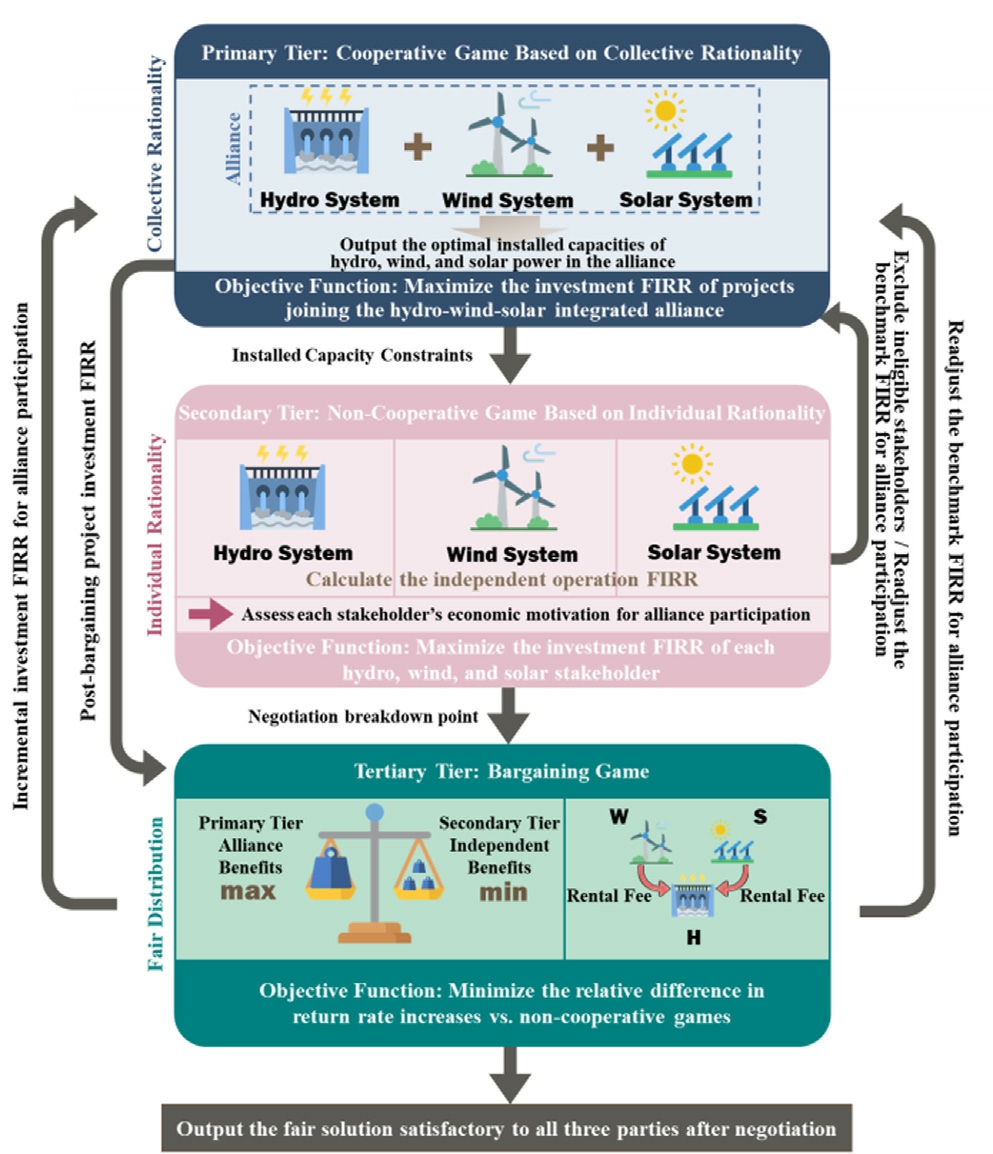
Fig. 1. Logical relationship diagram of the three-tier game theoretic model.
The logical relationships of the three-tier game model are illustrated in Fig. 1:
The primary tier adopts a cooperative game framework.Itdetermines the installed capacity configuration of hydropower, wind power, and solar power within the alliance based on the optimization principle that the incremental FIRR of wind and solar power projects is not lower than the benchmark FIRR for alliance participation. The configuration results are transmitted to the secondary and tertiary tiers as constraint conditions. Meanwhile, the primary tier receives feedback on the individually rational FIRR from non-cooperative games provided by the secondary tier and the post-bargaining FIRR provided by the tertiary tier. Through this dua l feedback, the primary tier judges the feasibility of alliance formation. The hydro-wind-solar integrated alliance can only be formed iftwo conditions are met: first, the collectively rational FIRR of the primary tier is greater than the individually rational FIRR of the secondary tier; second, the postbargaining FIRR of the tertiary tier is greater than the individually rational FIRR from the non-cooperative games of the secondary tier.
The secondary tier employs a non-cooperative game framework. It first accepts the installed capacities and stakeholder scope output by the primary tier as boundaries, then optimizes the investment strategy of each stakeholder based on the individual rationality of noncooperative game theory, and further solves for the individually rational FIRR. If the individually rational FIRR isgreater than the incrementally collectively rational FIRR of the alliance, the corresponding stakeholder lacks the incentive to participate in the alliance and should be excluded from the alliance. This information is fed back tothe prim ary tier, which then readjusts the target benchmark FIRR for alliance participation and re-optimizes the installed capacities of hydropower, wind power, and solar power within the alliance. Conversely, if the individually rational FIRR is less than the incremental FIRR of alliance participation, the secondary tier transmits this individually rational FIRR to the tertiary tier as the negotiation breakdown point for bargaining games.
The tertiary tier adopts a bargaining game framework.Itconstructs negotiation boundaries by comprehensively receiving the incremental FIRR of alliance participation from the cooperative game of the primary tier and the individually rational FIRR from the non-cooperative game of the secondary tier. If all stakeholders are satisfied with the post-bargaining FIRR, fair distribution is implemented,and the results are fed back to the primary and secondary tiers, completing the entire model solution and decisionmaking process. If any stakeholder is dissatisfied with the post-bargaining results, the information is fed back tothe primary tier, which then readjusts the benchmark FIRR for alliance participation and re-optimizes the installed capacities and scope of each stakeholder in the alliance.
1.2 Primary tier: efficiency-oriented cooperative game model guided by collective rationality
Hydropower stations, wind power plants, and solar power plants all participate directly in the hydro-windsolar integrated alliance as independent investment entities. Despite differences in their interest demands, the complementary regulation and joint operation of resources can generate synergistic incremental benefits characterized bya‘‘1+ 1+ 1 > 3” effect. The realization of this benefit relies on the cooperative behaviors and rule compliance of all entities, which justifies the adoption of cooperative game theory to construct the primary tier model. Cooperative game theory excels at accurately depicting the collaborative logic among multiple entities. Its core featureof emphasizing overall rationality ensures that all entities adhere to the agreements formulated by the alliance, ultimately maximizing the overall benefits of the alliance through the complementary regulation and joint operation of hydropower, wind power, and solar power resources.Building on this,the primary tier optimizes and determines the optimal installed capacity configuration of hydropower, wind power, and solar power within the hydrowind-solar integrated alliance based on the principleof collective rationality, laying a foundation for subsequent benefit distribution and inter-entity collaboration.
In accordance with the aforementioned economic optimization logic of collective rationality, wind power and solar power projects are sorted in ascending order of their investment cost per kWh. The incremental FIRR associated with alliance expansion by incorporating additional wind and solar projects is calculated as follows (Eq. (1)):
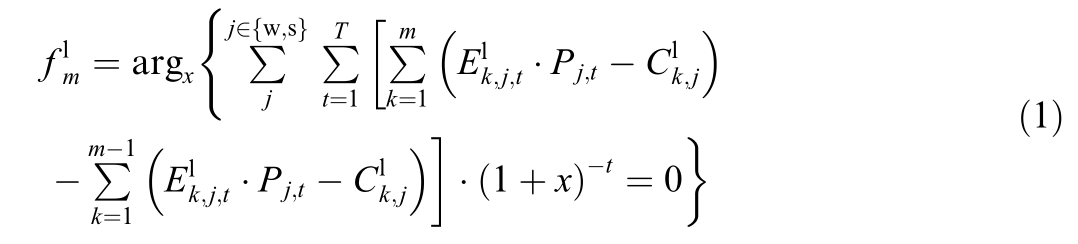
The incremental FIRR  for alliance expansion with additional wind and solar projects must not be lower than the benchmark FIRR il of the hydro-wind-solar inte -grated alliance, which serves as the econ omic optimization criterion for alliance inclusion (Eq.(2)). Accordingly, candidate projects are sequentially admitted to the alliance subject to the incremental FIRR criterion.

where  the incremental FIRR, defined as the discount rate at which the present value of the differences in annual net cash flow between the new hydro-wind-solar integrated alliance formed after incorporating additional windor solar power projects and the original alliance equals zero;superscript l— the primary-tier alliance; argx —the operator that returns the value of x satisfying the equation;t —the time index within the project calculation period;T —the total calculation period; j— the project type, wit h j w s corresponds to wind power plants and sol ar power plants, respectively; Pj t —the on-grid electricit y price of type-j power stations at time t; m—the proje ct sequence number in alliance inclusion;
  —the on-gri d electricity volume of the k th type -j project in the alliance at time t;
  —the investment cost of the k th type-j project in the alliance; il —the target benchmar k FIRR of the alliance.
Hydropower stations, wind power plants, and solar power plants operate within a power system constrained by limited power resources, leading to inherent interest competition regarding installed capacity, on-grid electricity volume, and other key factors. Each investor aims to maximize individual benefits by optimizing their own power station capacity and electricity generation levels.This scenario constitutes a typical non-cooperative game where investors compete fairly through optimal power generation strategies to achieve individual profit maximization. The hydro-wind-solar integrated alliance can generate certain excess benefits through collaborative operation, ensuring that each member gains more than they would under independent operation. To further highlight the synergistic advantages of the alliance,analyze the motivation mechanism for each entity to participate, and provide a basis for the negotiation breakdown point in subsequent alliance bargaining games, it is necessary to construct a non-cooperative game model for hydropower,wind power, and solar power operating independently in the power system. This model characterizes the optimal investment decision-making behavior of each entity without the constraints of the alliance.
Participants in the secondary-tier non-cooperative game include three types of entities: hydropower stations, wind power plants, and solar power plants. The game strategy of each entity consists of power generation output schemes across different time periods. Wind and solar power plants often need to be paired with supporting energy storage systems in light of the inherent volatility of their power output to ensure output stability. The profit functionof each game participant is a strategy combination function,as it is influenced not only by their own strategy choices but also by those of other participants. Based on the installed capacities of hydropower, wind power, and solar power in the hydro-wind-solar integrated alliance determined by the primary tier, the secondary tier optimizes the investment strategy of each entity to maximize their target rate of return in accordance with the principleof individual rationality. The calculation of the investment
1.3 Secondary tier: participation-oriented non-cooperative game model guided by individual rationality
FIRR for hydropower, w ind power, and solar power investors under non-cooperative game conditions is expressed as follows (Eq. (3)):

A corresponding entity has the econom ic incentive to participate in the integrated alliance if its individually rational investment FIRR does not exceed the incremental target investment FIRR of the alliance, i.e.:

where —the investment FIRR of the m th project of ty pe- j under individual rationality in non-coo perative ga m e; superscript g—the secondary-tier individualrationality scenario;
  —the on-grid electricity volume of the k th t ype-j project at time t;
  —the investment cost of the k th type-j project.
1.4 Tertiary tier: equity-oriented bargaining game model guided by alliance formation
Hydropower, wind power, and solar power belong to distinct stakeholders. When deciding whether to participate in the hydro-w ind-solar integrated alliance, each stakeholder acts independently and rationally. They can im prove their own investment FIRR through bargaining,ensuring that the actual benef its obtained from alliance participation exceed those from independent operation.This problem can be modeled as a fair bargaining game aimed at the coordinated optim ization of collective and individual rationality. W hile helping the alliance secure additional benef its, the bargaining gam e enables the fair distribution of these extra benef its among all stakeholders,ultimately reaching a distribution consensus that balances collective and individual interests.
Benef it distribution is implemented based on the marginal contribution of each m ember to the hydro-w indsolar integrated alliance. The FIRR of hydropower, w ind power, and solar power under non-cooperative games is selected as the negotiation breakdown point for bargaining, and the FIRR of each stakeholder is designated as the subjective utility evaluation indicator in the game process. This process continues until no party can further im prove its benef its by ad justing its negotiation strategy independently. By solving this equilibrium solution, the f inal bargaining strategy is determ ined, and an optimal benef it distribution scheme that balances the satisfaction of all parties is form ulated. The regulatory capability of hydropower can effectively enhance the quality of ongrid electricity and the actual grid-connected electricity volume of w ind and solar power. To ref lect this contribution,the benef its that hydropower brings to w ind and solar power w ithin the alliance can be com pensated to hydropower stations through a rental fee mechanism. In this study, the on-grid electricity volume of w ind and solar power in the alliance is used as the calculation base, and an electricity rental rate per kWh is set to calculate the com pensation fee for hydropower. The payment of ren tal fees can ad just the investment FIRR of each stakeholder in the alliance, realizing the fair redistribution of alliance benef its among stakeholders.The calculation of the hydropower investment FIRR after bargaining is shown below(Eq. (5)):
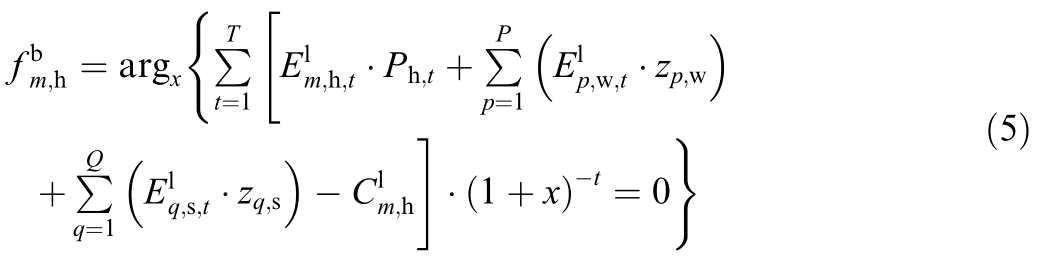
where  — the investment FIRR of the m th hydropo wer project after bargaining; superscript b—the tertiary-tier bargaining scenario;
  ,
,  —the on-grid ele ctricity volumes of the p th w ind power p lant and zq s —the rental fees paid by w ind power p lants and solar power p lants to com pensate hydropower stations, respectively; P, Q—the num bers of w ind power and solar power pr ojects in the alliance, respectively.
  —the investment cost of the m th hydropower project in the alliance.
The calculation of the investment FIRR for wind and solar power p lants follow ing bargaining is expressed as follows (Eq. (6)):q th solar power p lant in the alliance, respectively; zp w ,
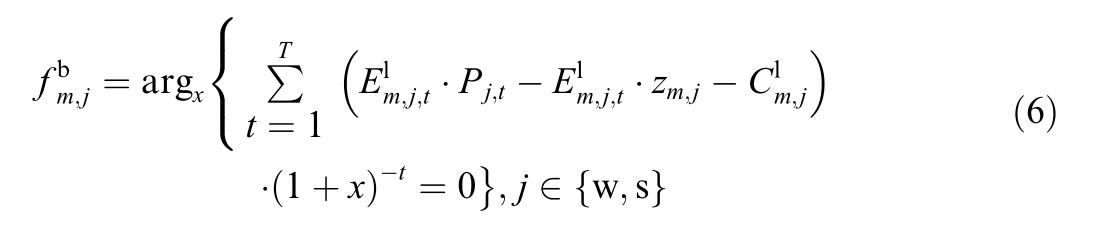
where  —the investment FIRR of the m th project of type-j after bargaining, w ith j w s representing w ind power and solar power,respectively;z m j—the rental fee paid by the corresponding wind power or solar power project.
The difference between the investment FIRR of each stakeholder under cooperative games and that under non-cooperative gam es is def ined as the econom ic contribution of the individual to the alliance. The individually rational investm ent FIRR under non-cooperative games represents the theoretical m inimum benef it that an individual can obtain, and it also serves as the negotiation breakdown point. To ensure fairness in benef it distribution, the fairness object ive is set to m inim ize the difference between the maximum and m inimum percentage increases in the actual post-bargaining investment FIRR of each stakeholder relative to their individually rational FIRR under non-cooperative games. The corresponding expression for the fairness objective function is shown below (Eqs.(7) and (8)):
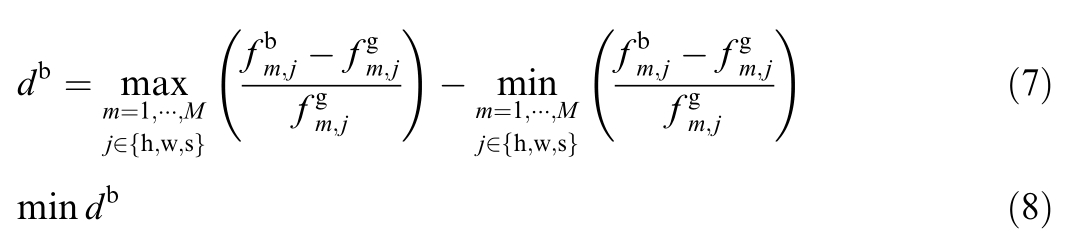
where db —the bargaining fairness value;  —the postbargaining investment FIRR of the m th project of type-j participating in the hydro-wind-solar integ rated alliance;
  —the individually rational investment FIRR of the m th project of type- j under non-cooperati ve games;M —the total number of stakehol ders in t he alliance.
1.5 Constraints
The constraint conditions of the three-tier model are mainly categorized into four types: power system constraints, economic indicator constraints, power station planning constraints, and power station operation constraints. Power system constraints cover the capacity limit of transmission channels, power balance constraints (including demand response and load shedding), output fluctuation constraints of hydropower, wind power, and solar power, and curtailment limit of hydropower, wind, and solar power. Economic indicator constraints include constraints on economic metrics such as return on investment and payback periods for hydropower, wind power, and solar power projects, requiring that projects incorporated into the integrated system possess independent economi c viability. Planning constraints encompass non-negative integer decision variables, installed capacity limits, restrictions on the number of power stations, geographical location constraints of power stations, policy restrictions,constraints on the earliest construction time, reservoir capacity constraints, and 0-1 variables indicating whether hydropower,wind power,or solar power stations are tobe constructed.Operation constraints include reservoir water level constraints, constraints on reservoir release, discharge, and generating flow, hydraulic connections between cascaded reservoirs, output constraints of hydropower, wind power, and solar power, water balance constraints, ramping rate limits, and reserve capacity limits.
2 Case study
2.1 Basic conditions and parameter setting
A hydropower station with multi-year regulation capacity was selected as the research object, with an installed capacity of 1000 MW and an annual power generation of approximately 2.7 billion kWh. The surrounding area of this hydropower station is rich in wind and solar resources: the techn ically developable wind power capacity is about 1500 MW with an annual utilization hour count of 1900 h, while the technically developable solar power capacity is about 500 MW with an annual utilization hour count of 900 h. Relying on the regulation capacity of this hydropower station to drive the development of surrounding wind and solar power, an integrated multi-energy complementary model for renewable energy canbe implemented. If the integrated renewable energy development model is not adopted (i.e., wind and solar power plants adopt an independent grid-connection mode), wind and solar power plants must comply with relevant requirements: they need to be equipped with energy storage power not less than 10% of their installed capacity, and the continuous charging-discharging duration of energy storage must be no less than 2 h, with the unit investment cost of energy storage being 1000 CNY/kWh. Other key parameters are set as follows: the on-grid electricity price is 0.35 CNY/kWh; the unit investment cost of the hydropower station is 2.66 CNY/kWh; the installed capacity of each individual wind and solar power station is planned to be100MW,with their unit investment costs being 5500 CNY/kW and 3000 CNY/kW, respectively.
Using the research method proposed in this study,a quantitative analysis was conducted on the interest coordination mechanism during the formation of the renewable energy integrated alliance.
2.2 Analysis of cooperative game results based on collective rationality
An 8760-hour hourly output time-series simulation method was adopted to optimize the economically reasonable scale of the hydro-wind-solar integrated alliance.Each wind and solar power station had an installed capacity of 100 MW, and wind and solar power projects were sequentially inco rporated into the alliance in ascending order of their investment cost per kWh. Throughout the capacity expansion process, the incremental FIRR for joining the alliance must always be no less than 6.5%.
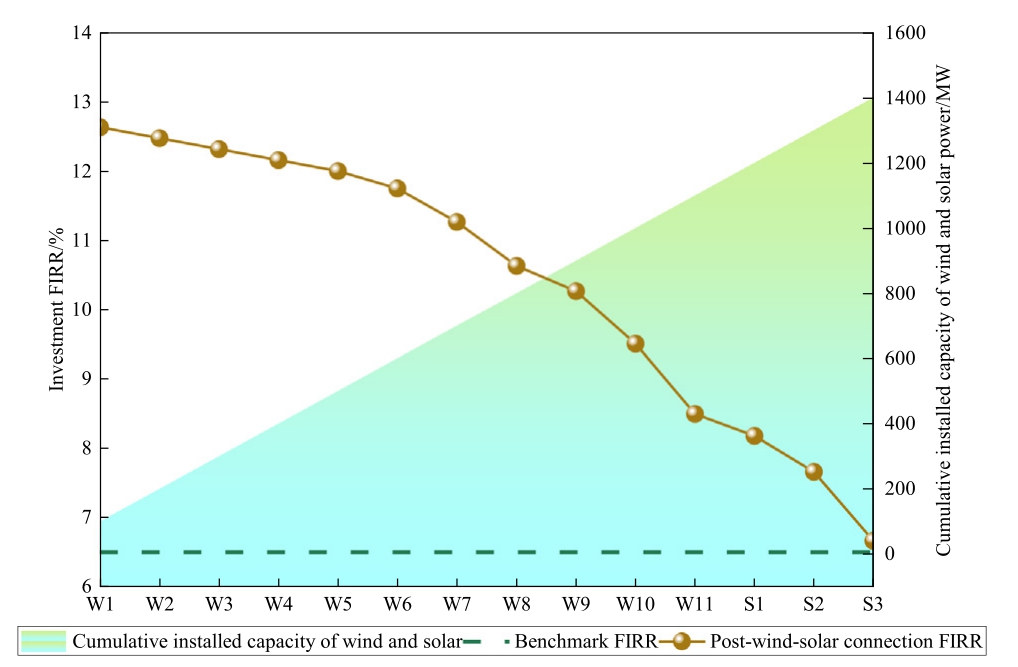
Fig. 2. Relationship between variation of investment FIRR and cu mulative installed capacity after wind and solar project connection.
The optimized configuration results of the hydro-windsolar integration are shown in Fig. 2. It can be observed that a total of 11 wind power plants (W1, W2, , W11)and 3 solar power plants (S1, S2, S3) were included in the alliance. If the capacity of wind or solar power plants is further increased, the incremental FIRR will be lower than the benchmark rate of return. After aggregating the wind and solar resources in the alliance, the total installed capacity of wind power reaches 1100 MW and that of solar power reaches 300 MW.Based on the collective rationality cooperative game framework,the investment FIRR values corresponding to wind power and solar power under this configuration are 11.198% and 7.510%, respectively.
As shown in Fig. 2, with the sequential connection of wind and solar power plants, the cumulative installed capacity of wind and solar power continues to increase,the investment per unit capacity gradually rises, and the system’s accommodation capacity becomes increasingly saturated, these factors collectively lead to a decline in the corresponding rate of return. Therefore, the investment FIRR of wind and solar power shows an overall downward trend after incorporation, which is consistent with the principle of diminishing marginal benefits.Meanwhile, the dashed line in the figure represents the benchmark FIRR of 6.5%, which serves as the critical threshold for the economic rationality of alliance expansion. The FIRR values of all 14 finally included wind and solar stations are higher than this threshold.
The variation characteristics of wind and solar curtailment in the hydro-wind-solar integrated system are shown inFig. 3. The data in the figure exhibits distinct phased patterns: in the initial connection phase with low wind and solar installed capacity, the superimposed output of wind-solar power and hydropower base load does not exceed the upper limit of the transmission channel capacity. The system has sufficient accommodation capacity for wind and solar resources, so the curtailment of wind and solar power remains at 0; as the installed capacity of wind and solar power continues to increase, it exceeds the transmission upper limit of the channel.The regulation capacity of hydropower can no longer fully resolve the conflict between wind-solar output fluctuations and transmission capacity, leading to a significant upward trend in wind and solar curtailment. The reduction in solar curtailment after the integration of solar power is attributed to the certain complementary effect between wind and solar power.
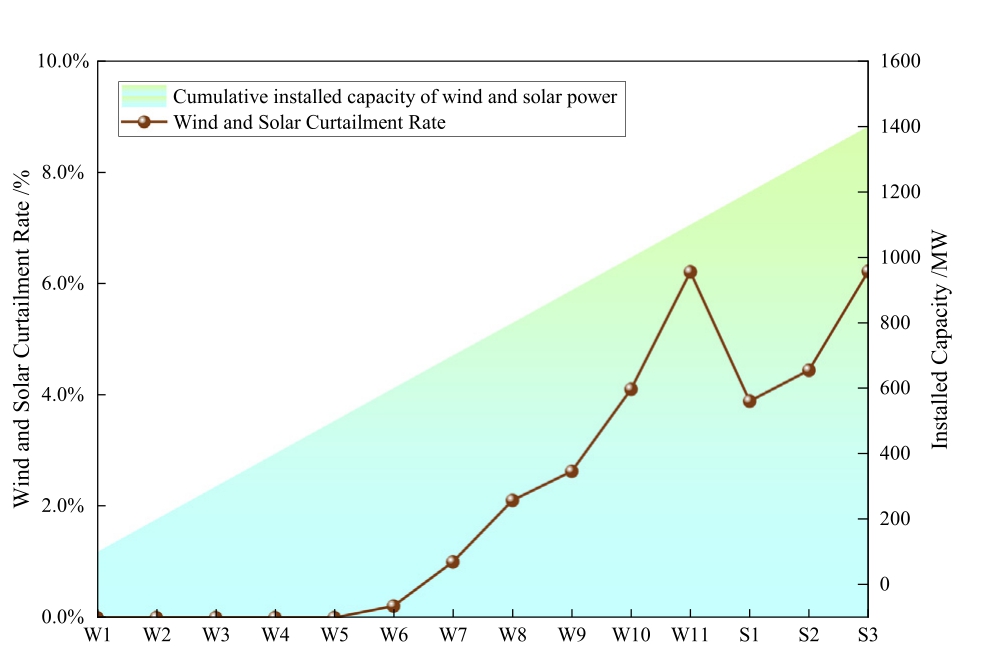
Fig. 3. Variation of wind and solar curtailment rates with the gradual integration of wind and solar projects into hydropower station.
2.3 Analysis of non-cooperative game results based on individual rationality
Following the principle of individual rationality, the secondary tier calculates the investment FIRR for hydropower, wind, and solar power plants under independent development, with the constraint of the economically viable scale of the hydro-wind-solar integrated alliance determined by the primary tier. The specific results are asfollows: The investment FIRR of the hydropower station under independent development is 8.000%. For the 1100 MW wind farm formed by aggregating 11 wind power stations: Its theoretical annual power generation is 2.09 billion kWh. In accordance with the renewable energy grid-connection requirements of the region, an energy storage system of 110 MW/2h is configured. Meanwhile,constrained by the capacity of the transmission channel,the wind curtailment volume under the energy storage configuration is 171.4 million kWh, and the effective on-grid electricity volume is 1.9186 billion kWh. After integrating the main wind power investment (6.05 billion CNY) and the energy storage investment (220 million CNY), the unit investment cost per kWh of on-grid electricity is 3.268 CNY/kWh, resulting in an investment FI RR of 7.815%for wind power. For the 300 MW solar power plant formed by aggregating 3 solar power stations: Its theoretical annual power generation is 270 million kWh. In line with the regional renewable energy grid-connection requirements, an energy storage system of 30 MW/2h is configured. Also constrained by the transmission channel capacity, the solar curtailment volume under the energy storage configuration is 6.73 million kWh,and the effective on-grid electricity volume is 263.27 million kWh. After combining the main solar power investment (900 million CNY) and the energy storage investment (60 million CNY), the unit investment cost per kWh of on-grid electricity is 3.646 CNY/kWh,leading to an investment FIRR of6.416% for solar power.
Under the collective rationality framework of the primary tier, the investment FIRR values of wind and solar power plants in the hydro-wind-solar integrated alliance are 11.198% and 7.510%, respectively. It follows that the individually rational FIRR values of wind and solar power plants in the secondary tier (7.815% and 6.416%) are both lower than their corresponding FIRR values in the alliance scenario. This indicates that the 1100 MW wind power and 300 MW solar power have economic incentives to participate in the hydro-wind-solar integrated alliance and can enter the bargaining game stage of the tertiary tier to further explore the internal interest coordination mechanism of the alliance.
2.4 Analysis of fair bargaining game results for alliance formati on
In this study, the fairness criterion is def ined as the range of percentage increases in the investment FIRR of different stakeholders after bargaining (relative to their individually rational investment FIRR) being zero. In other words, the relative increases in the rates of return of hydropower, w ind power, and solar power after bargaining when com pared w ith their rates of return under the individual rationality scenario are equal. A fter coordination through the bargaining game in the tertiary tier, the investment FIRR values of hydropower, w ind power, and solar power plants are 8.780%, 8.577%, and 7.042%,respectively. Compared with their individually rational FIRR values under non-cooperative games in the secondary tier (8.000%, 7.815%, and 6.416%), the percentage increase in the rate of return for all three types of stakeholders is 9.75%, which meets the fairness constraint. In the corresponding benef it distribution mechanism, the hydropower station receives com pensation rental fees of 32.7 m illion CNY and 0.73 m illion CNY from w ind power and solar power, respectively. The rental rates for w ind power and solar power are 0.0159 CNY/MWh and 0.0028 CNY/MWh,shown in Fig.4.
3 Research co nclusions
Against the backdrop of incentivizing multip le stakeholders to participate in the cooperation and operation of renewable energy com p lem entary system s, this study takes three types of energy entities: hydropower, w ind power, and solar power, as the research objects. From three dimensions, specif ically collective efficiency of renewable energy integration, indivi dual rational participation,and fairness of bargaining, a three-tier hierarchical gam e model of primary-secondary-tertiary is established:the primary tier makes decisions f irst, followed by the secondary and tertiary tiers. Information feedback among the tiers form s a closed-loop iteration, which cycles until a scheme meeting the demands of all parties is achieved. The key conclusions of this study are as follows:
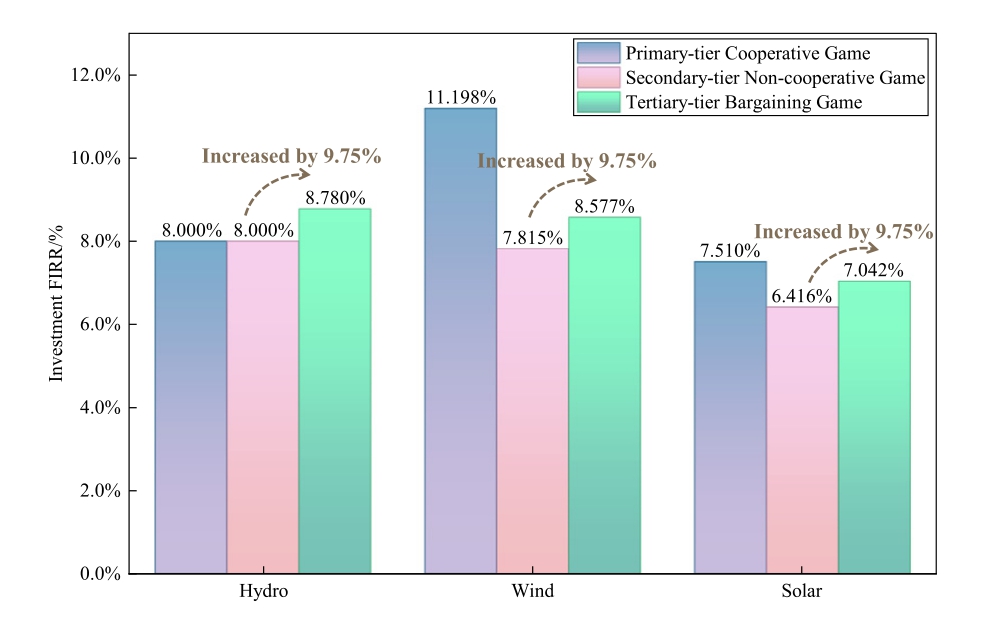
Fig. 4. Investment FIRR under different game scenarios.
1) The prim ary tier introduces cooperative game theory to establish a capacity optim ization conf iguration model for the hydro-w ind-solar integrated alliance based on collective rationality. This model ensures the overall optimality of the alliance. Signif ic ant incremental power generation benef its can be achieved through multi-energy com p lem entary cooperation w ithin the alliance, and hydropower, w ind power, and solar power can all obtain reasonable incremental returns from the cooperation.
2) The secondary tier incorporates non-cooperative game theory to develop an investment FIRR calculation model based on individual rationality. By comparing the differences in investment FIRR between collective rationality and individual rationality scenarios, the w illingness of each stakeholder to participate in the alliance is clarif ied, and the negotiation breakdown point for bargaining games is transm itted to the tertiary tier. Analysis results show that through integrated comp lementary cooperation,both the individual benef its of hydropower, w ind power, and solar power entities and the overall benef its of the alliance are im proved com pared w ith the independent operation scenario.
3) The tertiary tier adopts fair bargaining game theory to realize the fair and reasonable distribution of incremental benef its in the multi-stakeholder energy system. It takes the collectively rational incremental investment FIRR transm itted from the prim ary tier as the upper bound of bargaining and the individually rational investment FIRR from the secondary tier as the negotiation breakdown point. Results indicate that after distribution through this mechanism, all participating stakeholders obtain certain incremental benef its com pared w ith the noncooperative mode, which not only guarantees the fairness of distribution but also strengthens the stability of the alliance.
CRediT authorship contribution statement
Yanyue W ang: W riting - original draft, Visualization,Validation, Software, M ethodology, Investigation, Formal analysis, Data curation, Conceptualization. Chongru Liu:W riting - review & editing, Supervision, M ethodology,Funding acquisition, Formal analysis, Conceptualization.
Declaration of competing interest
W e declare that we have no conf lict of interest.
Ac knowledgment
This work was supported by Power Construction Corporation of China Science and Technology Project (DJHXGG-2024-03).
References
[1]T. Wang, T.S. Bi, H.F. Wang, et al., Decision tree based online stability assessment scheme for power systems with renewable generations, CSEE J. Power Energy Syst. 1 (2) (2015) 53-61.
[2]Y. Zhang, Y. Zhang, T. Wu, Integrated strategy for real-time wind power fluctuation mitigation and energy storage system control,Global Energy Interconnect. 7 (1) (2024) 71-81.
[3]L. Lu, M. Wei, Y. Tao, et al., Stochastic programming based coordinated expansion planning of generation, transmission,demand side resources, and energy storage considering the DC transmission system, Global Energy Interconnect. 7 (1) (2024) 25-37.
[4]B. Ming, P. Liu, S.L. Guo, et al., Optimizing utility-scale photovoltaic power generation for integratio n into a hydropower reservoir by incorporating long- and short-term operational decisions, Appl. Energy 204 (2017) 432-445.
[5]F.F. Li, J. Qiu, Multi-objective optimization for integrated hydrophotovoltaic power system, Appl. Energy 167 (2016) 377-384.
[6]B. Franc¸ois, M. Borga, J.D. Creutin, et al., Complementarity between solar and hydro power: sensitivity study to climate characteristics in Northern-Italy, Renew. Energy 86 (2016) 543-553.
[7]J.J. Gao, Y. Zheng, J.M. Li, et al., (2018) Optimal model for complementary operation of a photovoltaic-wind-pumped storage system, Math. Probl. Eng. 1 (2018) 5346253.
[8]B. Dallinger, D. Schwabeneder, G. Lettner, et al., Socio-economic benefit and profitability analyses of Austrian hydro storage power plants supporting increasing renewable electricity generation in Central Europe, Renew. Sustain. Energy Rev.107(2019)482-496.
[9]B. Zakeri, S. Syri, Electrical energy storage systems:a comparative lifecycle cost analysis, Renew. Sustain. Energy Rev.42(2015)569-596.
[10]S.A. Zheng, G.L. Qian, Overview of hydro-wind-solar power complementation development in China, Global Energy Interconnect. 2 (4) (2019) 285-289.
[11]X. Jiao, J. Wu, Y. Mao, et al.,Carbon efficiency evaluation method forurban energy system with multiple energy complementary,Global Energy Interconnect. 7 (2) (2024) 142-154.
[12]X.Y. Jin, B.X. Liu, Z.H. Deng, et al.,Deriving strategic region-wise hydro-wind-solar portfolios, Renew. Sustain. Energy Rev. 210(2025) 115145.
[13]C.M. Garc´ıa Mazo, Y. Olaya, S. Botero, Investment in renewable energy considering game theory and wind-hydro diversification,Energ. Strat. Rev. 28 (2020) 100447.
[14]H.Y. Wang, K. Li, C.H. Zhang, et al.,Capacity and operation joint optimization for integrated energy system based on Nash bargaining game, Energy 305 (2024) 132032.
[15]X. Wen, Y.L. Sun, Q.F. Tan, et al., Optimizing the sizes of wind and photovoltaic plants complementarily operating with cascade hydropower stations: Balancing risk and benefit,Appl.Energy 306(2022) 117968.
[16]Q.F. Tan, X. Wen, Y.L. Sun, et al., Evaluation of the risk and benefit of the complementary operation of the large windphotovoltaic-hydropower system considering forecast uncertainty,Appl. Energy 285 (2021) 116442.
[17]K. Ding, C.H. Yang, Y.L. Sun, et al., Design method of multi energy complementary comprehensive energy system for industrial parks based on game theory, in: Proceedings of 2024 International Conference on Power Electronics and Artificial Intelligence, 2024 inXiamen, China, 2024, pp. 280-287.
[18]Z.Q. Jing, Y.M. Wang, J.X. Chang, et al.,Benefit compensation of hydropower-wind-photovoltaic complementary operation in the large clean energy base, Appl. Energy 354 (2024) 122040.
[19]L.Q. Zhang, J. Xie, X.Y. Chen, et al., Cooperative game-based synergistic gains allocation methods for wind-solar-hydro hybrid generation system with cascade hydropowe r, Energies 13 (15)(2020) 3890.
[20]F.C. Yan, R.X. Lu, Y.M. Yin, Research on the distribution of benefits of ‘‘water-wind-lig ht” multi-energy complementary based oncooperative game, in: Proceedings of the 4th International Symposium on New Energy and Electrical Technology, 2024 in Singapore, 2024, pp. 607-615.
[21]J. Xie, L.Q. Zhang, X.Y. Chen, et al., Incremental benefit allocation for joint operation of multi-stakeholder wind-PVhydro complementary generation system with cascade hydropower: an Aumann-Shapley value method, IEEE Access 8 (2020)68668-68681.
[22]T. Ma, W. Pei, Y. Yang, et al., A coordinated operation method of wind-PV-hydrogen-storage multi-agent energy system, Global Energy Interconnect. 7 (4) (2024) 446-461.
[23]Y.X. Cai, X.B. Xiao, Y. Li, et al., Energy sharing transactions of wind and solar microgrids considering network topology: a game analysis based on Nash negotiation, J. Electr. Eng. Technol. 19(2024) 2889-2902.
[24]H.Y. Liu, Q.Q. Zhao, Y. Liu, et al., A multi-subject game-based operation strategy for VPPs integrating wind-solar-storage,Sustainability 15 (7) (2023) 6278.
[25]J.H. Li, H. Chen, Y.Z. Qi, et al., Collaborative optimization for cross-regional integrated energy systems producing electricity-heathydrogen based on generalized Nash bargaining,Energy 333(2025)137444.
[26]W. He, M. Liu, C.W. Zuo, et al., Massive multi-source joint outbound and benefit distribution model based on cooperative game, Energies 16 (18) (2023) 6590.
[27]Y.H. Luo, X.W. Zhang, D.S. Yang, et al., Optimal operation and cost-benefit allocation for multi-partici pant cooperation of integrated energy system, IET Gener. Transmiss. Distrib. 13 (22)(2019) 5239-5247.
[28]R. Prakash, B. Lokeshgupta, S. Sivasubramani, et al.,Optimal DG planning incorporating energy management for an economical and resilient smart distribution system, IEEE Trans. Ind. Appl. 60 (1)(2024) 1890-1901.
[29]H. Li, Z.Y. Ren, A. Trivedi, et al., A noncooperative game-based approach for microgrid planning considering existing interconnected and clustered microgrids on an island, IEEE Trans. Sustainable Energy 13 (4) (2022) 2064-2078.
[30]Y.B. Wang, Y.C. Zheng, Q. Yang, Nash bargaini ng based collaborative energy management for regional integrated e nergy systems in uncertain electricity markets, Energy 269 (2023)126725.
Received 8 August 2024; re删vis除ed 9 February 2026; accepted 27 February 2026
Peer review under the responsibility of Global Energy Interconnection Group Co. Ltd.
* Corres删ponding au除thor.
E-mail address: 2549533327@qq.com (Y. Wang).
https://doi.org/10.1016/j.gloei.2026.02.003
2096-5117/© 2026 Global Energy Interconnection Group Co. Ltd. Publishing services by Elsevier B.V. on behalf of KeAi Communications Co. Ltd.This is an open access article under the CC BY-NC-ND license(http://creativecommons.org/licenses/by-nc-nd/4.0/).

Yanyue Wang received B.S. degree at North China University of Water Resources and Electric Power, Zhengzhou, China, in 2019. She is working towards master’s degree at North China Electric Power University, Beijing,China. Her research interest includes energy storage planning for new power systems.