
0 Introduction
Moves towards a sustainable and decarbonized energy system relies heavily on hydrogen and as an energy carrier and storage energy. Hydrogen has the highest energy per mass of any environmentally friendly fuel,and the properties transform hydrogen into a critical future component of any clean power energy system. Hydrogen has emerged as a flexible energy carrier linking electricity with transport, heat and industry and delivering long-duration storage and grid services [1]. However, cost-efficient production, high storage density, and accommodating policy environments are priorities for hydrogen to be integrated into power systems [2]. While a large body of literature has focused on the pathways for hydrogen production, electricity-driven water electrolysis powered by renewable energy such as alkaline proton-exchange membrane (PEM), and solid-oxide electrolysis cells (SOEC)have been reported as the most advanced pathway to green hydrogen with reviews highlighting alkaline/PEM development and fast dynamics but more materials challenges[3]. Other researchers have suggested photoelectrochemical(PEC) water splitting as one strategy to address material challenges, by combining light absorption and electrochemistry into a single device to enable direct solar-tohydrogen conversion, but high stability and large-scale manufacture remain grand bottlenecks [4,5]. Zhang et al.[6] suggested that biomass gasification/reforming combined with carbon dioxide (CO2) capture can provide dispatchable, low or even negative-carbon hydrogen to back up the intermittent variable renewable energy (VRE) [6].Collectively, these pathways make up a portfolio, which can be adapted for system conditions prevailing in hydrogen production pathway.
Hydrogen has been previously stored and transported for many years as a compressed gas or cryogenic liquid,and so delivered in tanks, cylinders, tubes or cryogenic tanks for industrial use or as propellant through space programs [7]. Regarding storage, researchers have classified the hydrogen storage into compressed gas (usually 350–700 bar), cryogenic liquid or solid-state including metal/complex hydrides and liquid organic hydrogen carrier (LOHC) [8]. With regards to hydrogen storage, other researchers [9] have also revealed that underground storage particularly salt caverns can be another choice of hydrogen storage. Studies on materials and energy system component is in an ongoing effort to advance aspects of composite tank safet y, cryogenic insulation, hydride thermodynamics/kinetics and catalyst durability of hydrogen storage system that affect roundtrip efficiency and capital expense [10]. Cheng et al. [11]reported that round-trip efficiencies are somewhat lower(typically 35%–50% for P2H2P vs. batteries) necessitating careful system design, co-optimization, and a critical review of hydrogen production and storage systems.Despite advancing knowledge by several researchers [12–14] in the field of hydrogen production and storage, multiple gaps remain.
Recent studies [15] have considerably expanded the scientific understanding of hydrogen production and its integration into renewable-dominated energy systems.Emerging studies [16] highlight significant progress in next-generation electrolysis technologies, including hightemperature solid-oxide systems and advanced PEM configurations with improved catalytic durability, enhanced ramping capabil ity, and more accurate degradation modelling. For instance, recent work by Sebbahi et al. [15]demonstrates the importance of dynamic electrolyzer modelling and degradat ion dispatch strategies for renewabledriven hydrogen production. These developments underscore the need to evaluate hydrogen not merely as a conversion technology but as a flexible, and grid-interactive asset [16]. Studies by group of researchers [17] provide new insights into reactor optimization under fluctuating solar energy, demonstrating how integrated control strategies can significantly improve hydrogen yields. Similarly,recent analyses by other researchers [18,19] highlight the growing relevance of co-designed electrolysis–reactor systems capable of ope rating synergistically with variable renewable energy.
Furthermore, integrated renewable-hydrogen system designs have advanced substantially, with studies of Zou et al. [20] and Wang et al. [21] presenting new modelling approaches for optimizing hybrid PV–wind–electrolysis systems, multi-node hydrogen production networks, and regional hydrogen storage strategies. These studies deliver updated Techno-economic benchmarks, such as reduced levelized cost of hydrogen (LCOH), improved round-trip efficiency, and refined multi-energy coordination mechanisms that are crucial for understanding hydrogen’s strategic role in future power systems. By integrating these recent contributions, this study reflects the most up-todate advancements in hydrogen production, reactor engineering, and renewable-hydrogen system integration.
1) Novelty and Distinctiveness of the Present Study
Hydrogen production, storage, and reconversion technologies hold significant promises for enhancing system flexibility, enabling long-duration energy storage, and supporting deep decarbonization of modern power grids.However, several technical barriers including electrolyzer ramp-rate limitations, coordination with variable renewable energy (VRE), and dynamic behavior under fluctuating grid conditions continue to restrict large-scale deployment [5,14]. While the literature offers numerous reviews on hydrogen production pathways and storage systems, most studies address these components separately and do not provide an integrated, system-wide analysis of how hydrogen technologies interact with the operational requirements of future power systems. A few studies have begun to highlight the importance of coordinated hydrogen–electricity operation [22], yet a consolidated assessment linking production, storage, and grid-integration strategies remains limited.
To clarify the distinctiveness of the present review, a four-layer conceptual framework that organizes hydrogen technologies according to their functional interactions within modern power systems is presented. The proposed modular architecture consists of: (i) production modules,encompassing electrolysis, PEC, and biomass-CCS pathways; (ii) storage modules, including compressed gas,and liquid hydrogen (iii) power-system interface modules describing electrolyzer dynamics,storage cycling behavior,and hydrogen-to-power conversion; and (iv) cross-sector integration modules that address hydrogen’s contribution to sector coupling, grid balancing, and seasonal storage.This structured framework differs from earlier reviews by explicitly situating hydrogen technologies within the operational, economic, and stability-oriented demands of power systems. Through systematic comparison across modules, including efficiency metrics, dynamic response capabilities, Techno-economic performance, and suitability for renewable variability, this review advances beyond a descriptive reorganization of existing knowledge and provides a unified, power-system-centered perspective designed for planners, regulators, and researchers. In addition, the present study offers a broader and more integrated perspective than prior reviews that focus exclusively on individual technological components.Whereas earlier works typically analyze hydrogen production or storage in isolation, our approach emphasizes cooptimization between production dispatch, storage sizing,and power-system operation under high renewable penetration. By aligning hydrogen technologies with evolving policy frameworks, investment risks, and infrastructure requirements, the review also highlights the sociotechnical enablers and barriers that determine the feasibility of large-scale hydrogen integration.
Despite progress in recent literature, gaps remain, particularly regarding hydrogen production and challenges,comparative Techno-economic evaluations, and modelling frameworks that c apture multiscale interactions between hydrogen and electrical networks [23]. The present review contributes to filling these gaps by synthesizing recent advances, identifying cross-cutting challenges,and mapping technological developments to powersystem needs. Collectively, these elements establish the novelty of the study and position it as a comprehensive reference for understanding the technological,economic,and systemic dimensions of hydrogen deployment at scale.
Finally, this review outlines emerging research directions that are only beginning to appear in literature but are critical to future energy systems. These include coordinated multi-node electrolyzer dispatch, hydrogen-enabled grid-forming capabilities, digital-twin-based predictive control architectures, and co-optimization of hydrogen and electricity markets unde r high VRE conditions. By articulating these forward-looking priorities, the present work not only synthesizes existing knowledge but also positions hydrogen research within a broader systemtransformation agenda.
2) Methodology used in searchi ng literature
To ensure transparency and reproducibility, this review adopts a structured and conventional literat ure search procedure. Peer-reviewed publications, technical reports, and authoritative international assessments were retrieved from Scopus, Web of Science, ScienceDirect, and IEEE Xplore using search strings including ‘‘green hydrogen production”, ‘‘electrolysis technologies”, ‘‘hydrogen storage systems”, ‘‘P2H2P integration”, ‘‘photoelectrochemical hydrogen”, ‘‘biomass reforming hydrogen,”‘‘hydrogen power systems”, and ‘‘sector coupling with hydrogen”. The search covered studies published between 2010 and 2025, reflecting the period of significant technological progress in hydrogen technologies.
Inclusion criteria required that studies (i) report empirical, modelling, Techno-economic, or system integration findings; (ii) examine production or storage technologies relevant to power-system operation; and (iii) provided quantitative or qualitative performance indicators. Papers were excluded if they lacked technical depth, repeated identical content from earlier reviews, or were unrelated to power-system integration. In total, over 1100 records were initially identified,312 full-text articles were screened,and 196 studies were retained for synthes is as shown in Fig. 1.
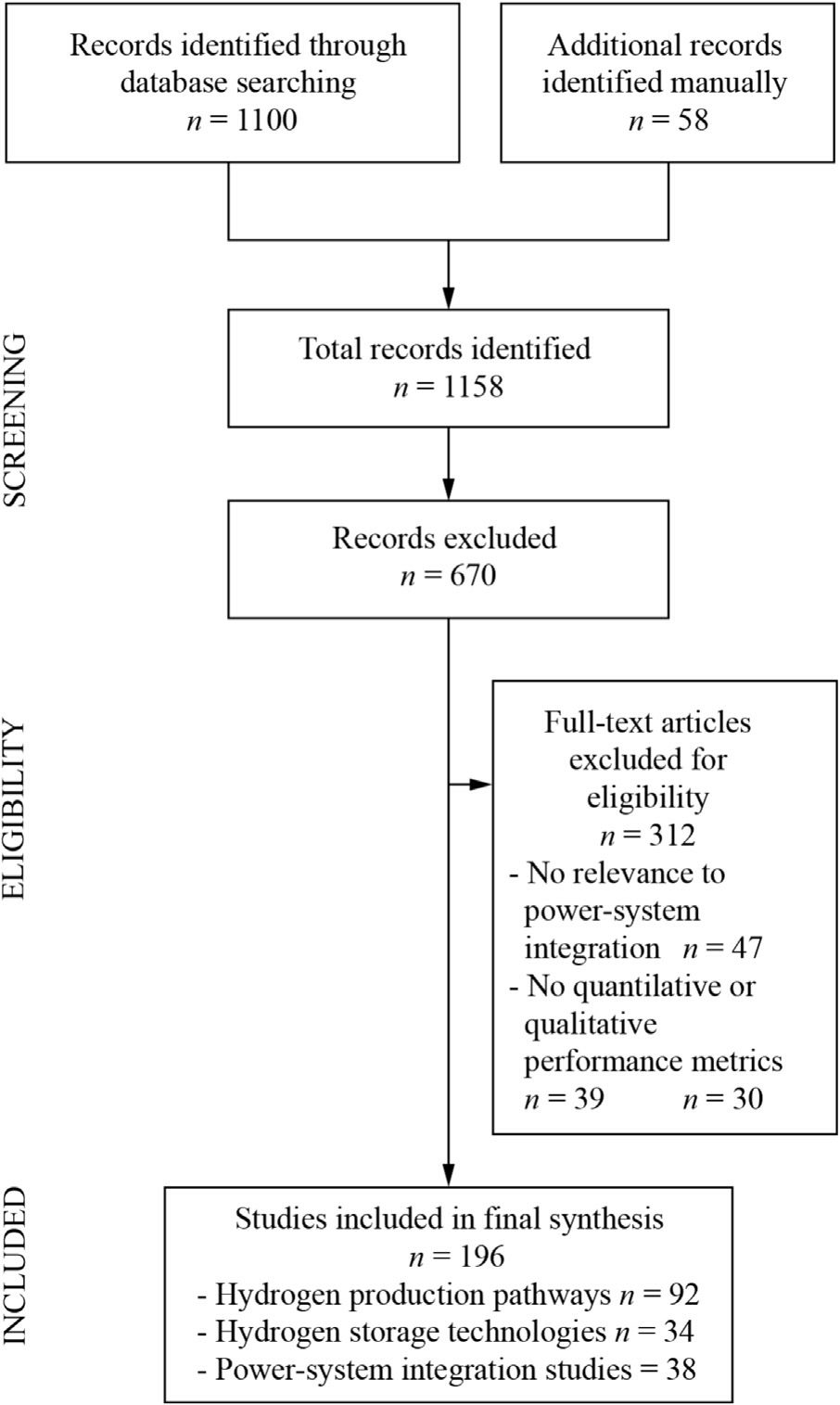
Fig. 1. Flow diagram illustrating the identification, screening, eligibility assessment, and inclusion of studies used in this review.
1 Green hydrogen product ion pathways
Green hydrogen is produced using renewable energybased processes that minimize carbon emissions and increase the flexibility of the energy system. The electrolysis pathway, using renewable electricity from wind, solar or hydro to split water into hydrogen and oxygen in an electrolyzer is presently the most advanced and widespread[24]. The quick response of PEM systems to fluctuating renewable energy has shown to be useful for grid balancing and for integration of variable power sources [25]. A promising approach is photoelectrochemical (PEC) water splitting in which solar energy is directly converted to chemical energy by incorporating light absorption and electrochemical water decomposition into a single device.This process uses semiconductor photoelectrodes to harvest solar radiation and produce hydrogen and oxygen.Despi te not requiring external electrical systems,the durability and performance of PEC is a major obstacle since nearly any semiconductor material hardly sustains over long periods of time in the presence of aqueous solutions.Current research efforts are focusing on corrosionresistant materials and protective coatings to improve stability and to improve solar-to-hydrogen(STH)conversion efficiency.
To enhance the technical clarity and analytical value of the review,the schematic shown in Fig. 2 incorporate summarize hydrogen production and storage performance from a power-system as well as power–to–hydrogen–to –power (P2H2P) system architecture and technology integration space.
The production comparison highlights alkaline, PEM,and solid oxide electrolysis (SOEC) as the dominant electricity-to-hydrogen routes, showing clear trade-offs between efficiency, dynamic response, a nd advanced technology. Fig. 2 shows that alkaline electrolysis is the most developed with moderate efficiency and slow response,making it suitable for steady or baseload operation, while PEM electrolysis offers faster response and better suitability for variable renewable energy integration at the expense of higher cost and moderate degradation. SOEC achieves the highest electrical efficiency by operating at elevated temperatures but suffers from higher degradation and lower operational flexibility, limiting its use in highly dynamic grid conditions as reported by Buttler et al.[26]. The storage comparison shows that compressed gas and underground storage provide very large volumetric capacities, enabling long-duration and seasonal storage.These distinctions are critical for selecting storage technologies aligned with short-term balancing versus longterm adequacy needs [27].
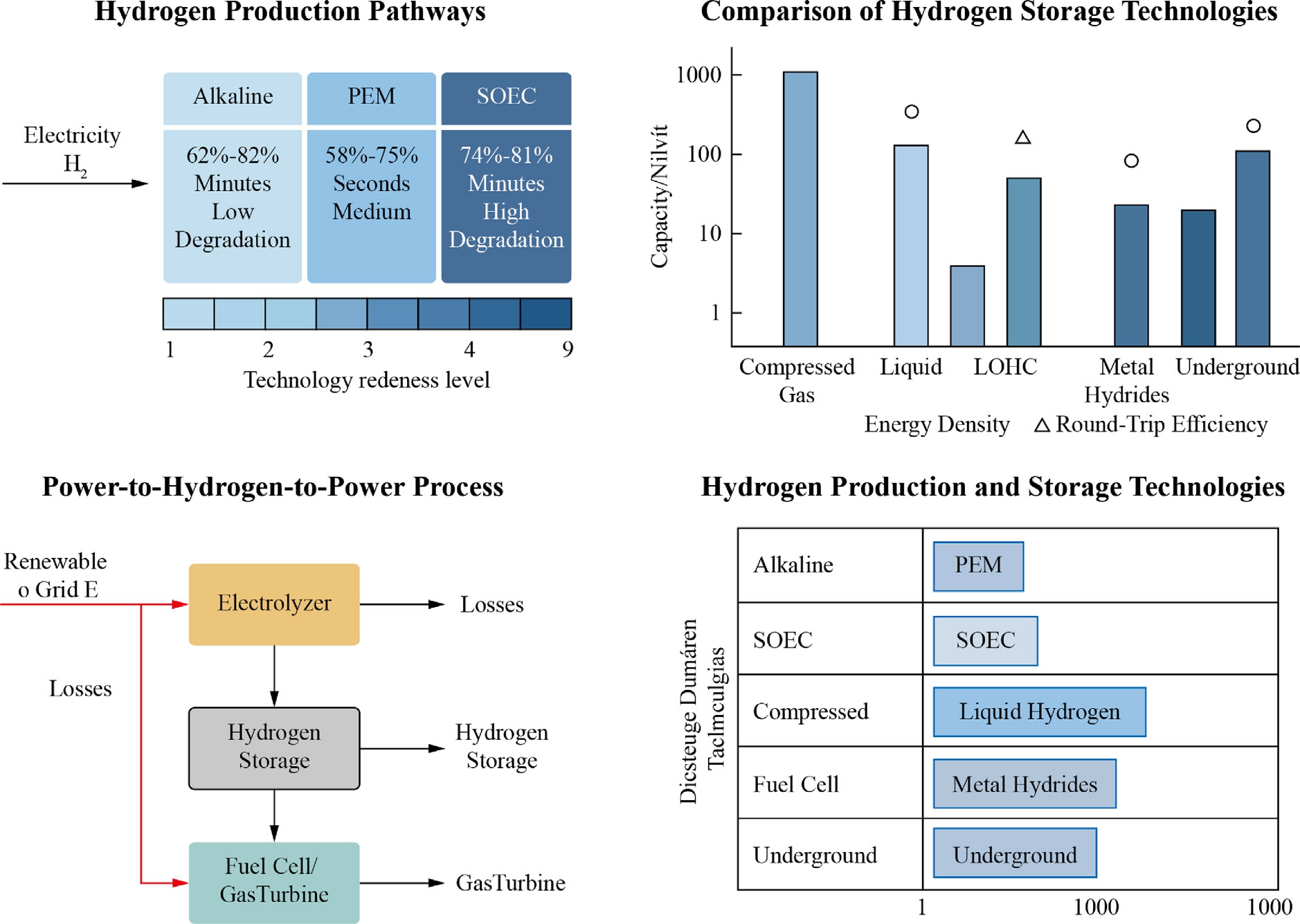
Fig. 2. Hydrogen tech integration.
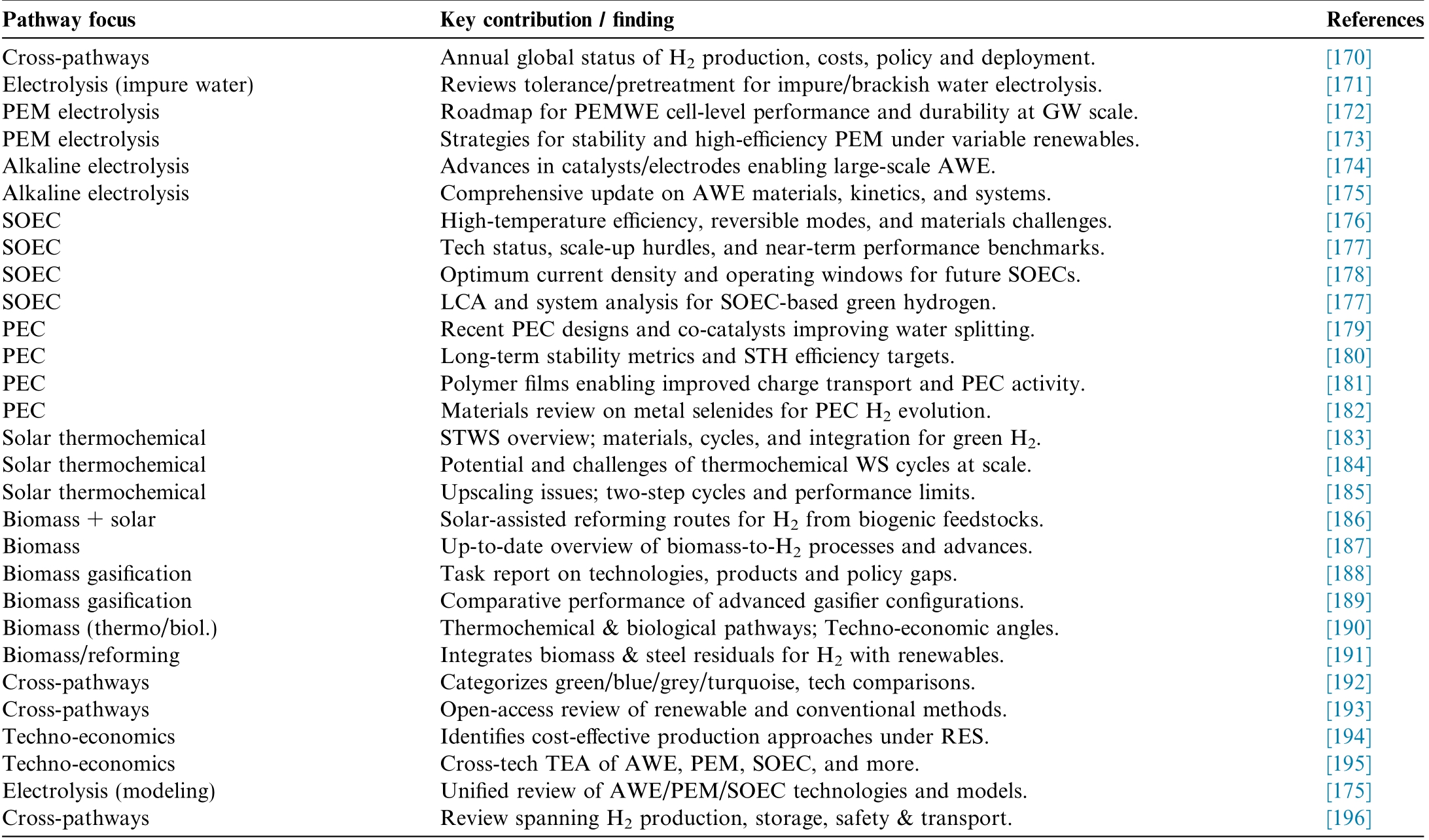
The process diagram displayed in Fig. 2 emphasizes that hydrogen acts as an energy carrier linking renewable electricity generation with long-duration storage and reconversion via fuel cells or gas turbines, while explicitly highlighting conversion losses at each stage. This reinforces the understan ding that P2H2P systems are not efficiency-optimized storage solutions but infrastructure assets for flexibility, resilience, and seasonal balancing in high-renewable power systems [28,29]. Table 1 shows the comparative study of major green hydrogen production pathways.
In overview, these green hydrogen pathw ays, summarized in Table 2, vary in terms of technological development, efficiency and scalability. While electrolysis is commercially proven and can be quickly deployed, PEC is yet to be realized at scale but presents direct solar conversion, and biomass reforming with CO2 capture has shown to offers a clean and baseload option for hydrogen[30]. When used in combination, the latter functions as a complementary portfolio to enable largescale an d sustainable hydrogen production within numerous different energy systems [31].
The technology mapping shown in Table 2 further positions production and storage options across operating scales, from distributed PEM electrolysis and fuel cells to large-scale underground storage, underscoring that no single technology is universally optimal. Instead, system value depends on coordinated selection of production, storage,and reconversion technologies based on time scale, capacity requ irement, and grid context. Such integrated visual synthesis aligns with recent system-level reviews that frame hydrogen as a complementary asset to batteries and pumped storage in deeply decarbonized energy systems[32]. The technology–service matrix provides a clear comparison of how different hydrogen production, storage,and conversion technologies contribute to power-system operation across a range of essential grid services. Fastresponding electrolysis technologies, especially PEM demonstrate strong capabilities in frequency regula tion and load, while slower, high-temperature SOEC systems are better suited for seasonal energy shifting and providing firm capacity [33].
Storage technologies show highly differentiated roles:compressed gas enables short-term balancing, whereas liquefied hydrogen, LOHCs, metal hydrides, and geological caverns suppo rt increasingly longer storage durations,with caverns offering the strongest seasonal performance.As shown in Table 1, conversion technologies such as fuel cells and hydrogen turbines play critical roles in providing firm capacity [15]. Overall, the matrix highlights that no single hydrogen technology serves all system needs; rather,hydrogen’s value emerges from a portfolio approach in which production, stora ge, and conversion pathways collectively support grid flexibility, reliability, and decarbonization across multiple time scales.
As illustrated in Fig. 2, biomass reforming is a dispatchable, and carbon–neutral hydrogen production path coupled with Carbon capture and storage (CCS)technologies. Such a pathway is based on the thermochemical conversion of organic feedstocks (e.g. agricultural waste, wood residues or biogas) towards hydrogen-rich syngas by means of gasification or pyrolysis [34]. Studies[35] have shown that the captured CO2 may be stored or used in other industrial processes, reducing net greenhouse gas emissions. In contrast to electrolysis and PEC, biomass reforming provides a constant supply of hydrogen irrespective of weather conditions and is therefore indispensable in combination with intermittent renewables.
1.1 Electrolysis
Electrolysis is the process in which the electric current passing through a molten ionic compound causes decomposition. It is commercially employed to recover metals from ore, produce chemicals, and electroplate surfaces.A simple electrolytic cell consists of an electrolyte,a directcurrent (DC) power supply and two electrodes (an anode and a cathode) that are introduced in to the electrolyte.Electrolysis is a key technology in green hydrogen production, as it allows for the splitting of water (H2O) into hydrogen (H2) and oxygen (O2), with electricity supplied from renewable energy sources such as solar photovoltaic(PV), wind, or hydropowe r. This is performed by an electrolyzer that separates water molecules using electricity.The sustainability of electrolysis relies mostly on the electricity systems whereby zero-carbon hydrogen is yielded when renewable powered its production resulting in green hydrogen [36]. This route is now seen as a key technology for decarbonizing different sectors includi ng steel, ammonia and long-haul transport on the global scale [37].
Table 1 Comparison of major green hydrogen production pathways.
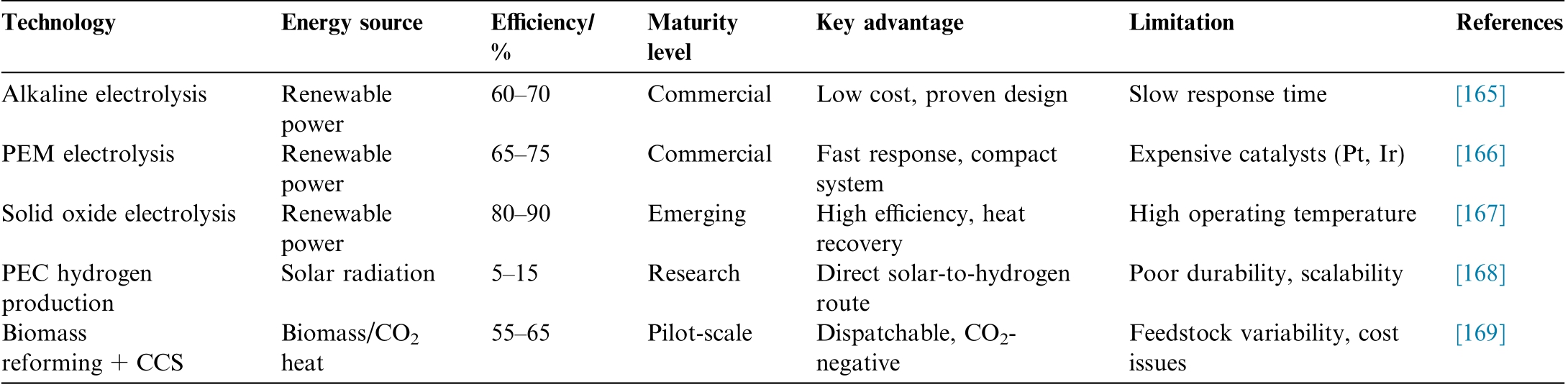
Table 2 Technology service matrix.
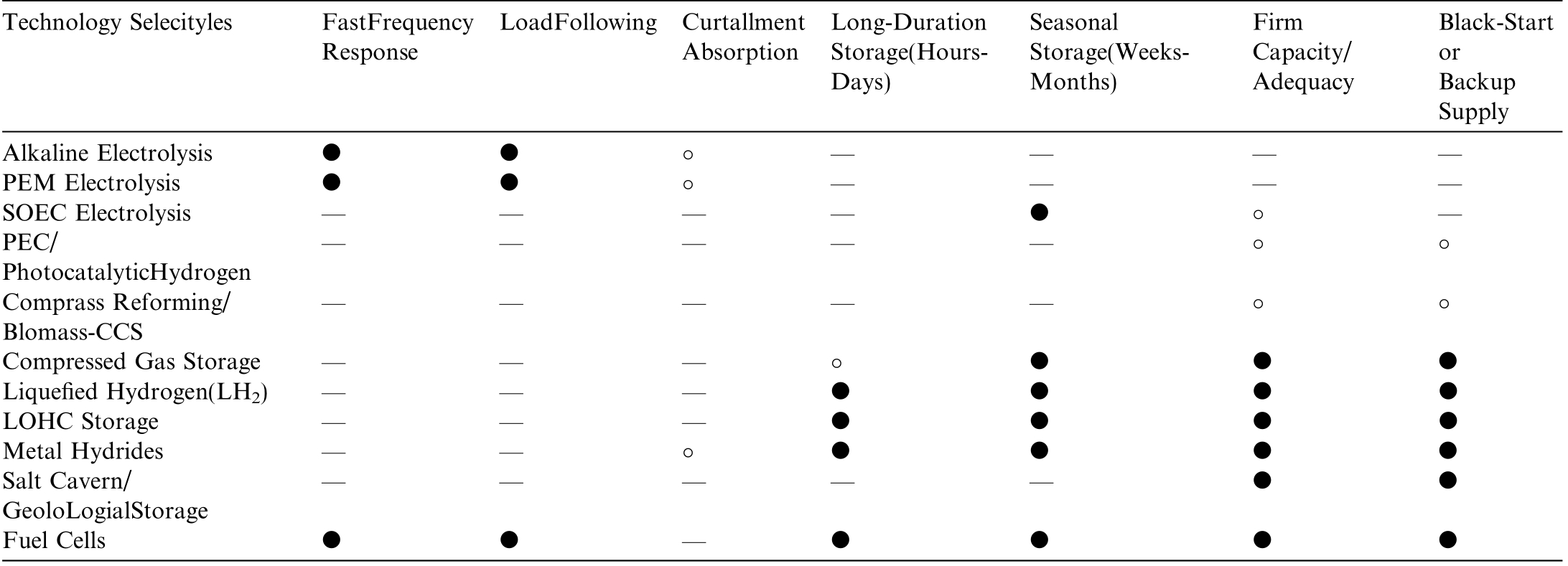
The predominant types of electrolyzers are PEM and solid oxide electrolysis cells (SOECs) that have different operati ng features and degrees of technological maturity.Ursu´a et al.[38] revealed that the oldest and most common system uses a liquid alkaline electrolyte, usually potassium hydroxide or sodium hydroxide, and nickel-based electrodes. The system functio ns at low cost and medium effi-ciency(60–70%)which is applicable for the industrial scale production of hydrogen [38]. Nevertheless, with variable power systems, alkaline systems have a slow response, thus restricting the flexibility in grid connected renewable systems [39]. In contrast, PEM electrolyzer uses a solid polymer electrolyte and noble metal catalysts including platinum and iridium, generating higher current densities and fast response time suitable for widely fluctuation renewable energy systems [40]. Although SOEC has been reported as the highest efficient hydrogen production partway, the system can work at high temperatures (700–1000 ° C) and then be able to use both the electrical and the thermal energy, reaching overall high system efficiencies [41]. In addition, the high tempe rature operation of the system allows integration with industrial waste heat and concentrated solar power (CSP), to improve energy application. However, the degradation of the material,sealing problems, and high cost co mpared to metallic components deter their current use as large scale equipment,with merely pilot or demonstration projects in operation[42]. Nevertheless, SOECs have been identified as a product technology for large-scale hydrogen production using renewable or nuclear thermal energy sources [43].
Electrolysis on the other hand is not only the basis for all hydrogen production, but it also forms the cornerstone of power conversion systems, in which renewable electrical energy is converted in to chemical energy that can be stored[44]. Kadam et a l. [44] revealed that electrolysis-derived hydrogen can be stored, transported and converted into ammonia (NH3) and synthetic methane (CH4), allowing seasonal energy storage and sector coupling [44]. Furthermore, electrolysis can employ reduced renewable electricity contributing to increased grid efficiency. Gibson et al. [45]showed that the fast start-up times and dynamic load following capabilities make electrolysis especially suitable for flexible energy systems, such as the PEM electrolyzer. This versatility enhances the potential of electrolysis process to support stabilization of renewable-heavy power grids and provide decarboniz ed hydrogen for a variety of end uses.Shaya et al. [46] demonstrated that the environmental advantages of electrolysis rely greatly on lifecycle emissions related to power production. Belmehdi et al. [47]reported that through renewable energy, the whole hydrogen chain can be nearly zero emission production and save more than 90% greenhouse gas emissions compared with steam methane reforming (SMR) [47]. However, complete sustainability also depends on water availability and electrolyzer efficiency [48]. Current international efforts aim at increasing production capacity, development of high performing membranes and catalysts as well as cost reduction of renewable electricity inputs is in progress [49,50].The International Energy Agency (IEA) predicts that electrolysis capacity could scale from less than 2 GW at present to more than 550 GW by 2030, provided there is strong policy support and the cost of electrolyzer can continue to decrease [51]. As technology innovation progresses and renewable energy costs decline, electrolysis will be the cornerstone of global hy drogen strategies to decarbonize not only energy but industry and transport.
1.2 Photoelectrochemical (PEC) water splitting
Photoelectrochemical (PEC) water splitting is a new concept of green hydrogen production, utilizing solar energy to drive the chemical splitting of water into hydrogen and oxygen. Compared with conventiona l electrolysis requiring an external electrical power supply,PEC uses the same device to absorb light and initiate electrochemical reactions [52]. The photoelectrochemical cell generally comprises semiconducting photoelectrodes in contact with an aqueous electrolyte. This direct solar-to-hydrogen(STH) step allows bypassing the energy losses of an intermediate electricity generation and presents a potentially more compact, and less expensive choice for decentralized hydrogen production[53]. Opakhai et al.[54] revealed that the bandgap energy of the semiconductor dominates in the PEC process, and it needs to be situ ated between the water-splitting potentials with overpotentials (1.23 eV).Zhou et al. [55] showed that realizing high STH efficiency needs to compromise with the light absorption, charge separation, and surface reaction kinetics carefully. The current world-record STH efficiency for integrated PEC systems is still approximately 19% [56]. However, photoelectrode corrosion, low photovoltage, and complicated production limit wide application of the semi-conductor materials.
For dealing with durability problems protective coatings, and passivation layers are currently being developed to avoid corrosion while maintaining charge transfer.Combining PEC cells with membrane separators can improve gas purification and avoid mutual contamination of hydrogen and oxygen. Collectively, these design enhancements are bringing PEC away from the laboratory-scale technology a nd into a potentially feasible renewable hydrogen production technology. From a system point of view, PEC water splitting is one of the most promising approaches to distributed hydrogen production where sunlight is abundant[57,58]. In addition, hybridized systems of a PEC device with PV cells or an electrolysis module have the potential to comb ine the high efficiency of PV and simplicity of PEC with their approach already verified [59,60]. STH efficiencies greater than the thermodynamic limit of a single absorber can be achieve d with these PV-PEC cycle systems and can lead to lower system costs. Furthermore, as scalable manufacturing of photoelectrodes and recycle of the harvesting materials continue to be developed in some emerging factories all over the world, and the practical performance of PEC-based hydrogen production technologies will be a potential complement for electrolysis in future hydrogen economy. While stability, efficiency and cost are the challenging issues to be overcome, development in semiconductor materials,protective coatings and tandem architecture is greatly promoting its feasibility. In comb ination with other hydrogen production technologies, PEC thus contributes to the diversification of renewable hydrogen sources, allowing for centralized as well as decentralized production routes.Material progresses and scalability attempts lead PEC water splitting to potentially become a key contributor in sustainable hydrogen economies in the short/mid-term future.
1.3 Biomass reforming
Biofuel reforming is the process of converting bio-oil,syngas from biomass gasification into a cleaner fuel or mixture of fuels such as H2 or a clean mixed hydrogen and carbon monoxide (syngas). It usually consists of heating the biomass derived feed with steam in presence of some catalyst to degrade complex hydrocarbons. Other processes to convert biomass are used as a heating upstream of the production of raw fuel before reformation takes place by means of catalytic processing. There are two main advantages of the thermochemical production of hydrogen from biomass reforming as a method to produce green hydrogen. C¸ag˘lı et al. [61] demonstrated that the methods can provide a promising pathway to obtain an hydrogen gas that can be generated by converting renewable organic feedstocks such as agricultural residues,forestry waste or energy crops. In contrast to electrolysis that relies on electricity, biomass reforming exploits the intrinsic chemical energy of carbonaceous feedstock provid ing a dispatchable and carbon neutral source for hydrogen [62]. The process can be divided into a number of steps: The first is biomass gasification to form syngas(CO, H2, and CO2), followed by reforming or water –gas shift reaction to enhance hydrogen production and finally CO2 capture co upled with hydrogen purification. Balat et al. [63] showed that with CCS, this pathway achieves negative emissions owing to the fact that carbon in biomass is initially derived from atmospheric CO2. The first step in the process of biomass reforming is gasification,which usually takes place at around 800–1000° C and with steam, oxygen or air as the gasifying medium. The main chemical reactions are partial oxidation (POX) a nd steam reforming (SR), resulting in a mixture of CO, H2, CH4,and CO2 [64]. Syngas can have different compositions depending on the type of feedstock and reactor conditions.More advanced gasifiers, such as fluidized-bed or entrained-flow systems have shown to enable better regulation of reaction parameters and yield higher amounts of hydrogen [65,66]. After the reforming process, cleaning of syngas and separation of hydrogen is an important step to make pure hydrogen that can be utilized in fuel cells and industry. Roy [67] revealed that tars, particulates, sulfur compounds and carbon dioxide impurities should be eliminated to avoid catalyst poisoning and provide the quality of fuel. Press Swing Adsorption (PSA), membrane separation and cupid distillation have been reported to be the technologies used in purification of hydrogen at 99.99%or above purity levels [68]. The CO2 thus captured could be either geologically sequestered or used for enhan ced oil recovery and chemical synthesis. Alizadeh et al. [69]suggested that the combination of biomass reforming and CCS as referred to by biohydrogen with carbon capture and storage could provide hydrogen.
Researchers [70,71] have shown that a thermochemical pathway for the biomass reforming other than steam gasification is also possible, such as pyrolysis,catalytic reforming, and supercritical water gasification. Li et al. [72]showed that the first step after the treatment of biomass is pyrolysis, which occurs at moderate temperature (400 to 600 ° C), and produces bio-oil that can be reformed to yield hydrogen. In contrast, supercr itical water gasification(SCWG) is performed at over 374 ° C and 22 MPa where wet biomass is converted directly to gaseous products without drying. This approach makes SCWG highly suitable for high-moisture feedstocks such as sewage sludge and algae [73]. The versatility of these pathways enables biomass reforming to be a function of local resources and circular bioeconomic systems. Besides environmental advantages, biomass reforming contributes energy system robustness through ongoing hydrogen production with no regard for solar or wind intermittency. The en ergy system advantage makes biomass reforming process valuable for complementing electrolysis-derived hydrogen, especially in mixed energy systems where the security of supply is important [74].
Life cycle analysis suggests that if sustainably generated, reforming of biomass can deliver 70–100% reductions in greenhouse gas emissions when compared to hydrogen derived from fossil sources [63]. With developments in gasification technology, CO2 capture and catalyst stability, biomass reforming may contribute strategically to realize net-zero energy systems. Despite several studies performed, the overall objective of green hydrogen production pathways is to integrate with renewable process heat and enhanced carbon capture systems to improve overall energy efficiency and ensure long term sustainability. Table 3 shows some of the studies carried out by several researchers on the green hydrogen produ ction pathways.
Table 3 Studies on green hydroge n production pathways.
2 Hydrogen storage technologies
Hydrogen storage is of great importance to facilitate hydrogen integration into the energy system because it can connect the production and utilization of hydrogen.Due to its low volumetric energy de nsity, efficient storage has been reported as a key requirement in the context of its transport, distribution and application in energy, mobility and indust ry[75]. As illustrated in Fig. 3, hydrogen can be integrated comparative ly into different frameworks.
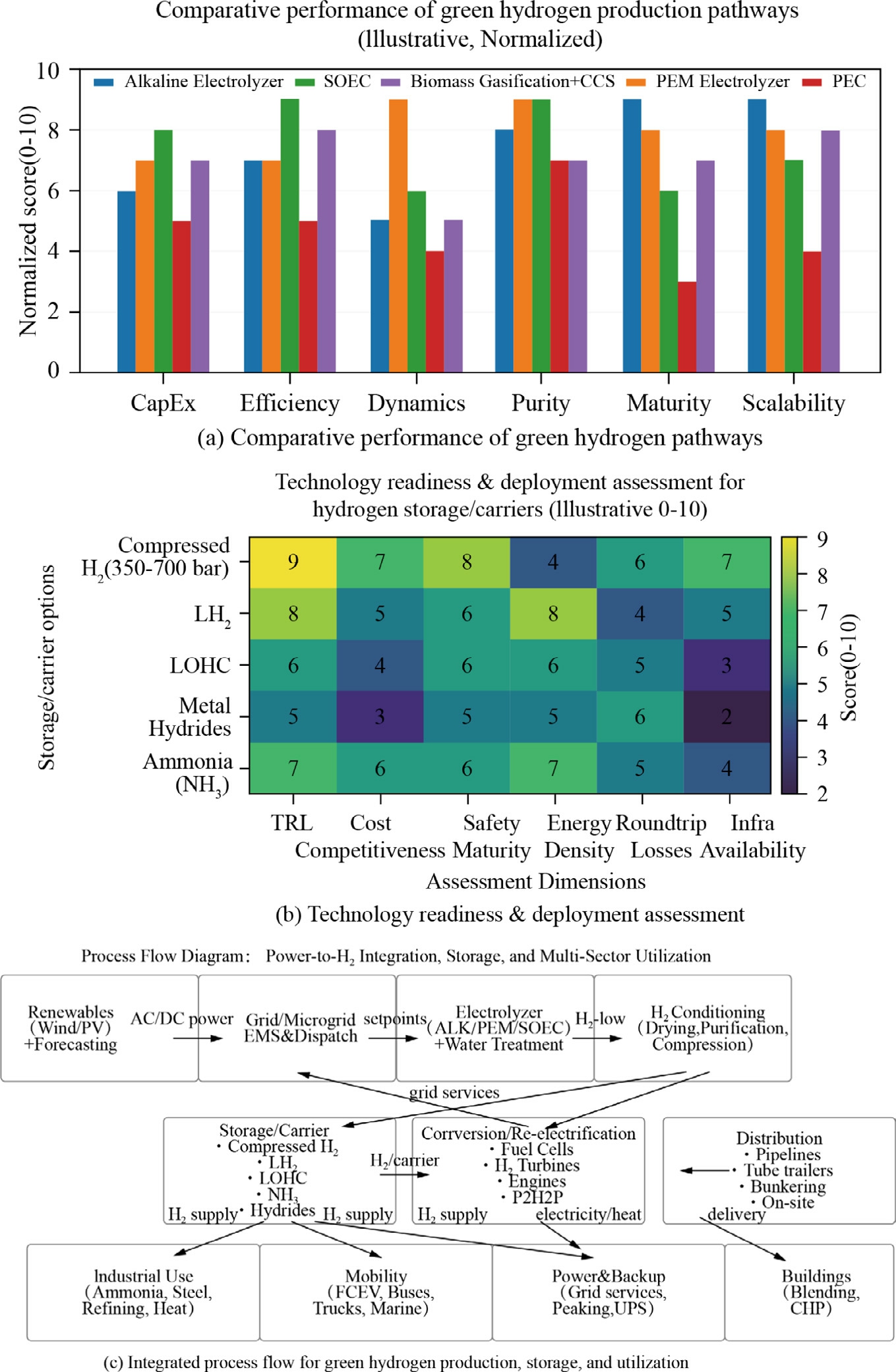
Fig. 3. Integrated comparative framework for green hydrogen systems: (a) normalized performance comparison of major green hydrogen production pathways, (b) technology readiness and deployment assessmen t of hydrogen storage and carrier options, and (c) power-to-hydrogen-to-end-use process flow illustrating multi-sector integration and system coupling.
When considering application, there are factors such as cost, efficiency, and safety for each appro ach. Glenk et al.[76] demonstrated that the storage technology is selected according to energy density needs, system size, and enduse applications. Among the hydrogen storage methods,the most straightforward and developed approach is compressed hydrogen storage, in which hydrogen is pressurized from 350 bar to 700 bars and stored in highstrength composite cylinders or large underground salt caverns. This technology is particularly used in fuel cell vehicles and industrial hydrogen pipelines due to the rapid refueling and modular design [77]. In the design of the compressed hydrogen storage state-of-the-art carbonfiber, composite tanks (Type IV) have replaced older designs made from steel or aluminum to provide lower weight and greater fatigue resistance[78]. However, energy demands for compressed storage are still in high demands and represent about 10% to 15%of the hydrogen’s energy content.Kumar et al.[79] revealed that the control of leakage and embrittlement is still a main technical obstacle in high pressure systems. In contrast, liquid hydrogen storage provides a vastly greater energy density per unit volume but also requires cryogenic temperatures below 253 ° C to keep hydrogen in the liquid state. While liquefacti on makes bulk transportation easier, in particular for shipping and aviation industries, hydrogen storage method requires a substantial amount of energy, specifically cold operation that can take up to 30% of the energy input[80]. In the design of the liquid hydrogen storage, tanks typically are double wal led and vacuum insulated to reduce boil-offlosses. Studies [81,82] have shown that the method has been widely used in the aerospace and industry, but long-term storage of liquid hydrogen is challenged by boil-off losses and capital costs. However, the increasing efficiency of cryocoolers and superior insulating materials are making liquid hydrogen more feasible as a bulk energy storage option.
In addition to physical storage, solid-state and chemical hydrogen storage strategies offer a different path for improving safety and volumetric density of hydrogen storage system. In the method, hydrogen instead is stored by reversible absorption into metal lattices (e.g., MgH2,LaNi5H6, TiFeH2) that allows for high storage densities and low operating pressures [83]. Complex hydrides, such as sodium alanate (NaAlH4) and lithium borohydrides(LiBH4) have higher hydrogen capacities but usu ally release hydrogen at elevated temperature. Preuster et al.[84] reported that hydrogen, in its organic liquid form(methylcyclohexane and dibenzyltoluene), can be reversibly loaded onto a carbon-based carrier via hydrogenation,then released through dehydrogenation reactions when required for use [84]. Underground storage of hydrogen in geological formations (e.g., salt caverns, aquifers,depleted gas fields) is an economic and saleable solution for large or seasonal storage[85]. Salt caverns in particular are attractive because of their very good sealing potential and long-term performance as gas storage[85]. These geological storage systems may help to stabilize renewable energy-based power grids when storing excess renewable hydrogen during high-demand periods. Such a type of grid-scale hydrogen buffer may be key to achieving deep decarbonization in power and heat sectors [76].
Based on the several studied present ed by different researchers [75,86,87], it can be concluded that hydrogen storage technologies are key roles for the flexible future but low carbon impact bearing hydrogen economy. Studies [88] have shown that compressed and liquified storage has become mature in commercial applications, and solid-state carriers are today rapidly developed at the research or pilot demonstration level [88]. Further advancements in materials and insulating technologies,as well as system integration will further decrease cost,increase safety, and enhance overal l energy efficiency endorsing hydrogen to its role as a major enabler of global decarbonization.
2.1 Comparative system-service capabilities of hydrogen production pathways
Although Sections 1 and 2 describe the operational principles of electrolysis, PEC, biomass reforming, and thermochemical pathways, a deeper synthesis reveals substantial differences in how these technologies support power-system services under varying boundary conditions.Alkaline electrolysis, for example, provides the lowest capital cost and is well suited for baseload hydrogen production, but its relatively slow ramping behaviour limits its ability to respond quickly to renewable fluctuations.PEM electrolysis,by contrast,offers fast dynamic response and wider part-load operability,making it more appropriate for high-VRE(variable renewable energy)systems that require rapid absorption of surplus wind and solar generation [17,89]. High-temperature SOEC systems achieve superior electrical efficiency when co-located with industrial heat sources, yet their thermal inertia and degradation sensitivity constrain their applicability in systems with sharp intra-day variability[17,89]. PEC and photocatalytic pathways offer direct solar-to-hydrogen conversion but currently lack the durability, efficiency, and controllability needed to support firm capacity or ancillary services. Biomass gasification and biomass-CCS systems, meanwhile,provide dispatchable outputs independent of real-time weather conditions, enabling them to supply spinning reserve, peak shaving, or seasonal balancing functions not easily delivered by intermittent renewable-coupled electrolysis systems.
Similarly, storage technologies differ not only in capacity and efficiency but also in the types of grid services they can provide. Compressed gas storage offers fast cycling and is suited for short-term balancing, whereas liquid hydrogen becomes favourable in systems requiring largescale, interses sional storage despite higher conversion losses [90]. Metal hydrides provide low-pressure, highdensity storage with excellent safety characteristics but slower kinetics, restricting their use in fast-response applications such as frequency regulation [90]. LOHC systems,while attractive for long-distance transport and integration with existing fuel infrastructure, introduce additional conversion steps that limit round-trip efficiency and make them less suitable for rapid cycling or high-frequency balancing. Geological storage options including salt caverns and depleted reservoirs enable multi-gigawatt, seasonalscale cushioning of excess renewable generation, which is essential for systems targeting very high renew able penetration.These distinctions underline that no single storage pathway offers universal advantages;instead,each delivers specific services depending on response time, energy density,cycling frequency,and system-level operational needs.The production and storage pathways reviewed in Sections 1 and 2 enable distinctly different power-system functions ranging from fast-acting demand-side flexibility and renewable curtai lment mitigation to long-duration and seasonal energy shifting [91].
Their comparative advantages become highly dependent on boundary conditions such as renewable mix, temporal variability, access to industrial heat, geographical storage opportunities, and required response times for ancillary services. By synthesizing these attributes across technologies, the review establishes a clearer underst anding of how hydrogen can serve as a versatile enabler of grid stability, flexibility, and decarbonization rather than simply a set of stand-alone production and storage methods,
2.2 Critical comparative analysis and techno-economic implications
2.2.1 Comparative advantages, limitations, and operational tradeoffs
While Sections 1 and 2 describe the fundamental hydrogen production pathways, a deeper comparative analysis reveals distinct operational advantages and limitations that determine their suitability under different system conditions. Alkaline electrolysis (AEL) remains cost-effective for steady-state baseload operation but suffers from slow dynamic response and reduced efficiency at partial loads,limiting its contribution to real-time balancing [92,93].PEM electrolysis, by contrast, offers millisecond-scale ramping and higher current densities, enabling frequency–response capability. However, its reliance on scarce materials such as iridium increases capital costs and accelerates degradation under aggressive cycling.SOEC systems achieve the highest theoretical electrical efficiency when supplied with high-temperature heat but remain constrained by thermal-cycling stresses, long start-up times, and m embrane degradation, making them more appropriate for industrial co-location than for highly variable renewable-electricity contexts. Emerging pathways such as PEC systems achieve direct solar-tohydrogen conversion but currently face low conversion efficiencies, short catalyst lifetimes, and unresolved material-stability issue s [94]. These trade-offs underscore that hydrogen production technologies are not interchangeable; their performance and operational characteristics must be matched to specific grid-service requirements and renewable-resource profiles.
2.2.2 Efficiency bottlenecks and material degradation mechanisms
Efficiency bottlenecks and degradation behaviors further differentiate the long-term performance of hydrogen production technologies. In PEM systems, catalyst dissolution, membrane thinning, and catalyst-particle agglomeration contribute to efficiency loss and increased overpotentials over time, particularly under highfrequency cycling demanded by VRE-rich environments[95]. AEL systems exhibit electrode passivation, carbonate precipitation, and gas-bubble formation, which reduce ionic conductivity and limit achievable current densities.SOEC units face significant material challenges, including electrode delamination, chromium poisoning, and phase instability in ceramic electrolytes, all of which accelerate performance decay when exposed to thermal cycling or redox environments. These degradation mechanisms have direct implications for system design because they influence the optimal dispatch strategy, maintenance intervals,and lifetime-cost assumptions used in Techno-economic models [96]. Integrating realistic degradation curves and efficiency decay factors into system-level modeling remains critical research need that is often simplified or overlooked in the existing literature.
2.2.3 Quantitative techno-economic trade-offs under realistic conditions
A more quantitative assessment is needed to highlight meaningful Techno-economic trade-offs across hydrogen production pathways. Under realistic VRE-driven operating patterns, including partial-load operation, start-stop cycling, and fluctuating capacity factors levelized cost of hydrogen (LCOH) diverges significantly from idealized laboratory values. For example, recent studies [97] report LCOH ranges of $3–6/kg for PEM systems operating under high cycling, compared with $2–4/kg for alkaline systems operating near-baseload conditions. The SOEC shows potential for sub-$2.5/kg hydrogen when colocated with industrial heat sources but remains sensitive to degradation-related replacement costs. Biomass-tohydrogen pathways exhibit competitive costs under $2–3/kg but depend heavily on sustainable feedstock availability and carbon-capture integration. Storage and conversion technologies further modify system-level economics:compressed-gas storage is inexpensive but short-duration,while geological cave rns provide seasonal storage at low cost but require significant upfront infrastructure [98].Incorporating these Techno-economic trade-offs into system-wide planning ensures hydrogen strategies are grounded in operational realism rather than theoretical maxima.
3 Integration of hydrogen into power systems
Integrating hydrogen into power systems includes production of renewable-hydrogen, storage and converting to electricity when required to balance intermittent renewables and enhance grid flexibility. This procedure, referred to as Power-to-Hydrogen-to-Power (P2H2P), is generated by using electrolysis that converts excess electricity from production into hydrogen and stores the gas so that it can be converted back into fuel using fuel cells or turbines running on hydrogen to meet peak demand [99]. Santisteban et al. [100] reported that this mechanism also contributes to energy security and decarbonization and facilitates sector coup ling by connecting the electricity grid with other energy sectors. Fig. 4 shows the integration of hydrogen into power systems.
It can be seen from Fig. 4 that the renewable energy,fuel cells, gas turbine, electrolyzer, and hydrogen storage systems are all connected to the power system. Studies[101,102] have shown that hydrogen is a game-changing contribution to low-carbon energy systems as it provides a flexible, clean and storable form of energy that can be paired with renewable power. Hydrogen incorporation into electricity systems fills the temporal gap between intermittent renewable production and continuous energy consumption, hence enhancing the grid stability and energy security.Researchers[103,104] have shown that renewable energy sources like wind and solar are used to power electrolyzers for water electrolysis to produce hydrogen. The produced hydrogen can be subsequently stored, transported, and re-conv erted back to electricity using fuel cells or gas turbines which support grid-level long-term energy storage and sectoral decarbonization [105].
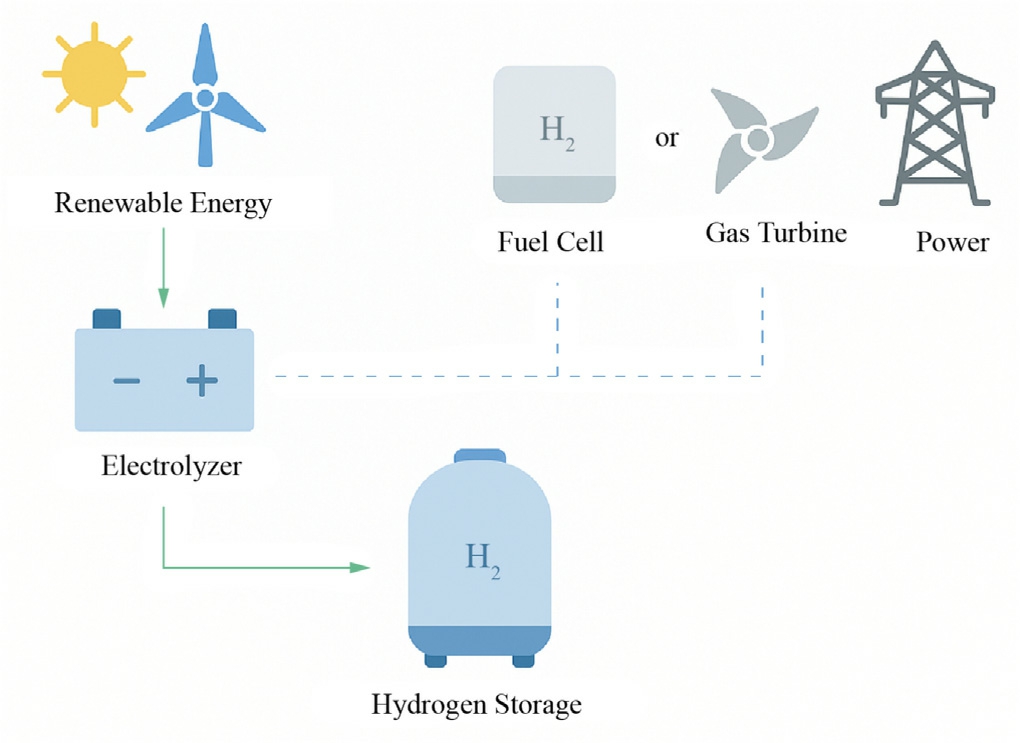
Fig. 4. Hydrogen integration into power systems.
The use of hydrogen in power systems has an advantage that it can be long-term storage for energy compared to conventional batteries that can be used for short-term(hourly to daily) energy balancing [106]. Moreso, hydrogen allows storage over the seasons by means of converting excess electricity generated from renewables into chemical energy using power-to-hydrogen (P2H) technologies. This hydrogen can be subsequently fed back into power-to-power(P2P)concepts,in which electricity is then re-generated from the hydrogen via fuel cells or combinedcycle gas turbines(CCGTs)[107]. Staffell et al.[1] revealed that the systems have lower round-trip efficiency (approximately 35–50%) than batteries, yet hydrogen is the most scalable and energy-dense option for grid-scale storage and resilience of the clean-energy system [1]. Hydrogen also strengthens sector coupling by connecting electricity systems with transport, heating and industry. Hydrogen derived from renewables can be used to produce synthetic fuels(ammonia,methanol or methane)via P2X pathways.[108]. Herc et al. [108] reported that the use of these fuels offers a possibility for the decarbonization of hard-toelectrify sectors in industries such as manufacturing and petrochemicals. Additionally, Carmo et al. [109] demonstrated that hydrogen can be co-supplied in the natural gas turbine, functioning as an intermediary pathway toward low emission from a legacy power plant. This mix offers grid flexibility in combination with existing gas infrastructure and allows a gradual introduction of hydrogen without the need for a full-system redesign. In distributed generation,fuel cells can be used in a decentralized power system, and the stored hydrogen is then converted back to electricity with high efficiency at near zero emissions.Research performed by Liso et al.[110] showed that proton exchange membrane (PEM) and solid oxide fuel cells (SOFC) are the dominant technologies, with effi-ciencies reaching up to 60% in standalone operation and beyond 80% in combined heat and power (CHP) applications. The addition of such systems to local renewables generation promotes microgrids, remote community and emergency backup applications. Additionally, hydrogenbased microgrids constitute an achievable measure to gain in energy autonomy and resiliency for sites or regions that are regularly affected by the intermittence of energy supply. Hydrogen integration systematically creates a fully connected (decarbonized) energy system by connecting the points of electricity generation, storage and end-use.Gasanzade et al. [107] suggested that further improvements in electrolyzer efficiencies, infrastructure developments and fuel cell technology will be essential for the full exploitation of hydrogen end uses in future power systems.
3.1 Fundamental issues, prospects, and possible obstacles on integration of hydrogen to power systems
The integration of hydrogen into the energy system is seen as a game changer for decarbonization and system flexibility in the future energy mix. Hydrogen has shown to be a key pillar that connects the electricity generation,storage and end-use sectors, embedded under the Powerto-X (P2X) umbrella, where surplus renewable electricity goes through electrolysis to produce hydrogen [111,112].This hydrogen can then be used to produce power or store over long periods or turned into synthetic fuels,and chemicals for transport and industry. Osman et al. [106]revealed that the integration is based on four primary components: electricity production from renewable sources,electrolyzer installations, hydrogen storage facilities, and conversion technologies such as fuel cells or hydrogen turbines. These attributes make it possible to integrate into a flexible and resilient low-carbon power system [113]. The advantage of integration with hydrogen stems from its capability to offer long-term energy storage, which is considered as one of the barriers to wide adoption due to the intermittent nature of renewable sources like solar and wind. Unlike ba tteries that are well suited for short-term balancing, hydrogen is able to accommodate large amounts of energy over long term that has the ability to facilitate seasonal energy shifting [76,105]. When there is an abundance of renewable energy, surplus electricity can be used to create hydrogen that could be turned into power during peak hours through fuel cells or CCGTs[107]. This feature further strengthens grid-stability and reliability and decreases renewable downshift.
Hydrogen integration allows reusing current gas infrastructure, which provides more affordable way to decarbonize natural gas toward low-carbon fuels [114]. Power plants based on hydrogen can offer fast ramping power,as well as load following capab ilities and therefore support the variable output of renewable generation [1]. Economically speaking, hydrogen integration drives investments in electrolyzer manufacturing, renewable energy expansion,and infrastructure construction which will open new industrial prospects and contribute to energy independence in territories relying on imported fossil fuels. Nevertheless, there are few technical and economic barriers for massive hydrogen incorporation. Efficiency losses in the hydrogen conversion chain through electrolysis, compression or liquefaction, storage, and reconversion can lower the roundtrip efficiencies of hydrogen[107]. Finally, infrastructure requirements in the form of hydrogen pipelines,storage caverns, and refueling networks are also substantial upfront barriers to investment. Failure of materials in electrolyzers, fuel cells, and pipelines attributed to hydrogen embrittlement and add further challenge in deployment of hydrogen integration [109]. From the economic point of view, green hydrogen is expensive to produce at the moment according to Okonkwo et al. [115].Nevertheless, hydrogen being renewable variable, long duration storage and sector coupling, all together make hydrogen an indispensable tool for achieving carbon neutrality.However,there are challenges associated with costeffectiveness, energy efficiency and infrastructure readiness. Ongoing research and policy backing, including financial support for green hydrogen, investment in infrastructure, and cooperat ion at the international level will be crucial for increasing hydrogen use in integrated energy systems[1,76]. With proper planning and the right technology, hydrogen can be at the heart of a sustainable global energy transition.
3.2 Modelling frameworks for P2H2P systems: time scales,network levels, and operational constraints
Recent modelling work on P2H2P systems spans a range of temporal and spatial scales, each capturing different aspects of hydrogen’s role within power-system operations. Short-term models emphasize dynami c interactions such as electrolyzer ramping, frequency response, and transient voltage stability. Study by Dozein et al. [116]incorporated detailed electrochemical or converter-level dynamics to assess how rapidly PEM electrolyzers can support frequency containment or how alkaline systems respond to sudden renewable fluctuations. On the other hand, operational models at hourly resolution focus on unit commitment, economic dispatch, and optimal scheduling of electrolyzers, storage units, and hydrogenfired turbines [117]. They include part-load efficiency curves, minimum stable operating levels, start-up times,and reserve requirements to evaluate how hydrogen systems interact with variable renewable energy (VRE)resources [118,119]. At the seasonal and annual scale,long-term planning models determine optimal hydrogen storage sizing, electrolyzers, multi-site energy sharing,and investment trajectories under various policy and cost scenarios. These models typically integrate infrastructure expansion, fuel availability, and cross-sectoral coupling to capture hydrogen’s emerging role in multi-energy systems. Transmission-level models treat hydrogen as a long-duration storage medium capable of mitigating seasonal imbalances, reducing curtailment, and providing firm capacity. In contrast, distribut ion-level models highlight the role of hydrogen in local grid congestion management, voltage support, and community-scale renewable integration. Multi-node, network-coupled models increasingly incorporate hydrogen pipelines and storage terminals, enabling cross-regional hydrogen flows and coordinated operation across geographically dispersed electrolyzer sites.
Furthermore, several advanced modelling frameworks now incorporate multi-site electrolyzer coordination,allowing spatially distributed electrolysis facilities to collectively optimize renewable energy absorption, hydrogen storage utilization, and grid interaction [120,121]. Lui et a l. [122] reported that such models enable system-level benefits such as geographic smoothing of renewable output, reduction of transmission bottlenecks through hydrogen production at constrained nodes, and joint optimization of hydrogen supply chains. These modelling advancements demonstrate that P2H2P systems are not simply add-on storage components but integral participants in power-system operation, influencing reserve allocation,unit commitment, flexibility markets, and long-term system adequacy.
Collectively, this structured analysis highlights the evolution of hydrogen modelling methodologies and clarifies the variety of operational constraints, time scales, and network interactions that modern P2H2P models must account for. By linking electrolyzer dynamics, storage characteristics, and multi-energy coordination,these modelling frameworks provide the foundation for designing robust, hydrogen-enabled power systems capable of supporting deep decarbonization.
4 Applications for hydrogen in energy systems
Hydrogen has been used in different sectors and with its unique capabilities of being clean and having high-energy content, and its applications remain important as a result of increasing reduction in environmental pollution. This quest has made different countries pursue the objectives[123]. At the core lies hydrogen as a versatile energy carrier linking four major application domain power systems,heating, combined heat and power (CHP), and transport[123]. In power systems, hydrogen facilitates energy conversion through power-to-power and power-to-gas technologies that stabilize renewable generation and enhance grid reliability [124]. For heating application, hydrogen supports both residential and industrial processes, reducing dependence on fossil fuels. Combined heat and power systems use hydrogen to simultaneously generate thermal and electrical energy. In transport, hydrogen powers fuel cell vehicles, trains, and ships, offering clean and efficient altern atives to conventional fuels.Collectively,these applications demonstrate hydrogen’s critical function in decarbonizing multiple sectors while promoting flexibility,resilience, and long-term energy sustainability.
4.1 Power systems
The steady decline in renewable energy costs has significantly enhanced the feasibility of incorporating green hydrogen into modern power networks. Numerous investigations on power-to-power (P2P) systems have examined configurations in which hydrogen generated from renewable electricity is subsequently reconverted to electrical energy via fuel cells[105,125]. These P2P systems are structurally simple and can be deployed in decentralized formats,thereby relieving stress on centralized grids.For example,Li et al. [126] proposed an advanced control-based energy management model using droop and maximum power point control for a PV–battery–electrolyzer–fuel cell hybrid.Similarly,Basu et al.[127] explored hydrogen-based configu rations to evaluate the performance of a hybrid setup supplying power to data centers, while Baldinelli et al.[128] introduced an integrated electricity–hydrogen–water framework that combined solid oxide fuel cells (SOFCs),electrolyzers, and desalination units to meet the energy and water requirements of an isolated island.
When operated in stationary mode, such systems not only deliver multi-level energy storage but also, owing to their compact design and high energy density, can serve as portable power sources. Technologies employing ondemand hydrogen generation from compounds like ammonia borane are particularly valuable for defense operations where energy-dense, mobile power systems are essential. In underwater applications, hydrogen systems are pivotal to proton exchange membrane(PEM)fuel cells that facilitates Air-Independent Propulsion (AIP) for unmanned underwater vehicles (UUVs), allowing quiet and prolonged operation. These systems depend on lightweight, compact hydrogen storage modules tailored to submarine constraints [129]. For grid-connected hybrids,energy buffering is often realized through power-to-gas(PtG) processes, trans forming excess renewable energy into hydrogen or synthetic methane [130]. This enables long-duration storage and integration with industrial facilities such as combined heat and power (CHP) plants or district heating. Additionally, hydrogen-based smart grids benefit from its function as a balancing medium that stabilizes renewable variability. Emerging power management architectures coupling PV and fuel cell systems are expected to ensure flexible and adaptive energy flow, optimizing supply–demand dynamics.
4.2 Heating
Hydrogen derived from renewable energy has become a practical pathway for sustainable and low-emission heating applications in residential, industrial, and district heating sectors. In domestic settings, hybrid heating systems typically combine hydrogen fuel cells with natural gas or renewable power inputs, achieving both carbon reduction and energy efficiency improvements. For instance, a molten carbonate fuel cell (MCFC) hybrid was demonstrated to su pply 36 kW of thermal energy while substantially cutting CO2 emissions [131]. Industrial facilities have also adopted hydrogen-assisted heating. Alstone et al. [132]showed that in one dairy plant, integrating hot-water cogeneration and heat pumps with hydrogen sources optimized energy consumption and product quality. Similar hybrid concepts have been extended to food processing and other temperature-sensitive industries to maintain consistent thermal profiles while minimizing fossil energy dependence. The integration of PtG systems with oxycombustion technologies has been shown to enhance effi-ciency to about 68%, simult aneously generating power and heat from surplus renewable electricity [130]. Further implementations include hydrogen–methane hybrid boilers in educational and institutional buildings, such as a solar-assisted system in a high school that produced hydrogen through on-site electrolysis. The stored hydrogen fueled methane boilers,delivering marked CO2 savings and favorable payback periods[133]. Solar–hydrogen configurations also serve heating and domestic hot-water needs in sunny regions, coupling PV arrays, electrolyzers,and hydrogen tanks with conventional heating units to ensure system reliability.
4.3 Combined heat and power (CHP)
Hydrogen-based CHP hybrids are increasingly integrated with renewables to address the combined heat and electricity demand of buildings and communities[134]. These systems typically couple molten carbonate fuel cells with renewable hydrogen sources, producing significant outputs of heat and corresponding electrical energy for residential use [134]. Farulla et al. [135] assessed a PV-driven hydrogen CHP configuration where the generated hydrogen was stored and later utilized in fuel cells and boilers, achieving substantial CO2 mitigation and demonstrating cost-effectiveness. Such systems illustrate the foundation for multi-vector energy networks that interconnect multiple en ergy carriers electricity, heat, and fuels,to maximize overall system performance.In the context of district heating, PtG–oxycombustion CHPs have achieved high efficiency through integrated waste heat recovery [130]. Solar-hydrogen CHP schemes have also proven beneficial for small communities in highirradiance regions, providing continuous, low-emission energy [110]. Nevertheless, widespread deployment faces challenges due to the capital intensity of electrolyzers, fuel cells, and storage materials. Enhancing durability, conversion efficiency, and reducing costs remain top priorities.Advanced control mechanisms such as digital twins now facilitate real-time monitoring and operational optimization. Environmentally, the systems hold considerable promise. Policy-driven incentives and subsidies are therefore essential to accelerate commercial adoption, particularly in markets transitioning toward multi-vector renewable energy infrastructures.
4.4 Industrial processes
Beyond residential and CHP use, hydrogen-supported hybrid systems are being adopted for industrial heating where steady, and controllable temperatures are critical. In food manufacturing, for instance, Schumm [136] designed a hybrid heating setup using hydrogen with heat pumps and hot-water cogeneration for a cheese powder plant, leading to improved operational efficiency and reduced production costs. In Germany, hybrid hydrogen systems have stabilized thermochemic al reactions while reducing fossil fuel consumption [137]. In the textile industry, p ilot-scale hydrogen-based steam generation for dyeing processes achieved superior energy efficiency and emission reductions.Owing to their flexibility in combining diverse power inputs,these systems provide industries with reliable t hermal management and improved efficiency [138]. In metallurgy,hydrogen hybrids have demonstrated potential for annealing and tempering operations where thermal u niformity is essential[139]. Overall, such technologies enhance industrial productivity while advancing decarbonizat ion objectives.
4.5 Transport
The transportation sector represents one of the most promising frontiers for hydrogen-based hybrid technologies. Okonkwo et al. [115] introduced a hydrogen–fuel-ce ll-powered hybrid train utilizing an off-grid system. Onroad, fuel cell electric vehicles (FCEVs) are gaining traction across passenger and freight fleets owing to their high energy density, short refueling times, and near-zero emissions. Hybridized FCEVs integrate batteries for regenerative braking and power assist,extending driving range and hydrogen efficiency [140]. These characteristics make hydrogen buses and taxis competitive alternatives to diesel in urban fleets[141]. Port facilities are beginning to replace diesel generators with hydro gen-based systems, contributing to cleaner harbors[142]. In aviation, although the technology remains experimental, hydrogen fuel cells paired with solar arrays are being tested for Unmanned Aerial Vehicles (UAVs) and lightweight aircraft, paving the way for zero-emission aviation solutions [143]. Persistent challenges include infrastructure expansion, storage complexity, and cost barriers. Innovations in cryogenic tanks,metal hydrides, and high efficiency electrolyzer are expected to alleviate these issue s. Intelligent control systems, including digital twins, have shown to enhance power flow management and improve overall reliability[144]. With continued cost reductions and renewable integration, hydrogen-driven transport stands as a transformative step toward decarbonized mobility. By enabling bidirectional energy exchanges vehicle-to-grid (V2G),grid-to-vehicle (G2V), and vehicle-to-home (V2H) these systems link transportation and power sectors, advancing the global hydrogen economy.
4.6 Advanced dynamic modeling and control for integrated powerto-hydrogen systems
4.6.1 Dynamic modeling of electrolyzer response
Recent literature highlights that hydrogen’s value in power systems depends critically on accurate representation of electrolyzer dynamic behavior under variable renewable energy(VRE) conditions. Modern PEM electrolyzers exhibit subsecond ramping capability and can respond to power deviations at rates comparable to battery inverters, whereas alkaline systems show slower dynamics and greater sensit ivity to frequent start–stop cycling.Study by Aatabe et al.[145] have shown that dynamic models now incorporate nonlinear effi-ciency curves, transient overpotentials, and degradation dispatch constraints, capturing how electrolyzer response varies under fluctuating PV and wind supply. These models demonstrate that inadequate representation of electrolyzer dynamics can substantially overestimate grid-stability benefits or underestimate cycling-induced efficiency losses. As a result, dynamic modeling has become essential not only for operational planning but also for evaluating hydrogen’s potential contributions to frequency support, primary reserves, and fast regulation services in high-VRE grids [146].
Power-system stability analyses increasingly examine how integrated hydrogen systems influence frequency quality,voltage stability, and inertia provision. Unlike synchronous generators, electrolysis and fuel cells do not inherently provide inertia, requiring grid-forming control strategies or converter-based synthetic inertia to support short-term stability. Studies by different researchers [19,147,148] showed that coordinated multi-electrolyzer operation can enhance frequency containment by rapidly modulating hydrogen production in response to imbalances, effectively acting as a flexible demand resource. Conversely, poorly coordinated modeled electrolyzer fleets may exacerbate ramping r equirements or introduce oscillatory behavior in low-inertia grids[149,150]. These findings underline the need for systemlevel co-simulation frameworks that integrate powerelectronics behavior, hydrogen conversion dynamics, and grid-transient models when assessing hydrogen’s role in future power systems. The transition from isolated electrolysis systems to multi-node hydrogen hubs has driven the development of advanced energy management systems(EMS) capable of real-time optimization. Recent studies propose coordinated control architectures that combine model predictive control (MPC), adaptive dispatch algorithms, and AI-supported forecasting to simultaneously mana ge renewable inputs, electrolyzer loading, hydrogen storage levels, and grid-service commitments. Other researchers [149,150] revealed that integrated power-tohydrogen-to-power (P2H2P) systems, real-time EMS frameworks can optimize hydrogen production during surplus periods while ensuring that fuel cells or hydrogen turbines remain available to supply electricity during peak demand or low-renewable conditions. These coordinated approaches reduce curtailment, minimize degradation, and improve both system reliability and economic performance. Emerging research also points toward digital-twin-based supervisory controls, enabling continuous alignment between physical assets and predictive models across multiple time scales. These models reveal that coordinated real-time optimization can significantly improve round-trip efficiency,reduce operational costs, and enhance grid-support capability. Incorporating these res ults strengthens the review’s discussion of hydrogen’s systemic role and clarifies how advanced control strategies unlock its flexibility value.
5 Policy pathways and hydrogen econom y implementation
The hydrogen economy will require coherent and coordinated policy frameworks to enable the development of research, innovation, infrastructure, and markets. Governments around the worl d are taking a growing interest in hydrogen as they seek to decarbonize energy and meet their net-zero targets.
5.1 Linking technical insights to system needs and policy pathways
The technical review presented in earlier sections highlights four major research needs which includes; improving electrolyzer flexibility, advancing long-duration hydrogen storage, optimizing P2H2P system architectures, and developing multi-energy control frameworks. These needs can be directly mapped to specific technology families,system configurations, and policy priorities. Zou et al. [20]reported that improving electrolyzer ramping, part-load efficiency, and degradation performance is most relevant to PEM and emerging high-temperature SOEC technologies, which are central to providing fast-response flexibility services under high-VRE conditions. Advances in longduration and seasonal storage, includi ng geological storage, LOHC pathways, and metal hydrides, are essential for configurations requiring inter-seasonal energy shifting,curtailment mitigation, and firm renewable-backed capacity [151]. Optimizing P2H2P architectures, including hybrid systems combining electrolysis, hydrogen storage,fuel cells, and hydrogen-ready gas turbines, addresses the need for configurable multi-scale balancing capability.Generally, multi-energy control frameworks and digital coordination of multi-site electrolyzers direct ly relate to modern transmission and distribution-level system operation,enabling hydrogen to serve as an integrated flexibility resource rather than a stand-alone technology.
These research needs also intersect with policy and regulatory instruments. Improving electrolyzer operability aligns with performance-based incentives, flexibility markets, and ancillary-service compensation schemes that reward rapid response. Long-duration storage development requires capacity-market mechanisms, investment tax credits, and guaranteed return frameworks similar to those emerging from grid-scale batteries and pumped storage. Hybrid P2H2P adoption depends on technologyneutral procurement processes, renewable-hydrogen certification sc hemes, and support for infrastructure codes and standards. Wang et al. [21] revealed that coordinated energy-system operation relies on style="font-size: 1em; text-align: justify; text-indent: 2em; line-height: 1.8em; margin: 0.5em 0em;">The key elements of hydrogen policy frameworks comprise national strategies, funding incentives, and regula -tions, standards & cooperation as is illustrated in Fig. 5.These frameworks will help achieve the goal of stable investment climates, innovative technologies and expanding hydrogen production,storage,and end-use in a variety of sectors [152]. Setting national hydrogen strategies is a key policy instrument for the development of hydrogen.More than 40 countries, such as Japan, Germany, Australia and the USA, have issued detailed hydrogen roadmaps including production objectives, infrastructure plans, and funding priorities [153]. For example, Japan’s Basic Hydrogen Strategy (2017) [154] targets the development of a ‘hydrogen society’ with an investment in fuel cells technology and import supply chain, whereas the European Union’s Hydrogen Strategy for a Climate-Neutral Europe (2020) emphasizes on large scale green hydrogen generation by renewable-electrolysis European Commission (2020). These approaches are also coherent with lofty climate targets within frameworks such as the Paris Agreement, placing hydrogen as one of the pillars for energy transition and industrial decarbonization[155]. It is also the imperative of financing and Public–Private Partnerships (PPPs) that will shape the future of hydrogen economy. Measures such as grants, feed-in tariffs, carbon pricing and tax credits are some of the mechanisms that governments use in an effort to incentivize investment into hydrogen infrastructure and technologies.Standardized hydrogen pipeline, storage tank, and refueling station safety req uirements are crucial for public confidence as well as for cross-border interoperability.Moreover, international cooperation through the International Partnership for Hydrogen and Fuel Cells can help to harmonize standards and makes it possible to develop a global hydrogen market” [156]. Even with considerable policy momentum, much remains to be done and these include the high capital cost of electrolyzers, limited refueling station infrastructure, and uncertainties about longterm demand and pricing [157]. Furthermore, inconsistent policy across jurisdictions can prevent widespread adoption. In order to address these challenges, experts suggest combining hydrogen policies with more general energy planning, renewables deployment, carbon pricing, and industrial decarbonization strategies. Ultimately, strong policy measures that coordinate technological progress with financial investments and international collaboration will be necessary in establishing an environmentally friendly global hydrogen economy.
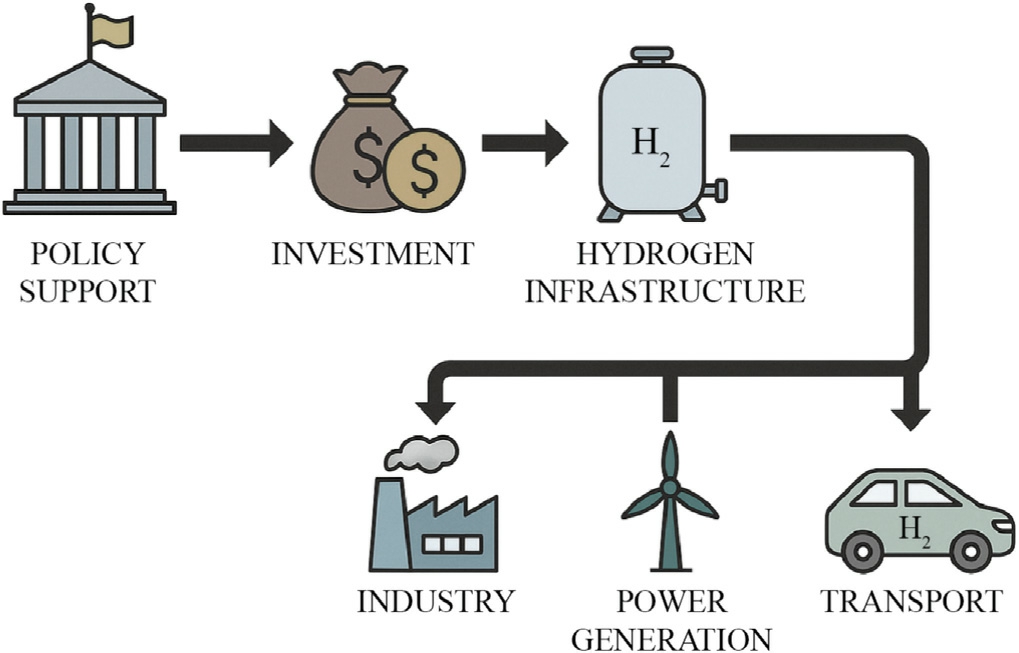
Fig. 5. Policy pathways and hydrogen economy implementation.
6 Challenges and future directions
A primary technical challenge in integrating hydrogen production with power systems arises from the inherent mismatch between variable renewable electricity supply and the steady operation of electrolyzer and storage units.When electrolysis systems operate under fluctuating grid input, their efficiency often declines, and their lifetime may shorten. Even though hydrogen technology has developed a lot, there are still many technical barriers on the practical lev el towards large-scale (power grids) power generation, production, and its integration. One of the most critical issues is the low round-trip efficiency of power-to-hydrogen-to-power systems, which usually stands under 40–45% since it is limited by the energy loss in electrolysis, compression, and reconversion issues[158].Efficiency is further degraded in the case of intermittent supply, when electrolyzers run under their rated conditions in fluctuating power input conditions. Thus, one of the major future research directions is to design adaptive EMSs and hybrid power converters which can achieve near-optimum efficiency at wide load variations [158].Understanding electrolysis durability under dynamic operating conditions and integration into the grid flexibility is necessary. Moreso, consider ation should focus on the short term, medium-term, and long-term planning as shown in Fig. 6.
A key technological limitation also stems from the high cost and lack of scale for electrolyzers, which are controlled by expensive materials and production methods. On the other hand, Proton Exchange Membrane (PEM) and Solid Oxide Electrolysis Cells (SOECs) have high purity and conversion efficiencies but are capital-intensive as they use rare or criti cal materials like iridium and yttrium-stabilized zirconia[159]. The follow-up work needs to focus on the replacement of noble metal catalysts by earth-abundant transition metal alloys and improve additive manufacturing methods for high efficiency membranes and electrodes prepa ration with minimum material waste[160]. Also, it would be interesting to investigate different electrolyzer design options to increase the scalability and flexibility of operation for distributed energy applications.
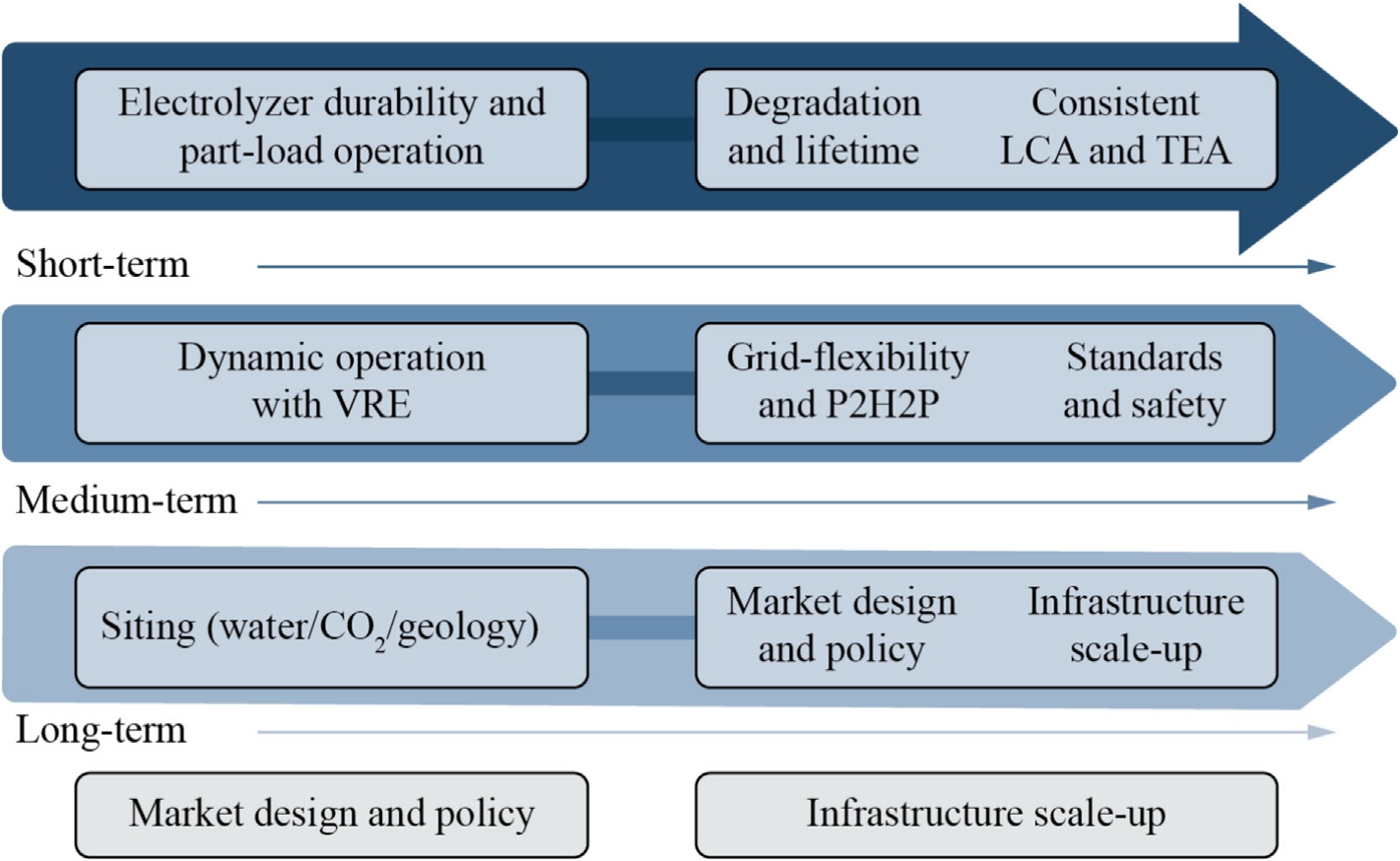
Fig. 6. Challenges of hydrogen production, storage and integration.
Another challenge is the intermittent trade-off between hydrogen production complexes and variable renewables photovoltaic and wind. The noncontinuous generation by renewable power sources results in significant voltage change at point of co mmon coupling, as well as power and frequency fluctuation,while that is detrimental to electrolyzer lifetime and stability of hydrogen production[14,161]. Most of the control and prediction methods in use today have limited time resolution and predictive ability to dampen out such transients. Therefore, the next phase of research should be on digital twin framework and predictive machine learning model for real-time system monitoring, state prediction, and adaptive control of electrolyzers in a hybrid power system.
The issue of hydrogen storage is equally technically and operationally challenging. Traditional high-pressure gas bottles and cryogenic liquid hydrogen tanks cannot be utilized in storage of quantities from future byproducts while accounting for small volumetric density,energy-intensive liquefaction, and material fatigue during cyclic loading. The advanced solid-state storage candidates of metal hydrides, liqui d organic hydrogen carriers(LOHCs), and chemisorbed porous materials are considered for vehicles due to their high packing density relative to liquefied or gaseous hydrogen, but suffer from sluggish sorption kinetics,complex heat management,and regeneration loss[162]. Hence the research needs to move towards multi-scale thermodynamic models and nano-engineered hydride composites with heat/mass transfer properties so that faster absorption/desorption cycles can be achieved. The storage of hydrogen in combination with the power grid requires even more complexity regarding safe operation, control correlation, and spatial distribution. Many grid-scale storage technologies do not have a standardized interface, which would be required for safe handling of hydrogen in such decentralized infrastructures. Further to this, the integration of hydrogen storage with a power grid requires state-of-the-art hydrogen -topower conversion technologies like high-efficiency reversible fuel cells or hydrogen gas turbines [163]. It is recommended that future work should focus on standard system modelling approaches and cyber-physical cosimulation tools for assessing trans ient response, propagation of faults, and control stability across hydrogen and electrical domains.
At the scale of the system and technology, life-cycle assessment (LCA) and Techno-economic analysis (TEA)are still not fully reconciled among different hydrogen production routes. Inconsistencies in the assumed purity of the feedstock, intensity of the grid-mix, and degradation factor for electrolyzers have resulted in different estima tions, with respects to cost and emissions [164]. Studies should establish harmonized style="font-size: 1em; text-align: justify; text-indent: 2em; line-height: 1.8em; margin: 0.5em 0em;">One important barrier is the policy and infrastructure preparedness for hydrogen implementation. Nonharmonized laws and regulations about the hydrogen blending content, pressure levels, and cross-border transportation continue to hinder establishing a commercial scale of renewable hydrogen systems. Moreover, there are lack of id="generateCatalog_23" style="text-align: left; text-indent: 0em; font-size: 1.4em; color: rgb(195, 101, 0); font-weight: bold; margin: 0.7em 0em;">7 Conc lusions
The potential contribution of hydrogen production,storage technologies, and energy power integration was analyzed in a holistic approach. The study demonstrated that incorporation of hydrogen in power systems creates potential for flexible sector coupling, grid storage as well as seasonal energy storage solutions using Power-tohydrogen-to-Power (P2H2P) cycles. This vision can only be achieved by overcoming various key roadblocks like losses in efficiency, investment in infrastructure, material constraints and unification of safety and regulatory requirements. Hydrogen’s contribution to future power systems depends strongly on the underlying system configuration, renewable penetration level, and prevailing market structure. Under low-to-moderate renewable penetration hydrogen provides limited value as a bulk storage system but can contribute to targeted services such as load shifting, capturing off-peak electricity for industrial hydrogen demand, and reducing curtailment in regions with localized congestion. In these contexts, alkaline electrolysis and compressed-gas storage offer cost-effective entry points, with hydrogen primarily functioning as a sector-coupling mechanism. At medium renewable penetration levels, hydrogen’s value increases because power systems require flexible assets capable of absorbing daily and intra-weekly variability.PEM electrolyzers,with ramp rates in the millisecond-to-second range and high partload efficiency, become effective for mitigating short-term renewable fluctuations and providing other energy services. Under very high renewable penetration, hydrogen emerges as a structural enabler of system stability,providing seasonal balancing, long-duration storage, and firm low-carbon capacity.
From a storage perspective, the manuscript emphasized the variety of methods to store hydrogen-compressed gas and liquid as well as solid-state materials fulfilling different roles in mobility and industrial processes. Supplementary routes including biomass reforming coupled with CO2 capture, and photoelectrochemical (PEC) water splitting further broaden the technological portfolio to dispatchable as well as distributed hydrogen production in support of circular carbon.
Based on the ability to act as an energy carrier and storage medium, hydrogen has potential to be a carrier for future low-carbon power systems, and the extent of hydrogen adoption will depend on the intersect ion between technological innovation, policy supportive,and industrial cooperation to drive both scale and speed.With further developments in production efficiency, storage solutions and system integration, hydrogen can act as a major driver of global net-zero efforts as well as contribute significantly to security of supply and the decarbonization of global energy system. These configuration and suggestions lead to several actionable recommendations. For system planners, early deployment should prioritize regions with high curtailment levels, industrial heat integration opportunities, or limited short-term storage alternatives. For grid operators, operational models must incorporate electrolyzer ramp rates, part-load effi-ciency characteristics, and degradation profiles to ensure realistic dispatch outcomes. For policymakers, market structures should reward long-duration flexibility and firm low-carbon capacity, including mechanisms such as seasonal storage credits, hy drogen flexibility markets,and performance-based support for electrolyzer participation in ancillary services. These insights highlight that hydrogen’s role is not uniform but system and contextdependent, with its greatest contributions occurring in grids pursuing deep decarbonization and high shares of variable renewables. The recommendations provided here offer a roadmap for aligning technology deployment, system planning, and policy design to maximize hydrogen’s value across diverse energy-system futures.
CRediT authorship contribution statement
Ibrahim B. Mansir: Writing – review & editing, Writing– original draft, Validation, Supervision, Resources, Project administration, Methodology, Investigation, Funding acquisition, Formal analysis, Data curation, Conceptualization. Paul C. Okonkwo: Writing – review & editing,Writing – original draft, Visualization, Validation, Software, Resources, Methodology, Investigation, Formal analysis, Conceptualization. Talal F. Qahtan: Writing –review & editing, Writing – original draft, Methodology,Investigation, Funding acquisition, Formal analysis.
Declaration of competing interest
The authors declare that they have no known competing financial interests or personal relationships that could have appeared to influence the work reported in this paper.
Acknowledgments
The authors extend their appreciation to Prince Sattam bin Abdulaziz University for funding this research work through the project number (PSAU/2025/01/38318).
References
[1]I. Staffell, D. Scamman, A.V. Abad, P. Balcombe, P.E. Dodds,P.Ekins, et al., The role of hydrogen and fuel cells i n the global energy system, Energ. Environ. Sci. 12 (2019) 463–491.
[2] Z. Abdin, K. Khalilpour, K. Catchpole, Projecting the levelized cost of large scale hydrogen storage for stationary applications,Energ. Conver. Manage. 270 (2022) 116241.
[3]G. Vialetto, M. Noro, P. Colbertaldo, M.Rokni,Enhancement of energy generation efficiency in industrial facilities by SOFC–SOEC systems with additional hydrogen production, Int. J.Hydrogen Energy 44 (2019) 9608–9620.
[4]C. Jiang, S.J. Moniz, A. Wang, T. Zhang, J. Tang,Photoelectrochemical devices for solar water splitting–materials and challenges, Chem. Soc. Rev. 46 (2017) 4645–4660.
[5]V. Madadi Avargani, M. Habibzadeh, H. Abdlla Maarof, S.Zendehboudi, X. Duan, Harnessing renewable energy for hydrogen production: advances, challenges, and opportunities,Ind. Eng. Chem. Res. 64 (2025) 12368–12418.
[6]S. Zhang, M. Wu, Z. Qian, Q. Li, Y. Zhang, H. Zhou, CO rich syngas production from catalytic CO2 gasification-reforming of biomass components on Ni/CeO2, Fuel 357 (2024) 130087.
[7]S. Zendehboudi, B. Ghorbani, Hydrogen Production,Transportation, Storage, and Utilization: Theoretical and Practical Aspects, Elsevier, 2025.
[8]P. Preuster, C. Papp, P. Wasserscheid, Liquid organic hydrogen carriers (LOHCs): toward a hydrogen-fre e hydrogen economy,Acc. Chem. Res. 50 (2017) 74–85.
[9]A. Zu¨ttel, N. Gallandat, P.J. Dyson, L.Schlapbach,P.W.Gilgen,S.-I. Orimo, Future Swiss Energy Economy: the challenge of storing renewable energy, Front. Energy Res. 9 (2022) 785908.
[10]M. Lototskyy, I. Tolj, Y. Klochko, M.W.Davids,D.Swanepoel,V. Linkov, Metal hydride hydrogen storage tank for fuel cell utility vehicles, Int. J. Hydrogen Energy 45 (2020) 7958–7967.
[11]J. Cheng, X. Liu, Techno-economic comparison of long duration energy storage, in: 2024 IEEE 8th Conference on Energy Internet and Energy System Integration(EI2):IEEE, 2024, pp.4530–4537.
[12]A. Olabi, A.A. Abdelghafar, A. Baroutaji , E.T. Sayed, A.H.Alami, H. Rezk, et al., Large-vscale hydrogen production and storage technologies: current status and future directions, Int. J.Hydrogen Energy 46 (2021) 23498–23528.
[13]B.C. Tashie-Lewis, S.G. Nnabuife, Hydrogen production,distribution, storage and power conversion in a hydrogen economy-a technology review, Chem. Eng. J. Adv. 8 (2021)100172.
[14]R. Bai, Y. Shi, M. Yue, X. Du,Hybrid model based on K-means++ algorithm, optimal similar day approach, and long short-term memory neural network for short-term photovoltaic power prediction, Global Energy Interconnect. 6 (2023) 184–196.
[15]S. Sebbahi, A. Assila, A.A. Belghiti, S. Laasri,S.Kaya,E.K.Hlil,et al., A comprehensive review of recent advances in alkaline water electrolysis for hydrogen production, Int. J. Hydrogen Energy 82 (2024) 583–599.
[16]V.M. Avargani, M. Momeni, M. Nowrouzi, A. Rostami, S.Zendehboudi, Design of a novel tubular membrane reactor with a middle annular injector for enhancement of dry reforming towards high hydrogen purity: CFD analysis, Int. J. Hydrogen Energy 61 (2024) 1230–1250.
[17]J. Wang, J. Wen, J. Wang, B. Yang, L. Jiang, Coordinated scheduling of wind-solar-hydrogen-battery storage system for techno-economic-environmental optimization of hydrogen production, Energ. Conver. Manage. 314 (2024) 118695.
[18]S. Mingolla, L. Rosa, Techno-econo mic feasibility of centralized and decentralized ammonia production in the United States,Renew. Sustain. Energy Rev. 226 (2026).
[19]J. Wang, J. Wen, J. Wang, B. Yang, L. Jiang, Water electrolyzer operation scheduling for green hydrogen production: a review,Renew. Sustain. Energy Rev. 203 (2024) 114779.
[20]P. Zou, H. Lin, X. Zhou, Y. Zou, Y. Li, G. Yan, et al., Control strategies for multi-electrolyzer alkaline hydrogen generation systems improving renewable energy utilization and electrolyzer lifespan, Renew. Energy (2025) 123628.
[21]C. Wang, Y. Qiao, Y. Wang, G. Huang, X. Zhang, P. Bao,Optimal scheduling of electric-hydrogen hybrid shared energy storage system considering seasonal time scale, Energy (2025)136674.
[22]D.D.M. Di Bucchianico, G.E. Scarponi, J.-C.Buvat,S.Leveneur,V.C. Moreno, Sustainable design of biomass valorization processes for the production of gamma valerolactone integrating wind energy and green hydrogen, J. Clean. Prod. 491 (2025)144829.
[23]O. Akinsooto, O.B. Ogundipe, S. Ikemba, Strategic policy initiatives for optimizing hydrogen production and storage in sustainable energy systems, Int. J. Front. Res.Rev.2(2024)001–021.
[24]E. Villa-A´ vila, P. Are´valo, M. Tostado-Ve´liz, F. Jurado,Electrolyzers for H 2 production: a review, Towards Green Hydrogen Generation. (2024) 359–406.
[25]M.A. Parra Ramirez, S. Fogel, S.F. Reinecke, U. Hampel,Techno-economic assessment of PEM electrolysis for O2 supply in activated sludge systems—a simulation study based on the BSM2 wastewater treatment plant, Processes 11 (2023) 1639.
[26]A. Buttler, H. Spliethoff, Current status of water electrolysis for energy storage, grid balancing and sector coupling via power-togas and power-to-liquids: a review, Renew. Sustain. Energy Rev.82 (2018) 2440–2454.
[27]A. Zu¨ttel, Materials for hydrogen storage, Mater.Today 6(2003)24–33.
[28]G. Glenk, S. Reichelstein, Economics of converting renewable power to hydrogen, Nat. Energy 4 (2019) 216–222.
[29]H. Blanco, A. Faaij, A review at the role of storage in energy systems with a focus on power to gas and long-term storage,Renew. Sustain. Energy Rev. 81 (2018) 1049–1086.
[30]C. Tang, Y. Chen, J. Rao, H. Guo, Y. Zhou, Solar-to-hydrogen conversion efficiency for photovoltaic water electrolysis to produce green hydrogen, Small (2025) 2502342.
[31]A. Franco, C. Giovannini, Recent and future advances in water electrolysis for green hydrogen generation: critical analysis and perspectives, Sustainability 15 (2023) 16917.
[32]P.-M. Heuser, Worldwide hydrogen supply infrastructure based on renewable energy, Forschungszentrum Ju¨ lich GmbH(Germany). Institut fu¨r Energie-und (2021).
[33]A. Sun, W. Shuai, N. Zheng, Y. Han, G.Xiao,M.Ni,et al.,Selfadaptive heat management of solid oxide electrolyzer cell under fluctuating power supply, Energ. Conver. Manage. 271 (2022)116310.
[34]H.M.A. Shahzad, Z. Asim, S.J. Khan, F. Almomani, K.A.Mahmoud, M.R.U. Mustafa, et al., Thermochemical and biochemical conversion of agricultural waste for bioenergy production: an updated review, Disc. Environ. 2 (2024) 134.
[35]F. Lecomte, P. Broutin, E. Lebas, CO2 capture: technologies to reduce greenhouse gas emissions, Editions Technip (2010).
[36]J. Bolard, F. Dolci, K. Gryc, U. Eynard, A. Georgakaki, S.Letout, et al., Clean energy technology observatory: water electrolys is and hydrogen in the european union-2024 status report on technology development, trends, value chains and markets. 2023.
[37]A. Badgett, J. Brauch, P. Saha, B. Pivovar, Decarbonization of the electric power sector and implications for low-cost hydrogen production from water electrolysis, Adv. Sustain. Syst. 8 (2024)2300091.
[38]A. Ursu´a, I. San Martı´n, E.L. Barrios, P. Sanchis, St and-alone operation of an alkaline water electrolyser fed by wind and photovoltaic systems, Int. J. Hydrogen Energy 38 (2013) 14952–14967.
[39] A. Parra-Puerto, K.L. Ng, K. Fahy, A.E.Goode, M.P. Ryan,A.Kucernak, Supported transition metal phosphides:activity survey for HER, ORR, OER, and corrosion resistance in acid and alkaline electrolytes, ACS Catal. 9 (2019) 11515–11529.
[40]R. Bhandari, Green hydrogen production potential in West Africa–Case of Niger, Renew. Energy 196 (2022) 800–811.
[41]X. Zhang, B. Liu, Y. Yang, J. Li, J.Li,Y.Zhao,et al.,Advances in component and operation optimizat ion of solid oxide electrolysis cell, Chin. Chem. Lett. 34 (2023) 108035.
[42]P. Moc¸oteguy, A. Brisse, A review and comprehensive analysis of degradation mechanisms of solid oxide electrolys is cells, Int. J.Hydrogen Energy 38 (2013) 15887–15902.
[43]S.-D. Kim, Y. Choi, H. Park, Advances in solid oxide electrolysis cell (SOEC) technology for sustainable, efficient, and durable hydrogen production, Electrochemical Society Meeting Abstracts prime2024: The Electrochemical Society, Inc., 2024. p.3437.
[44]R.S. Kadam, G.D. Yadav, Life cycle analysis of ammonia and methane production using green hydrogen and carbon dioxide,J.Clean. Prod. 449 (2024) 141620.
[45]T.L. Gibson, N.A. Kelly, Predicting efficiency of solar powered hydrogen generation using photovoltaic-ele ctrolysis devices, Int.J. Hydrogen Energy 35 (2010) 900–911.
[46]N. Shaya, S. Glo¨ser-Chahoud, A review of life cycle assessment(LCA) studies for hydrogen production technologies through water electrolysis: recent advances, Energies 17 (2024) 3968.
[47]I. Belmehdi, B. Beladjine, M. Djermouni, A. Sabeur, M.E.Ganaoui, Steam methane reforming (SMR) combined with ship based carbon capture (SBCC) for an efficient blue hydrogen production on board liquefied natural gas (LNG) carriers, Fluid Dyn. Mater. Process. 21 (2025).
[48]R. Cozzolino, G. Bella, A review of electrolyzer-based systems providing grid ancillary services: current status, market,challenges and future directions, Front. Energy Res. 12 (2024)1358333.
[49]A.I. Osman, Z. Chen, A.M. Elgarahy, M. Farghali, I.M.Mohamed, A. Priya, et al., Membrane technology for energy saving: principles, techniques, applications, challenges, and prospects, Adv. Energy Sustain. Res. 5 (2024) 2400011.
[50]R. Hong, L. Xing, F. Huang, Y. Chen, P. Li, X. Fang, et al.,Scaling up membrane electrode assemblies for industrial applications, Chem Catal. 5 (2025).
[51]J. Shi, Y. Zhao, Challenges and pathways for tripling renewable energy capacity globally by 2030, Chin. J. Urban Environ. Stud.13 (2025) 2550004.
[52]A. El Idrissi, M. Arab, M. Zbair, H.Haspel,M.Saadi,A.H.Ait,Review of photoelectrochemical water splitting:from quantitative approaches to effect of sacrificial agents, oxygen vacancies,thermal and magnetic field on (photo) electrolysis, Int. J.Hydrogen Energy 51 (2024) 1044–1067.
[53]S.S. Khamgaonkar, A. Leudjo Taka, V.Maheshwari,Engineering and design of halide perovskite photoelectrochemical cells for solar-driven water splitting, Adv. Funct. Mater. 34 (2024)2405414.
[54]S. Opakhai, A.M. Abed, A. Mukhtar, A. Abduvokhidov, B.Madaminov, S. Madaminov, Photoelectrochem ical hydrogen generation using gradient-bandgap semicond uctor arrays for improved solar energy conversion and water splitting efficiency,Int. J. Hydrogen Energy 159 (2025) 150471.
[55]J. Zhou, H. Cheng, J. Cheng, L. Wang,H.Xu,The emergence of high-performance conjugated polymer/inorganic semiconductor hybrid photoelectrodes for solar-driven photoelectrochemical water splitting, Small Methods 8 (2024) 2300418.
[56]X. Zhang, X. Liu, L. Liu, Y. Han, H. Tan, L. Liu, et al.,Heterogeneous integration of III–V semicond uctor lasers on thinfilm lithium niobite platform by wafer bonding,Appl.Phys.Lett.122 (2023).
[57]F. Qureshi, M. Tahir, Photoelectrochem ical water splitting with engineering aspects for hydrogen production: recent advances,strategies and challenges, Int. J. Hydrogen Energy 69(2024)760–776.
[58]Y. Zhao, Z. Niu, J. Zhao, L. Xue, X. Fu, J. Long, Recent advancements in photoelectrochemical water splitting for hydrogen production, Electrochem. Energy Rev. 6 (2023) 14.
[59]B. Tam, O. Babacan, A. Kafizas, J. Nelson, Comparing the netenergy balance of standalone photovoltaic-co upled electrolysis and photoelectrochemical hydrogen production, Energ. Environ.Sci. 17 (2024) 1677–1694.
[60]S.A. Olaleru, N. Palaniyandy, B.B. Mamba, B.W. Mwakikunga,Hybrid perovskite solar cells: a disruptive technology for hydrogen production through photocatalyt ic water splitting,ChemistryOpen (2025) 2500181.
[61]E.E. C¸ ag˘lı, N. Ayas, H2 rich gas production from agricultural waste mixture over Ni/kaolin and Ni/bentonite catalyst by gasification, Int. J. Hydrogen Energy 52 (2024) 909–922.
[62]B. Zhang, Y. Jiang, R. Balasubramanian, Synthesis, formation mechanisms and applications of biomass-der ived carbonaceous materials: a critical review, J. Mater. Chem. A 9 (2021) 24759–24802.
[63]H. Balat, E. Kırtay, Hydrogen from biomass–present scenario and future prospects, Int. J. Hydrogen Energy 35 (2010) 7416–7426.
[64]S.K. Patel, R.K. Gupta, D. Das, J.-K. Lee, V.C. Kalia,Continuous biohydrogen production from poplar biomass hydrolysate by a defined bacterial mixture immobilized on lignocellulosic materials under non-sterile condition s, J. Clean.Prod. 287 (2021) 125037.
[65]E. Falascino, R.K. Joshi, L. Kovach, L. Isom, A. Tong, L.-S.Fan, Biomass chemical looping: Advancem ents and strategies with the moving bed reactor for gasification and hydrogen generation, Energy 285 (2023) 129326.
[66]V.M. Avargani, S. Zendehboudi, Parametric analysis of a hightemperature solar-driven propane steam reformer for hydrogen production in a porous bed catalytic reactor, Energ. Conver.Manage. 276 (2023) 116539.
[67]R. Roy, Mineral matter behavior during the combustion of biomass and coal blends and its effect on particulate matter emission, Ash Deposit. Sulfur Dioxide Emission. (2024).
[68]B. Li, G. He, X. Jiang, Y. Dai, X. Ruan, Pressure swing adsorption/membrane hybrid processes for hydrogen purification with a high recovery, Front. Chem. Sci. Eng. 10 (2016) 255–264.
[69]S.M. Alizadeh, Y. Khalili, M. Ahmadi, Comprehensive review of carbon capture and storage integration in hydrogen production:opportunities, challenges, and future perspectives, Energies 17(2024) 5330.
[70]H. Wang, S. Liu, H. Wang, J. Chao, T. Li, N. Ellis, et al.,Thermochemical conversion of biomass to fuels and chemicals: a review of catalysts, catalyst stability, and reaction mechanisms,Catal. Rev. 67 (2025) 57–129.
[71]G. Kumar, A.P. Eswari, S. Kavitha, M.D.Kumar,R.Y.Kannah,L.C. How, et al., Thermochemical conversion routes of hydrogen production from organic biomass: processes,challenges and limitations, Biomass Convers. Biorefin. 13 (2023)8509–8534.
[72]J. Li, K. Xu, X. Yao, J. Liu, Investigation of biomass slow pyrolysis mechanisms based on the generation trends in pyrolysis products, Process Saf. Environ. Prot. 183 (2024) 327–338.
[73]A. Kruse, Thermochemical conversion of lignocellulosic b iomass for the production of bioenergy, Byproducts from Agricul ture and Fisheries: Adding Value for Food Feed, Pharma, an d Fuels.(2019) 619–62 8.
[74] G. Guan, M. Kaewpanha, X. Hao, A. Abudula, Catalytic steam reforming of biomass tar: prospects and challenges, Renew.Sustain. Energy Rev. 58 (2016) 450–461.
[75]A.S. Mekonnin, K. Wacławiak, M. Humayun, S. Zhang, H.Ullah, Hydrogen storage technology, and its challenges:a review,Catalysts 15 (2025) 260.
[76]G. Glenk, S. Reichelstein, Energy conversion and storage: the value of reversible power-to-gas systems, ZEW Discussion Papers(2021).
[77]M. Yang, R. Hunger, S. Berrettoni, B. Sprecher, B. Wang, A review of hydrogen storage and transport technologies, Clean Energy 7 (2023) 190–216.
[78]S. Khan, A. Kumar, Manufact uring challenges in advanced cylindrical composite pressure vessels for hydrogen storage: a comprehensive review, Energy Storage 7 (2025) e70263.
[79]S. Shiva Kumar, S. Ramakrishna, K. Naga Mahesh, B. Rama Devi, V. Himabindu, Palladium supported on phosphorus–nitrogen dual-doped carbon nanoparticles as cathode for hydrogen evolution in PEM water electrolys er, Ionics 25 (2019)2615–2625.
[80]A. Zu¨ttel, Introduction to the hydrogen books. Utilization of hydrogen for sustain, Energy Fuels. (2021) 117.
[81]L.-D. Nguyen, M. Kim, K.H. Do, Y. Han, Boil-off of cryogenic liquid due to sudden loss of vacuum in a double-walled vacuuminsulated tank, J. Mech. Sci. Technol. 1–10 (2025).
[82]A. Naquash, N. Agarwal, M. Lee, A review on liquid hydrogen storage: current status, challenges and future directions,Sustainability 16 (2024) 8270.
[83]M. Lototskyy, M.W. Davids, D. Swanepoel, G. Louw, Y.Klochko, F. Smith, et al., Hydrogen refuelling station with integrated metal hydride compressor: layout features and experience of three-year operation, Int. J. Hydrogen Energy 45(2020) 5415–5429.
[84]P. Preuster, A. Alekseev, P. Wasserscheid, Hydrogen storage technologies for future energy systems, Annu. Rev. Chem.Biomol. Eng. 8 (2017) 445–471.
[85]T. Peng, J. Wan, W. Liu, J. Li, Y. Xia,G.Yuan,et al.,Choice of hydrogen energy storage in salt caverns and horizontal cavern construction technology, J. Storage Mater. 60 (2023) 106489.
[86]I. Hassan, H.S. Ramadan, M.A. Saleh, D. Hissel, Hydrogen storage technologies for stationary and mobile applications:review, analysis and perspectives, Renew. Sustain. Energy Rev.149 (2021) 111311.
[87]P. Muthukumar, A. Kumar, M. Afzal, S.Bhogilla,P.Sharma,A.Parida, et al., Review on large-scale hydrogen storage systems for better sustainability, Int. J. Hydrogen Energy 48 (2023) 33223–33259.
[88]M. Aziz, Liquid hydrogen: a review on liquefaction, storage,transportation, and safety, Energies 14 (2021) 5917.
[89]F.R. Bianchi, B. Bosio, Operating principles, performance and technology readiness level of reversible solid oxide cells,Sustainability 13 (2021) 4777.
[90]Y. Cao, Y. Yang, X. Zhao, Q. Li,A review of seasonal hydrogen storage multi-energy systems based on temporal and spatial characteristics, J. Renewable Mater. 9 (2021) 1823–1842.
[91]D. Elliott, Energy Storage Systems, IOP Publishing Bristol, UK,2017.
[92]H. Sayed-Ahmed, A´.I. Toldy, A. Santasalo-Aarnio, Dynamic operation of proton exchange membrane electrolyzers—critical review, Renew. Sustain. Energy Rev. 189 (2024) 113883.
[93]S.F. Amireh, N.N. Heineman, P. Vermeulen, R.L.G. Barros, D.Yang, J. van der Schaaf, et al., Impact of power supply fluctuation and part load operation on the efficiency of alkaline water electrolysis, J. Power Sources 560 (2023) 232629.
[94]G.T. Chavan, D.P. Dubal, E.C. Cho, D.R.Patil,J.S.Gwag,R.K.Mishra, et al., A roadmap of sustainable hydrogen production and storage: innovations and challenges,Small 21(2025)2411444.
[95]H. Yu, L. Bonville, J. Jankovic, R.Maric,Microscopic insights on the degradation of a PEM water electrolyzer with ultra-low catalyst loading, Appl. Catal. B 260 (2020) 118194.
[96]A. Taleb, E. Maine, E. Kjeang, Technical-economic cost modeling as a technology management tool: a case study of membranes for PEM fuel cells, J. Manuf. Technol. Manag. 25 (2014) 279–298.
[97]E. Yıldırım, Y. Budak, Electrolyzer systems as hydrogen refueling stations: a review of capex, opex, and LCOH calculations, Int. J.Energy Horizon. 1 (2025) 20–25.
[98]F. Aldakheel, R. Hanke-Rauschenbach, Energy transition with green hydrogen: Toward computational design of comprehensive proton exchange membrane water electrolys is stacks, PAMM 23(2023) e202300287.
[99]B. Yang, R. Xie, J. Duan, J. Wang, State-of-the-art review of MPPT techniques for hybrid PV-TEG systems: modeling,methodologies, and perspectives, Global Energy Interconnect. 6(2023) 567–591.
[100]A.B. Santisteban, G.H. del Pozo, T.L. Hydrogen-Based, Grids:Technologies and P2H2P Integration. Energy Systems Integration for Multi-Energy Systems: from operation to Planning in the Green Energy Context, Springer, 2025, pp. 319–342.
[101]B. Koirala, H. Cai, J. De Koning, P. Heer, K. Orehounig,Flexibility assessment of power-hy drogen-power (P2H2P) system in multi-energy districts, Journal of Physics: Conference Series,IOP Publishing, 2023.
[102]X. He, X. Wang, X. Zhang, Q. Wu, Strategic power-to-gas pathways: driving the power sector towards carbon neutrality,in:2024 IEEE Power & Energy Society General Meeting (PESGM),IEEE, 2024, pp. 1–5.
[103]T. Egeland-Eriksen, A. Hajizadeh, S. Sartori, Hydrogen-based systems for integration of renewable energy in power systems:achievements and perspectives, Int. J. Hydrogen Energy 46(2021)31963–31983.
[104]A.M. Qureshy, I. Dincer, A new integrated renewable energy system for clean electricity and hydrogen fuel production, Int. J.Hydrogen Energy 45 (2020) 20944–20955.
[105]G. Glenk, S. Reichelstein, Synergistic value in vertically integrated power-to-gas energy systems, Prod. Oper. Manag.29(2020)526–546.
[106]A.I. Osman, N. Mehta, A.M. Elgarahy, M. Hefny, A. Al-Hinai,A.-M. AaH, et al., Hydrogen production, storage,utilisation and environmental impacts: a review, Environ. Chem. Lett. 20 (2022)153–188.
[107]F. Gasanzade, F. Witte, I. Tuschy, S. Bauer, Integration of geological compressed air energy storage into future energy supply systems dominated by renewable power sources, Energ.Conver. Manage. 277 (2023) 116643.
[108]L. Herc, A. Pfeifer, N. Duic´ , Optimization of the possible pathways for gradual energy system decarbonization, Renew.Energy 193 (2022) 617–633.
[109]L. Carmo-Calado, R. Mota-Panizio, A.C. Assis, C. Nobre, O.Alves, G. Lourinho, et al., Pre-feasibility study of a multi-product biorefinery for the production of essential oils and biomethane,C 9 (2022) 2.
[110]V. Liso, A.C. Olesen, M.P. Nielsen, S.K. Kær, Performance comparison between partial oxidation and methane steam reforming processes for solid oxide fuel cell (SOFC) micro combined heat and power (CHP) system, Energy 36 (2011)4216–4226.
[111]R.T. Shafiee, D.P. Schrag, Carbon abatement costs o f green hydrogen across end-use sectors, Joule 8 (2024) 3281–3289.
[112] J. Bistline, G. Blanford, T. Mai, J. Merrick, Modeling variable renewable energy and storage in the power sector, Energy Policy 156 (2021) 112424.
[113]V.M. Avargani, S. Zendehboudi, X. Duan, H.A. Maarof,Advancements in non-renewable and hybrid hydrogen production: Technological innovations for efficiency and carbon reduction, Fuel 395 (2025) 135065.
[114]V.M. Avargani, S. Zendehboudi, X. Duan, S. Imtiaz, Integrated experimental and multiphysics modeling investigation of a novel photocatalytic reactor for sustainable hydrogen production,Chem. Eng. J. (2025) 166228.
[115]P.C. Okonkwo, M.S. Islam, U.H. Taura, E.M. Barhoumi, I.B.Mansir, B.K. Das, et al., A techno-economic analysis of renewable hybrid energy systems for hydrogen production at refueling stations, Int. J. Hydrogen Energy 78 (2024) 68–82.
[116]M.G. Dozein, A. Jalali, P. Mancarella, Fast frequency response from utility-scale hydrogen electrolyzers, IEEE Trans. Sustain.Energy 12 (2021) 1707–1717.
[117]G. Matute, J.M. Yusta, J. Beyza, L.C. Correas, Multi-state techno-economic model for optimal dispatch of grid connected hydrogen electrolysis systems operating under dynamic conditions, Int. J. Hydrogen Energy 46 (2021) 1449–1460.
[118]J. Ullmark, L. Go¨ransson, P. Chen, M. Bongiorno, F. Johnsson,Inclusion of frequency control constraints in energy system investment modeling, Renew. Energy 173 (2021) 249–262.
[119]K.B. Guerra Huilca, Flexibility and stability constraints in the future power system with a high share of variable renewable energy: the role of new generation and storage technologies(hydrogen), 2023.
[120]H. Jin, X. Chen, Y. Da, L. Fan, R. Jiang, W. Chen, Advancing multiscale-coupled heterointerface catalysts for enhanced water electrolysis, Acc. Mater. Res. 6 (2025) 648–660.
[121]Z. Wang, J. Zhou, Y. Shi, L. Luo, H. Li, Q. Zhou, et al., Multisite electrocatalysts for hydrogen production under neutral conditions, Chem. Soc. Rev. (2025).
[122]H. Liu, J. Ma, A review of models and methods for hydrogen supply chain system planning, CSEE J. Power Energy Syst 1–12(2020).
[123]C.B. Agaton, K.I.T. Batac, E.M. Reyes Jr, Prospects and challenges for green hydrogen production and utilization in the Philippines, Int. J. Hydrogen Energy 47 (2022) 17859–17870.
[124]H. Mehrjerdi, H. Saboori, S. Jadid, Power-to-gas utilization in optimal sizing of hybrid power, water, and hydrogen microgrids with energy and gas storage, J. Storage Mater. 45(2022) 103745.
[125]G. Raimondi, G. Spazzafumo, Exploring renewable energy communities integration through a hydrogen power-to-power system in Italy, Renew. Energy 206 (2023) 710–721.
[126]N. Li, Z. Lukszo, J. Schmitz, An approach for sizing a PV–battery–electrolyzer–fuel cell energy system: a case study at a field lab, Renew. Sustain. Energy Rev. 181 (2023) 113308.
[127]S. Basu, A. John, A. Kumar, Design and feasibility analysis of hydrogen based hybrid energy system: a case study, Int. J.Hydrogen Energy 46 (2021) 34574–34586.
[128]A. Baldinelli, L. Barelli, G. Bidini, G. Cinti, A. Di Michele, F.Mondi, How to power the energy–water nexus: Coupling desalination and hydrogen energy storage in mini-grids with reversible solid oxide cells, Processes 8 (2020) 1494.
[129]A. Magliano, C. Perez Carrera, C.M. Pappalardo,D.Guida,V.P.Berardi, A comprehensive literature review on hydrogen tanks:storage, safety, and structural integrity, Appl.Sci.14(2024)9348.
[130]A. Litheko, B. Oboirien, B. Patel, Life cycle assessment of Powerto-Gas (PtG) technology–Evaluation of system configurations of renewable hydrogen and methane production, Sustain. Energy Technol. Assess. 60 (2023) 103527.
[131]J.-C. Li, H. Xu, K. Zhou, J.-Q. Li, A review on the research progress and application of compressed hydrogen in the marine hydrogen fuel cell power system, Heliyon 10 (2024).
[132]P. Alstone, E. Mills, J. Carman, A. Cervantes, Toward carbonfree hot water and industrial heat with efficient and flexible heat pumps, Schatz Energy Research Center, Arcata, CA. 2021.
[133]M. Barrett, T.G. Cassarino, Heating with steam methane reformed hydrogen–a survey of the emissions, security and cost implications of heating with hydrogen produced from natural gas,2021.
[134]A. Maleki, M.A. Rosen, Design of a cost-effective on-grid hybrid wind–hydrogen based CHP system using a modified heuristic approach, Int. J. Hydrogen Energy 42 (2017) 15973–15989.
[135]G. Airo` Farulla, M. Cellura, F. Guarino, M.Ferraro,A review of thermochemical energy storage systems for power grid support,Appl. Sci. 10 (2020) 3142.
[136]G. Schumm, M. Philipp, F. Schlosser, J. Hesselbach, T.Walmsley, M. Atkins, Hybrid heating system for increased energy efficiency and flexible control of low temperature heat,Energ. Effi. 11 (2018) 1117–1133.
[137]S.D. Prabhu, Understanding the sustainable hydrogen generation potential for the region of bavaria, germany via bio-waste processing using thermochemical conversion technology,Energies 18 (2025) 2002.
[138]Z.-Q. Dai, Y.-J. Yang, W.-W. Yang, L. Rong, X.-Y. Tang, A thermochemical reactor design with better thermal management and improved performance for methane/carb on dioxide dry reforming, Int. J. Hydrogen Energy 47 (2022) 34794–34809.
[139]D. Ferna´ndez-Gonza´lez, A state-of-the-art review on materials production and processing using solar energy, Miner. Process.Extr. Metall. Rev. 46 (2025) 1–43.
[140]A. Ouadah, I. Merzouk, A. Hafaifa, A. Iratni, I. Colak,Enhancing energy efficiency for sustainable mobility in fuel cell electric vehicles via an integrated intelligent energy management system, Process Integr. Optim. Sustain. 1–34 (2025).
[141]G. Krawczyk, G. Karon´, T.W. Szulc, Energy transition in public transport: a cost-benefit analysis of diesel, electric, and hydrogen fuel cell buses in Poland’s GZM metropolis, Energies 18 (2025)4658.
[142]D. Tang, Z. Zheng, J.M. Guerrero, A hybrid multi-criteria dynamic sustainability assessment framewor k for integrated multi-energy systems incorporating hydrogen at ports, Int. J.Hydrogen Energy 99 (2025) 540–552.
[143]W. Tian, X. Zhang, P. Zhou, R. Guo, Review of energy management technologies for unmanned aerial vehicles powered by hydrogen fuel cell, Energy 323 (2025) 135751.
[144]G. Rahmani-Sane, S. Azad, M.T. Ameli, S. Haghani, The applications of artificial intelligence and digital twin in power systems: an in-depth review, IEEE Access (2025).
[145]M. Aatabe, W. Jenkal, M.I. Mosaad, S.A. Hussien, Stochastic control for sustainable hydrogen generation in standalone PV–battery–PEM electrolyzer systems, Energies 18 (2025) 3899.
[146]E. Kaushik, V. Prakash, O.P. Mahela, B.Khan,A.El-Shahat,A.Y. Abdelaziz, Comprehensive overview of power system flexibility during the scenario of high penetration of renewable energy in utility grid, Energies 15 (2022) 516.
[147]X. Wei, S. Sharma, F. Mare´ chal, Efficient, affordable, carbonneutral power: Advanced solid oxide fuel cell-electrolyzer system,Renew. Sustain. Energy Rev. 211 (2025) 115328.
[148]M. Chen, J. Jia, B. Zhang, L. Han, M.Ji,Z.Yu,et al.,Enhancing the efficiency of multi-electrolyzer clusters with lye mixer:topology design and control strategy, Energy Eng.: J. Assoc.Energy Eng. 121 (2024) 3055.
[149]N. Thakkar, P. Paliwal, Hydrogen storage based micro-grid: a comprehensive review on technology, energy management and planning techniques, Int. J. Green Energy 20 (2023)445–463.
[150]V. Korovushkin, S. Boichenko, A. Artyukhov, K. C´wik, D.Wro´blewska, G. Jankowski, Modern optimization technologies in hybrid renewable energy systems: a systematic review of research gaps and prospects for decisions, Energies 18 (2025)4727.
[151]M. El-Shimy, A. Afandi, Overview of Power-to-Hydrogen-to-Power (P2H2P) systems based on variable renewable sources, The 5th International Conference on Electrical, Electronics, and Information Engineering, 2017.
[152]F. Israilova, Q. Shen, X. Yan, Economic and technological innovations in hydrogen production, storage, and utilization for sustainable energy systems and industrial applications, Int. J.Hydrogen Energy 147 (2025) 149762.
[153]H.P.S. Yalamati, R.K. Vij, R. Srivastava, Green hydrogen revolution: Mapping G20 nations’ policies and geopolitical strategies in the net-zero emission era, Wiley Interdiscip. Rev.:Energy Environ. 13 (2024) e538.
[154]Y. Ishimoto, A. Kurosawa, M. Sasakura,K.Sakata,Significance of CO2-free hydrogen globally and for Japan using a long-term global energy system analysis, Int. J. Hydrogen Energy 42 (2017)13357–13367.
[155]S. Gota, C. Huizenga, K. Peet, N. Medimorec, S. Bakker,Decarbonising transport to achieve paris agreement targets,Energ. Effi. 12 (2019) 363–386.
[156]E. Vechkinzova, L.P. Steblyakova, N. Roslyakova, B. Omarova,Prospects for the development of hydrogen energy: overview of global trends and the Russian market state, Energies 15 (2022)8503.
[157]D. Apostolou, G. Xydis, A literature review on hydrogen refuelling stations and infrastructure. current status and future prospects, Renew. Sustain. Energy Rev. 113 (2019) 109292.
[158]Y. Xu, Y. He, H. Liu, H. Kang, J. Chen, W. Yue, et al.,Optimization configuration of electric–hydr ogen hybrid energy storage system considering power grid voltage stability, Energies 18 (2025) 3506.
[159]M. Yousaf, J. Deng, Y. Liu, C. He, T. Chen, Y. Tao, et al.,Advances in materials development for solid oxide electrolysis:to overcome fuel efficiency and durability challenges via nanoengineering techniques, ACS Sustain. Chem. Eng. (2025).
[160]C. Comanescu, Materials for solid oxide electrolysis cells(SOECs)electrolysis and hydrogen production, Sustain. Mater. Fuel Cell Technol. (2025) 451–480.
[161]J. Salacin´ski, J. Milewski, P. Rys´, J. Paczucha, M. Kłos, Grid frequency fluctuation compensation by using electrolysis:literature survey, Energies 18 (2025) 4376.
[162]H. Zhao, P. Chakraborty, D. Ponge, T. Hickel,B.Sun,C.-H.Wu,et al., Hydrogen trapping and embrittlement in high-strength Al alloys, Nature 602 (2022) 437–441.
[163]J. Lindorfer, D.C. Rosenfeld, H. Bo¨hm, Fuel Ce lls: Energy Conversion Technolo gy, Future energy: Elsevier, 2020, pp.495–517.
[164]B. Zhang, K. Yan, Y. Lyu, Y. Qian, H. Gao, J. Tian, et al., A‘‘water and carbon” near-zero emission WWTP system: Model development and techno-economic-environm ental benefits assessment, Appl. Energy 371 (2024) 123727.
[165]A. Shubair, M.S. Houache, M.S.S. Mousavi, G.A. Botton, E.A.Baranova, Electrolysis of glycerol to value-added chemicals in alkaline media, J. Chem. Technol. Biotechnol. 97 (2022) 1950–1958.
[166]Y. Wang, Y. Pang, H. Xu, A. Martinez,K.S.Chen,PEM fuel cell and electrolysis cell technologies and hydrogen infrastructure development–a review, Energ. Environ. Sci.15(2022)2288–2328.
[167]A. Saarikoski, A techno-economic analysis of a pressurized high temperature solid oxide electrolysis system. 2022.
[168]A. Ziani, I. Al-Shankiti, M. Khan, H. Idriss, Integrated photoelectrocatalytic (PEC) systems for water splitting to hydrogen and oxygen under concentrated sunlight: effect of internal parameters on performance, Energy Fuel 34 (2020) 13179–13185.
[169]Z. Tasnadi-Asztalos, P.-S. Agachi, C.-C. Cormos, Evaluation of energy efficient low carbon hydrogen production concepts based on glycerol residues from biodiesel production, Int. J. Hydrogen Energy 40 (2015) 7017–7027.
[170]O.A. Marzouk, 2030 Ambitions for hydrogen, clean hydrogen,and green hydrogen, Eng. Proc. 56 (2023) 14.
[171]M. El-Shafie, Hydrogen production by water electrolysis technologies: a review, Results Eng. 20 (2023) 101426.
[172]C.R. Wang, J.M. Stansberry, R. Mukundan,H.-M.-J.Chang,D.Kulkarni, A.M. Park, et al., Proton exchange membrane (PEM)water electrolysis: cell-level considerations for gigawatt-scale deployment, Chem. Rev. 125 (2025) 1257–1302.
[173]W. Liu, Z. Hu, T. Ren, Z. Xiang, J.Piao,K.Wan,et al.,Efficient and robust single-layer IrOx cluster electrocatalyst for oxygen evolution reaction, Chem. Eng. Sci. 299 (2024) 120508.
[174]H. Tu¨ysu¨z, Alkaline water electrolysis for green hydrogen production, Acc. Chem. Res. 57 (2024) 558–567.
[175]A. Vedrtnam, K. Kalauni, R. Pahwa, Water electrolysis technologies and their modeling approaches a comprehensive review, Eng (2673–4117) 6 (2025).
[176]H. Liu, M. Yu, X. Tong, Q. Wang, M. Chen, High temperature solid oxide electrolysis for green hydrogen production, Chem.Rev. 124 (2024) 10509–10576.
[177]R. Wikstro¨m, Life cycle assessment comparisons between AEL,PEMEL and SOEC hydrogen technologies from an environmental sustainability perspective. 2025.
[178]G. Barreto, M. Romero, J. Gonzalez-Aguilar, A. Giaconia, M.Testi, Design point, part load and annual performanc e analysis of a 100 kW SOEC system integrating a solar steamer under electrolyser operational constraints, Renew. Energy (2025) 124340.
[179]M. Kumar, B. Meena, P. Subramanyam, D. Suryakala, C.Subrahmanyam, Recent trends in photoelectrochemical water splitting: the role of cocatalysts, NPG Asia Mater. 14 (2022) 88.
[180]S. Vanka, G. Zeng, T.G. Deutsch, F.M.Toma,Z.Mi,Long-term stability metrics of photoelectrochemical water splitting, Front.Energy Res. 10 (2022) 840140.
[181]H. Qu, X. Xu, L. Hong, X. Wang, Y. Zan, H. Zhang, et al.,Enhanced photoelectrochemical water splitting with a donoracceptor polyimide, Front. Energy 18 (2024) 463–473.
[182]B. Singh, V.K. Dhiman, G.C. Behera, S.Gautam,R.Kumar,M.S. Kumar, et al., Bi2Se3/ZnSe heterojun ction on flexible Mo metal foil for photo electrolysis water splitting application,Zeitschrift fu¨r Physikalische Chemie. 239 (2025) 697–710.
[183]S. Shajan, V. Baiju, Designing a novel small-scale parabolic trough solar thermal collector with secondary reflector for uniform heat flux distribution, Appl. Therm. Eng.213(2022)118660.
[184]R. Verduci, V. Romano, G. Brunetti, N. Yaghoobi Nia, A. Di Carlo, G. D’Angelo, et al., Solar energy in space applications:review and technology perspectives, Adv. Energy Mater.12(2022)2200125.
[185]A. Lidor, Hydrogen–steam separation using mechanical vapor recompression cycle, Int. J. Hydrogen Energy 94 (2024) 664–668.
[186]H. Pan, J. Li, Y. Wang, Q. Xia, L. Qiu, B. Zhou, Solar-driven biomass reforming for hydrogen generation:principles,advances,and challenges, Adv. Sci. 11 (2024) 2402651.
[187]S.I. Mustapha, Y.M. Isa, Thermal conversion of microalgae into biochar: a review on processes, properties, and applications,ChemBioEng Rev. 12 (2025) e202400035.
[188]I.A. Khalil, M. DanielRos, Biomass energy: pathways, pote ntials,and challenges for a sustainable energy future, Energy C onvers.4(2025).
[189]S. Kumar, R. Palange, C. De Blasio,Advancements in gasification technologies: insights into modeling studies, power-to-X applications and sustainability assessments, Sustain. Energy Fuels (2025).
[190]A. Ghasemi, H. Nikafshan Rad, M. Akrami, Biomass-to-green hydrogen: a review of techno-economi c-enviro assessment of various production methods, Hydrogen 5 (2024) 474–493.
[191]R. Pela´ez, P. Mar´ın, S. Ordo´n˜ez, Hydrogen production through the integration of biomass gasificatio n and residual steelmaking streams, Int. J. Hydrogen Energy 176 (2025) 151420.
[192]M. Mohammadi, Z. Mobini, D. Galappaththige, C. Tellambura,A comprehensive survey on full-duplex communication: current solutions, future trends, and open issues, IEEE Commun. Surv.Tutor. 25 (2023) 2190–2244.
[193]S.A. Ansari, M.W. Alam, N. Dhanda, M.S. Abbasi, M.E.Ahmed, A.B. Alrashidi, et al., Sustainable hydrogen production,a review of methods, types, applications, challenges, and future perspectives, Global Chall. 9 (2025) 2500086.
[194]A. Asif, T. Di Giulio, E. Mazzotta, G. Mele, Nature-inspired Sustainable graphene oxide photocatalyst for sunlight-driven H2 production, J. Environ. Chem. Eng. (2025) 119881.
[195]E.N. Aminaho, N.S. Aminaho, F. Aminaho, Techno-economic assessments of electrolyzers for hydrogen production, Appl.Energy 399 (2025) 126515.
[196]S.K.S. Patel, R.K. Gupta, M. Rohit, J.-K. Lee, Recent developments in hydrogen production, storage, and transportation: challenges, opportunities, and perspectives, Fire 7 (2024) 233.I
Received 15 November 2025;revised 17 Decembe r 2025; accepted 3 January 2026
Peer review under the responsibility of Global Energy Interconnection Gro up Co. Ltd.
* Corresponding author.
E-mail addresses: i.balarabe@psau.edu.sa (I.B. Mansir), pokonkwo@du.edu.om (P.C. Okonkwo), t.qahtan@psau.edu.sa (T.F. Qahtan).
https://doi.org/10.1016/j.gloei.2026.01.001
2096-5117/© 2026 Global Energy Interconnection Group Co. Ltd. Publishing services by Elsevier B.V. on behalf of KeAi Communications Co. Ltd.This is an open access article under the CC BY-NC-ND license(http://creativecommons.org/licenses/by-nc-nd/4.0/).

BRAHIM B. MANSIR is currently an Associate Professor at Prince Sattam bin Abdulaziz University, Alkharj, Saudi Arabia. He received his B.Eng. degree in mechanical engineering from Bayero University Kano, Nigeria, a master’s degree in mechanical engineering from Ahmadu Bello University, Zaria, Nigeria, and a Ph.D. in mechanical engineering from King Fahd University of Petroleum and Minerals,Saudi Arabia. He is a Fellow of the UK Higher Education Academy (FHEA). He is a Senior Research Fellow at the Center for Energy Research and Training, Ahmadu Bello University Zaria, Nigeria. He has about 15 years of research experience in the fields of renewable energy,combustion,nuclear energy and thermofluids in general and has published many papers in top international journals related to renewable energy and combine energy systems, hydrogen generation and optimization.