
0 Intr oduction
The global energy crisis has become an increasingly urgent challenge, highlighting the pressing need for clean,efficient, and sustainable energy technologies. Among various alternatives, hydrogen energy stands out due to its inherently clean nature, low carbon footprint, high energy density, and efficient energy conversion, positioning it as a central pillar in future energy systems. Accelerating the development of the hydrogen industry represents a strategic breakthrough for enhancing China’s energy selfsufficiency and security, while also supporting the timely realization of the national ‘‘dual-carbon” goals. Fuel cells,which directly convert the chemical energy stored in fuels and oxidants into electricity, offer the advantages of high efficiency, low energy consumption, modularity, and environmental friendliness. As the dominant pathway for the efficient utilization of hydrogen, their performance advancement and cost reduction will play a decisive role in determining the breadth and depth of hydrogen’s commercial deployment [1–4].
Proton exchange membrane fuel cells (PEMFCs), as clean and highly efficient electrochemical power devices,hold great promise for applications in transportation and distributed power generation. However, most state-ofthe-art proton exchange membranes (PEMs) operate only within narrow temperature windows, making it difficult to meet the requirements of flexible, wide-temperature-range operation. In low-temperature PEMFCs (LT-PEMFCs),the representative membrane materials include perfluorosulfonic acid (PFSA) membranes such as Nafion and hydrocarbon-based polyelectrolytes. These membranes employ water as the primary proton carrier. Nafion, in particular, exhibits exceptional chemical stability and impressive proton conductivity, reaching 10 2–10 1-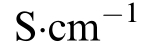 at
at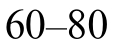 ° C and 98% relative humidity (RH),enabling rapid start-up and operation below 80 ° C [5].Nevertheless, its proton transport is strongly dependent on the presence of water. When the temperature falls below 0 °C or approaches/exceeds the boiling point of water, ice formation, thawing, or rapid water evaporation disrupts the hydrogen-bond network, increases ionic cluster spacing, and reduces channel connectivity.These effects substantially raise the activation barriers for proton hopping and diffusion,sharply increasing membrane resistance and causing significant performance degradation [6,7].Conductivity further decreases due to water loss or freeze–thaw-i nduced mechanical damage within the membrane [8].Moreover, the glass transition temperature of Nafion lies between 120–130 ° C, above which the membrane rapidly softens and eventually collapses [9,10].
At low temperatures, cathode flooding is common,necessitating complex water/thermal management strategies. In addition, Pt-based catalysts are highly sensitive to impurities. Moreover, Pt-based catalysts exhibit extreme sensitivity to fuel impurities. Even trace contaminants such as CO can markedly degrade fuel cell performance [11]. Beyond these issues, sluggish electrode kinetics at low temperatures further limit reaction rates.Collectively, these factors constrain system efficiency,durability, and dynamic response under practical operation. These challenges cannot be fully mitigated through balance-of-plant optimization alone, but instead reflect fundamental materials-level constraint.
Raising the operating temperature above 100 ° C offers multiple intrinsic advantages. First, the larger temperature gradient between the cell and the environment facilitates efficient water removal, allowing product water to remain predominantly in the vapor phase and thereby greatly simplifying water and thermal management. Second, catalyst tolerance to fuel impurities is substantially enhanced at elevated temperatures; for example, at 200 ° C, hydrogen streams containing up to 3% CO have been reported to cause no noticeable performance degradation [12,13].Therefore, increasing the operating temperature provides an effective pathway to alleviate the stringent requirements on hydrogen purity. Third, higher operating temperatures significantly accelerate electrochemical reaction kinetics,reducing activation losses and improving overall cell efficiency.
Owing to these combined benefits, increasing the operating temperature represents an effective strategy to overcome the fundamental limitations of LT-PEMFCs.Consequently, research efforts have increasingly shifted toward high-temperature fuel cell operation, and hightemperature PEMFCs (HT-PEMFCs) have emerged as a promising alternative capable of alleviating impurity sensitivity, simplifying water ma nagement,and enhancing electrochemical performance [14]. Phosphoric acid (PA),featuring nonvolatility, chemical stability, and strong proton dissociation capability, possesses excellent thermal stability and proton conductivity under high-temperature a nd anhydrous conditions[15]. Currently, PA-doped polymers,such as polybenzimidazole (PBI), represent the mainstream in HT-PEMFC technology and exhibit good output performance at 130–200 ° C without external humidification. However, HT-PEMFCs face a critical challenge during room-temperature start-up and lowtemperature operation. Due to the stronger affinity of PA molecules toward water than toward the polymer backbone (e.g., PBI), exposure to humidified gases and the generation/removal of water at the cathode alter the PA concentration inside and outside the membrane. This imbalance drives the diffusion and loss of free phosphoric acid from the membrane [16–18]. The rapid depletion of PA necessitates that the cell be preheated to above 120 °C before operation to avoid a sharp performance drop,thereby increa sing the start-up time and operational complexity.
In summary, both LT-PEMFCs, which rely on water as the proton carrier, and HT-PEMFCs, which suffer from phosphoric acid leaching, are restricted by their stringent operating environments and therefore cannot satisfy the urgent practical demand for wide-temperature-range operation. Rapid start-up at low temperatures is essential for reducing system response time, whereas stable operation at elevated temperatures enhances electrode reaction kinetics and thus increases power density and energy conversion efficiency. These considerations have stimulated growing interest in wide-temperature-range proton exchange membrane fuel cells (WT-PEMFCs). The central challenge lies in developing polymer electrolyte membranes capable of maintaining efficient and stable proton conduction across a broad temperature range. The fundamental obstacle arises from the pronounced temperature dependence of proton conductivity within the membrane. Whether caused by water evaporation in LT-PEMFCs or phosphoric acid loss in HT-PEMFCs, the consequence is the same:a sharp decline in proton conductivity within specific temperature regions, which ultimately narrows the operational window of the fuel cell. Therefore, the essence of designing wide-temperature-range PEMs is to construct a proton conduction mechanism that remains intrinsically stable and adaptive over a wide thermal range, without relying on single proton carriers that are pron e to volatilization or leaching. Based on these considerations, this review begins with an analysis of proton-transport mechanisms to elucidate the intrinsic limitations that prevent current PEMs from operating over wide temperature ranges. It then summarizes the challenges, design concepts, and recent progress associated with three major categories of membranes, including systems that rely on watermediated proton transport,systems that utilize nonvolatile doped proton carriers under anhydrous conditions, and emerging membrane architectures that support widetemperature-range proton conduction. This review is therefore not to advocate a single universal membrane,but rather to elucidate how materials design strategies can bridge or integrate these regimes, ultimately enabling continuous and reliable PEMFC operation across an extended temperature window. The review concludes with perspectives on future research directions.
1 Proton-conduction mechanisms in PEMs
Achieving wide-temperature-range operation in proton exchange membranes requires efficient and stable proton transport across a broad thermal range. Proton conduction in PEMFCs arises from the combined effects of the polymer matrix and the incorporated proton carriers,making it essential to understand the underlying transport mechanisms in different membrane systems. In general,proton transport in PEMs occurs through two primary pathways (Fig. 1): the vehicle mechanism and the Grotthuss mechanism [19–23].
Proton transport typically occurs through interactions with specific molecular environments, and the species that associate with protons are referred to as proton carriers or proton solvents. In the vehicle mechanism, protons bind to these carriers, and the diffusion of the proton–carrier complex generates a concentration gradient. This gradient induces the counter-diffusion of unprotonated carrier molecules, and the resulting net flux of protons constitutes the overall proton conductivity. Thus, the transport rate in this mechanism is governed by the diffusion rate of the carriers. In contrast, the Grotthuss mechanism involves proton migration through hydrogen-bond networks without requiring the physical motion of the carrier molecules themselves. Protons ‘‘hop” between neighboring sites along hydrogen bonds, and continuous conduction is sustained through the reorientation of the carrier molecules,which reconstructs the hydrogen-bond pathways. The effectiveness of this mechanism depends on both the reorientation dynamics of the carriers and the activation energy required for proton transfer between adjacent sites. In most PEMFC systems, proton transport arises from a combination of these two mechanisms. The dominant mechanism varies with membrane structure and must be elucidated through detailed structural analysis. Therefore,in this review, we examine the proton-conduction principles associated with the three categories of membranes discussed.
1.1 Water-mediated proton transport in PEMs
Water-mediated PEMs can be broadly categorized into three types: fully fluorinated, partially fluorinated, and nonfluorinated membranes [24,25]. Fully fluorinated PEMs such as perfluorosulfonic acid (PFSA), perfluoroimide acid (PFIA), and perfluorocarboxylic acid(PFCA) consist of a fluorocarbon backbone combined with vinyl ether side chains that carry sulfonic, imide, or carboxylic acid groups. These materials exhibit excellent thermal stability, chemical resistance, and mechanical strength. Among them, PFSA membranes represented by Nafion have become the most widely used commercial products because they offer high proton conductivity together with good mechanical flexibility. Partially fluorinated PEMs are produced using simplified fabrication processes and lower-cost raw materials, although they generally possess lower oxygen solubility and mechanical robustness compared with fully fluorinated membranes.Their reduced durability also increases the risk of degradation during operation in energy conversion and storage devices.Nonfluorinated PEMs are primarily based on sulfonated aromatic polymers,including sulfonated poly(arylene ether sulfone) (SPAES), sulfonated poly(ether ketone)(SPEK), and sulfonated poly(ether ether ketone)(SPEEK). These membranes do not contain fluorinated components and provide advantages such as lower cost and improved environmental compatibility. The aromatic backbone combined with hy drophilic proton-conducting side groups, typically sulfonic acid moieties, enables hydrocarbon-based PEMs to be actively explored as alternatives to fully fluorinated membranes.
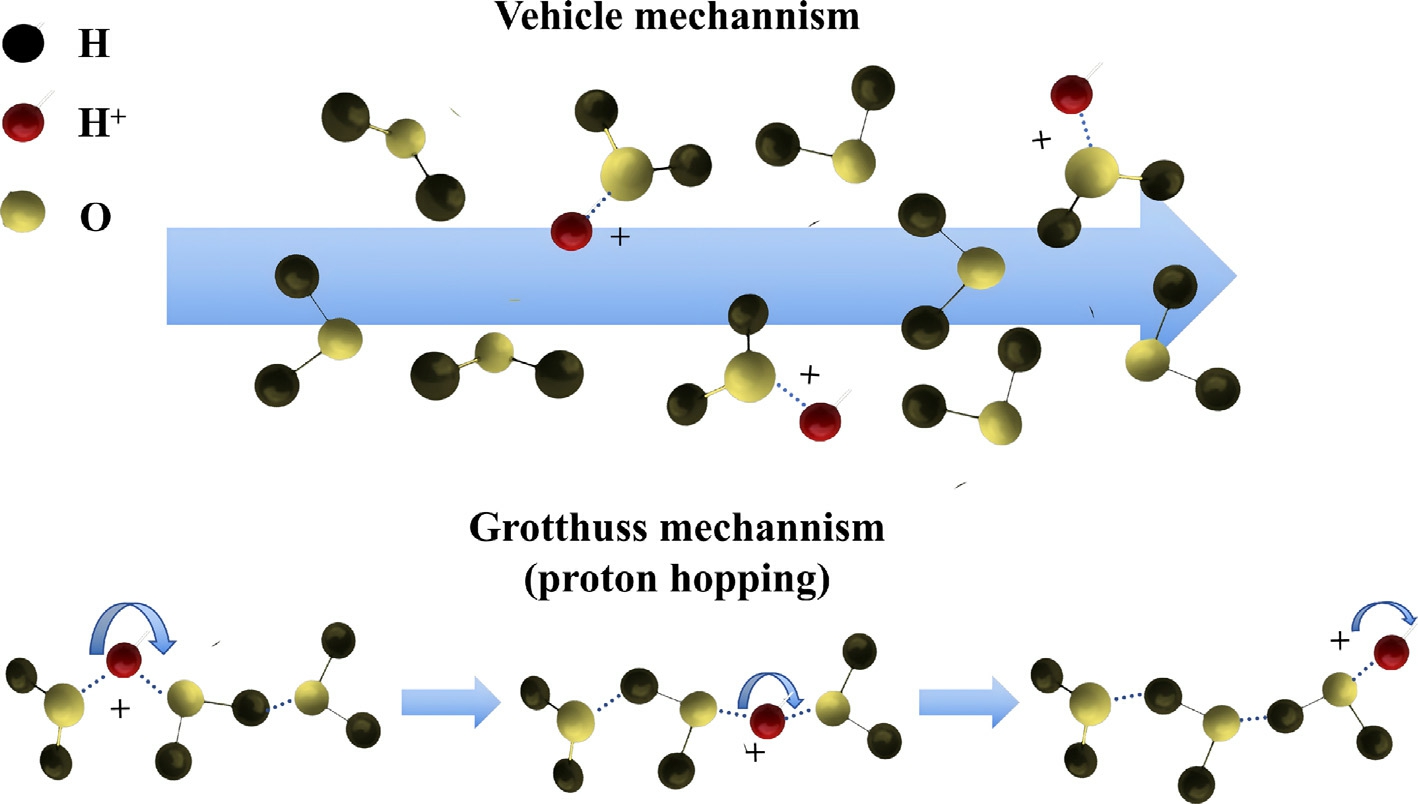
Fig. 1. Schematic illustration of proton transport via the vehicle mechanism and the Grotthuss mechanism. Hydrogen bonds and proton transfer events are shown schematically to indicate dynamic proton hopping and molecular reorientation, rather than static chemical bonding configurations.
In water-mediated PEMs, proton transport occurs through a combination of the vehicle mechanism and the Grotthuss mechanism. Under highly hydrated conditions,the Grotthuss mechani sm predominates, whereas under low hydration the system relies more strongly on the vehicle mechanism [26,27]. Hydrated proton species such as H3O+ and H5O2 + diffuse along concentration gradients,and their transport rate is closely related to their diffusion coefficients. Water molecules simultaneously form a hydrogen-bond network that enables proton hopping in the Grotthuss mechanism. In this process, protons migrate among stationary proton acceptors such as SO3H groups or water molecules through repeated breaking and reformation of hydrogen bonds. As a result, water content exerts a decisive influence on the membrane’s proton conductivity [28,29]. When the operating temperature approaches or exceeds the boiling point of water, extensive evaporation leads to dehydration of the membrane. The resulting decrease in hydrogen-bond density, the increased spacing between ionic clusters, and the narrowing or disruption of transport pathways greatly hinder both proton hopping and the diffusion of hydrated proton species,which in turn increases membrane resistance. Therefore,two general strategies are available for maintaining high proton conductivity under high-temperature and lowhumidity conditions: enhancing the water-retention ability of the membrane and reducing the dependence of proton transport on water.
1.2 Proton transport in water-independent PEMs
To address the rapid evaporation of water under hightemperature or low-humidity conditions, extensive efforts have been devoted to developing proton-conducting media with low volatility that can replace water and enable effi-cient proton transport at elevated temperatures. Anhydrous or doped-proton-carrier PEMs generally employ nonvolatile proton solvents or conductors such as ionic liquids, organic heterocycles, or inorganic acids in place of water to sustain proton conduction [30,31]. These proton carriers typically include imidazolium-based salts,tetrafluoroborate ionic liquids, heterocyclic molecules such as imidazole or pyrazole, and phosphoric acid. They provide suitable proton-transport pathways while offering superior thermal and chemical stability compared with water.
Ionic liquids, which are molten salts composed of organic cations and inorganic or organic anions and remain liquid near room temperature, have attracted considerable attention because of their negligible volatility,high thermal stability, and wide electrochemical windows.Their room-temperature ionic conductivity can reach appro ximately 10 3 S cm 1 and increases with temperature [32]. Incorporating ionic liquids into PEMs allows them to serve as high-temperature proton carriers above 100 ° C, reducing the dependence on water and improving tolerance to impurities such as CO. They also enhance the proton conductivity of hydrocarbon-based polymers such as SPEEK and PBI. In practice, ionic liquids are introduced into membranes through blending with polymers,forming polymerized ionic liqui ds,or combining with inorganic fillers [33]. Proton transport in these composite structures depends strongly on viscosity: at high viscosities, the Grotthuss mechanism predominates, whereas the vehicle mechanism is suppressed. Consequently, proton conductivity depends not only on the intrinsic conductivity of the ionic liquid but also on its compatibility with the polymer matrix and the stability of the composite structure. Long-term operation may lead to leakage of the ionic liquid from the membrane due to poor compatibility,which compromises conductivity, dimensional stability,and mechanical performance. To mitigate these issues,strategies such as chemical cross-linking, incorporation of porous fillers, or direct synthesis of polymeric ionic liquids have been employed. Continued advances in ionic liquid design and membrane architecture are expected to improve their potential for wide-temperature-range anhydrous PEM applications.
Heterocyclic compounds such as imidazole, pyrazole,and benzimidazole can also function as proton carriers and maintain effective proton transport in the temperature range of 150–200 ° C. Crystalline imidazole exhibits very low conductivity ( 10 8 S cm 1 ), whereas its molten form reaches approximately 10 3 S cm 1 at 90° C. The nitrogen atoms in heterocycles serve both as proton donors and acceptors, and these molecules can be grafted onto polymer backbones to form structures analogous to Nafion.Unlike Nafion, however, the proton carriers in grafted heterocyclic systems are covalently anchored to the polymer backbone, meaning that proton transport occurs exclusively through the Grotthuss mechanism. Proton mobility in such systems is strongly influenced by the strength of the covalent linkages,the mobility of the polymer backbone,and the concentration of heterocyclic units.Experimental evidence indicates that immobilized proton carriers can still exhibit high proton mobility through structural diffusion enabled by hydrogen-bond reorganization [34–36].
PBI is another important polymer in anhydrous protonconducting systems. PBI inherently contains proton donor and acceptor sites, and acid-doped PBI exhibits high proton conductivity. Upon doping, phosphoric acid not only supplies abundant proton carriers but also forms extended hydrogen-bond networks via its dissociated H2PO4 species, creating continuous pathways for proton migration.As doping levels increase, these anionic networks become more interconnected, enabling dominant Grotthuss-type proton hopping without the need for water. The proton conductivity of such anhydrous systems is governed by the density of proton carriers and the free volume available for polymer-chain rearrangement,which modulates carrier reorientation and proton hopping rates. These developments have enabled PEMs to operate stably above 100 °C while significantly reducing dependence on water [37].
The development of acid–base polymer systems has been one of the most effective strategies for creating high-performance anhydrous PEMs. Early studies examined basic polymers such as poly(vinyl acetat e) (PVA),polyacrylamide (PAAM), and polyethyleneimine (PEI),which form proton-conducting structures upon doping with various acids [38]. Although high acid content improves conductivity, it often compromises mechanical stability, particularly above 70–80° C. To address this limitation, cross-linked polymers (e.g., PEI), thermally stable polymers such as polyoxadiazole (POD), and composite materials incorporating inorganic fillers or plasticizers have been explored. Since the first demonstration of PBI membranes as proton-conducting electrolytes, PBI has been extensively studied due to its remarkable thermal,chemical,and mechanical robustness[39,40]. Its high glass transition temperature (425–436 ° C), low flammability,resistance to radiation, and relatively low cost further strengthen its advantages. Researchers have investigated various mineral acids as dopants, includi ng H2SO4,H3PO4, HClO4, HCl, and HNO3. According to Xing et al.[38], proton conductivity follows the order H2SO4 >-H3PO4 > HCl > HNO3. Although sulfuric acid yields the highest conductivity, it requires humid conditions at 150 ° C and exhibits poor chemical stability at elevated temperatures, limiting its applicability. By contrast, phosphoric acid has emerged as a preferred dopant for hightemperature PEMFCs due to its favorable conductivity,excellent thermal stability, and very low vapor pressure[41]. In phosphoric acid-doped membranes, proton conduction occurs primarily through anhydrous Grotthusstype hopping along hydrogen-bond networks formed by phosphoric acid molecules and their conjugate anions.These membranes achieve excellent high-temperature conductivity in the range of 130–180 ° C, but their performance deteriorates rapidly at lower temperatures due to accelerated acid loss, making the retention of free phosphoric acid a major challenge.
Therefore, similar to the strategies used to extend the high-temperature applicability of water-mediated PEMs,the performance of anhydrous or doped-proton-carrier PEMs in low-temperature or high-humidity environments can be improved by enhancing the retention of nonvolatile proton carriers and reducing the dependence of proton transport on these carriers.
2 Water-mediated PEMs
To extend the operational temperature window of water-mediated PEMs and maintain efficient proton conduction under wide-temperature conditions, the central challenge lies in overcoming the transport failure caused by water evaporation at high temperatures and low humidity. Research efforts addressing this issue generally follow two core approaches. The first involves enhancing the membrane’s ability to retain water, the primary mobile proton carrier, through strategies such as material compositing, microstructural regulation, and surface or interfacial engineering. The second approach focuses on reducing the dependence of proton transport on water content by introducing or constructing new protonconducting sites and networks that enable stable conduction even when hydration levels are low.
2.1 Composite membranes with hydrophilic fillers
Researchers have introduced inorganic fillers such as SiO2, TiO2, ZrO2, P2O5, and Fe3O4 into electrolyte membranes using conventional casting and solventevaporation methods [42–47]. These fillers enhance the water-retention capability of the membrane at elevated temperatures, thereby improving proton conductivity under high-temperature conditions. However, the overall enhancement remains limited because the incorporation of ino rganic fillers can disrupt continuous protontransport pathways and lead to agglomeration within the polymer matrix. To address these challenges, Nam et al.[48] developed uniformly patterned mesoporous TiO2 micropillars (PTMPs) and embedded them into the anodic surface of Nafion membranes through a micropatterning template and ionomer spray-coating technique, as shown in Fig. 2a. This strategy precisely positioned the TiO2 micropillars on the membrane surface, preserving proton-transport pathways while eliminating the agglomeration typically associated with hygroscopic fillers. As a result, the modified membrane achieved a power density more than 35.2% higher than that of commercial Nafion 211 at 120 ° C and 35% RH, while the ohmic resistance decreased by 24.5%.The hygroscopic mesoporous PTMPs embedded within the membrane attracted water molecules at temperatures above 100 ° C, helping mitigate the dehydration-induced decline in proton conductivity.Nicotera et al.[49] further developed a Nafion/MWCNTs-TiO2 composite membrane by integrating TiO2 nanoparticles directly grown on the surfa ce of multiwalled carbon nanotubes(MWCNTs),as illustrated in Fig. 2b. This synthesis approach enabled nanoscale dispersion of TiO2 within the polymer matrix, improving water retention. The elongated carbon nanotubes also offered additional pathways for proton transport. The assembled H2/air single cell with an active area of 5 cm2 delivered a power density of 307.7 mW cm 2 at 120 ° C and 30% RH. Building on this work, the same research group [50] introduced sulfonated clay–carbon nanotube (SCC) hybrid fillers into Nafion membranes, as shown in Fig. 2c. The resulting composite membranes exhibited increased ion-exchange capacity(IEC) and enhanced hydrolytic stability, both of which are essential for proton transport and membr ane durability. Improved water retention and sustained proton diffusion were particularly evident at elevated temperatures.The optimized nanocomposite membrane at 3 wt% of loading (Nafion-sCC-L3) achieved a proton conductivity of 42.3 mS cm 1 at 120 ° C and 20% RH, demonstrating significant potential for enhancing the performance and durability of Nafion-based PEMs.
Clay-based fillers have emerged as popular additives for improving proton conductivity, while simultaneously enhancing mechanical stren gth and dimensional stability under fuel cell operating conditions [51]. Mabrouk e t al.[52] incorporated functionalized sepiolite clay (Sep) into sulfonated poly(arylene ether sulfone) sulfonamide (SPESOS) to form composite membranes. The unique properties of Sep and its interactions with the sulfonated polymer matrix resulted in increased hydrophilicity and higher IEC. The silanol (Si-OH) groups in Sep formed hydrogen bonds with water molecules, significantly enhancing water uptake. As the Sep content increased,the contact angle decreased, indi cating improved wettability and hydrophilicity. The dispersed nanofillers created microchannels within the polymer matrix, improving the accessibility and mobility of sulfonic acid groups. Consequently, proton conductivity increased markedly, especially under high-humidity conditions. In another study[53], hybrid clays formed by functionalized layered double hydroxides (LDHs) and sepiolite were incorporated into low-sulfonation poly(arylene ether sulfone octyl sulfonamide) (LSPSO) membranes using eithe r solution casting or in situ polymerization, The hydrophobic angle of its membrane is shown in Fig. 2d This approach enabled precise positioning and dispersion of hydrophilic nanoclays within the polymer matrix, establishing continuous proton-transport pathways while minimizing filler agglomeration. As a result, the proton conductivity of the LDHs/Sep-LSPSO composite membrane at 100° C increased severalfold compared with the pure LSPSO membrane (approximately 250 mS cm 1 versus 35 mS cm 1). The embedded LDHs and Sep effectively attracted and retained water molecules at elevated temperatures,mitigating dehydration caused by the low sulfonation level and significantly reducing the decline in proton conductivity.
In summary, while the incorporation of hydrophilic fillers effectively enhances water retention and thermal stability, a critical trade-off exists regarding filler loading.Excessive addition of inorganic particles often leads to agglom eration and phase separation, which can disrupt continuous proton-transport pathways and compromise the mechanical flexibility of the composite membrane.
2.2 Constructing confined hydrophilic domains for water retention
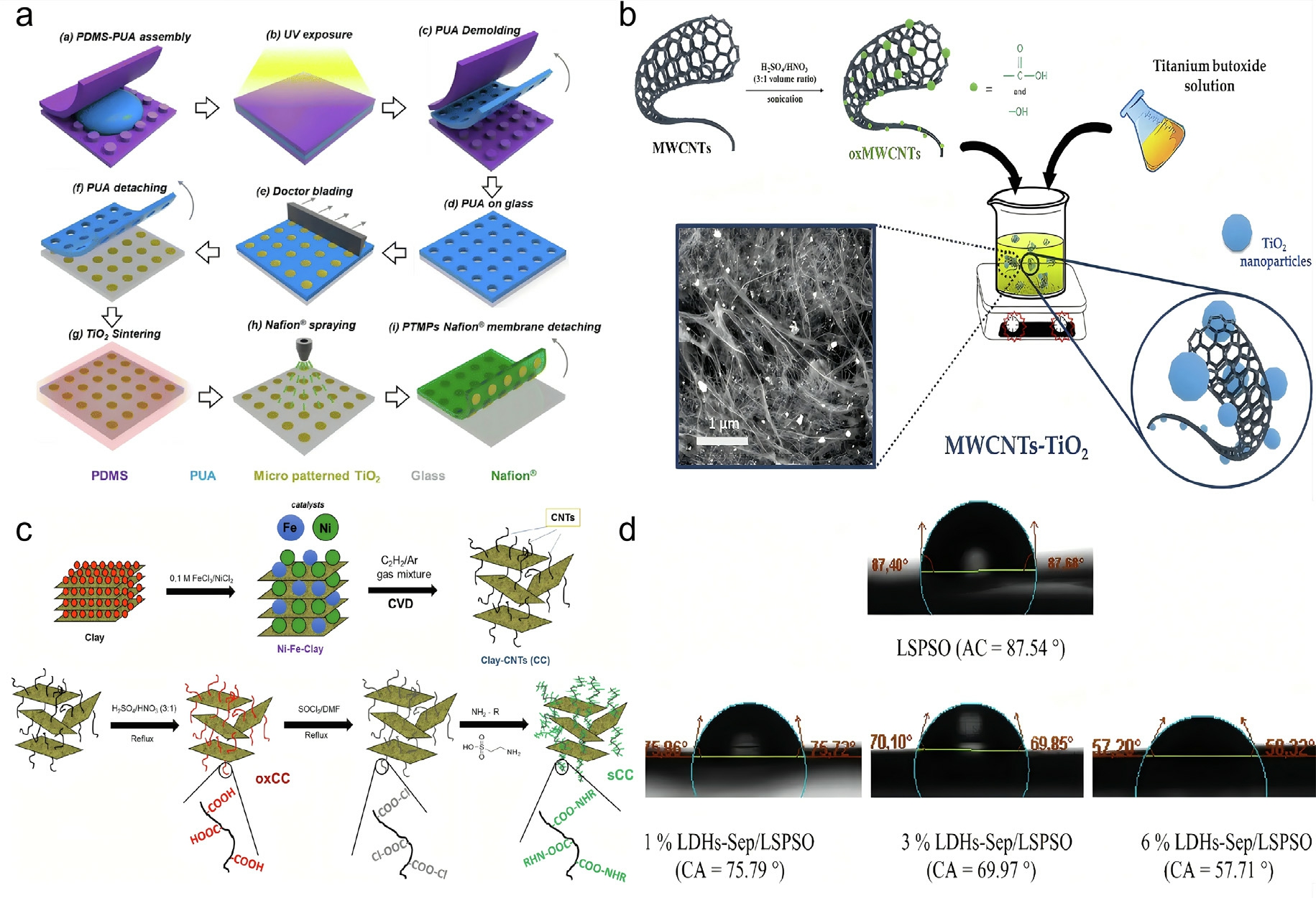
Fig. 2. (a) Schematic diagram of the PTMP fabrication process embedded in a Nafion membrane Reprinted (Adapted) with permission. [48] Copyright 2021, Elsevier; (b) Schematic diagram of the synthesis of carbon nanotube/TiO2 nanocomposite materials. Reprinted (Adapted) with permission. [49]Copyright 2021, SpringerOpen; (c) Schematic diagram of the synthesis process of sulfonated clay carbon nanotubes (SCC)used as a nanofiller in a Nafion matrix.Reprinted(Adapted)with permission.[50] Copyright 2025, SpringerOpen; (d) Contact angle of the composit e membrane Reprinted(Adapted)with permission. [53] Copyright 2024, SpringerOpen.
The polymer architecture of proton exchange membranes strongly influences the morphology of hydrophilic nanochannels, which in turn governs proton transport under high-temperature and low-humidity conditions[54,55]. Strategies such as block copolymer design, comblike side chains, and densely packed ionic clusters can induce thermodynamically driven microphase separation between hydrophilic and hydrophobic domains, enabling precise control over the dimensions of hydrophilic nanochannels [56,57]. Narrow hydrophilic domains (less than 5 nm) support capillary condensation of water and effectively confine water molec ules within the nanochannels, even at elevated temperatures and low humidity.
Park et al. [58] developed a series of polystyrenesulfonate-block-polymethylbutylene (PSS-b-PMB) block copolymer membranes with hydrophilic channel sizes ranging from 2 to 40 nm. When the hydrophilic domain size was below 5 nm, the membranes were able to retain hydration and sustain high proton conductivity under high-temperature/low-humidity conditions, achieving 0.035 S cm 1 at 90 ° C and 50% RH. Similarly, Lee et al. [59] synthesized proton exchange membranes based on sulfonated poly(arylene ether sulfone) (SPAES) with varying ion-cluster sizes by employing multiblock architectures and grafted side chains. The grafted side chain polymer (G-SPAES) membrane e xhibited smaller hydrophilic domains(less than 5 nm)and significantly enhanced water retention,maintaining a water content of 8.89%even after 2 h at 120 ° C and 35% RH, as shown in Fig. 3a. PFSA membranes exist in several structural variants, including Nafion, Flemion, Aiplex, 3 M membranes, and shortside-chain types(Fig. 3b). Molecular dynamics simulations indicate that long-side-chain PFSAs tend to form large and heterogeneous water clusters, whereas short-sidechain PFSAs form more continuous and tortuous lamellar water domains, which help sustain proton conduction under high-temperature/low-humidity conditions. Experimental results corroborate these findings: short-sidechain membranes such as AquivionTM possess higher ionic group densities and smaller ionic-cluster sizes, resulting in higher hydration levels and lower resistivity across a wide range of humidity conditions [55,60].
Guan et a l.[61] incorporated two-dimensional Ti3C2Tx(MXene) nanosheets into a short-side-chain PFSA matrix to fabricate SSC/Ti3C2Tx composite membranes. With a filler content of 1.5 wt%, proton conductivity increased by 15%, attributed to hydrophilic functional groups (–OH/-F) on the MXene surface that improved the proton transport environment. More importantly, hydrogen permeation decreased by 45%, owing to the tortuous diffusion pathways created by the impermeable MXene layers.Small-angle X-ray scattering (SAXS) analysis further revealed a reduced spacing between hydrophilic ionic clusters, suppressing hydrogen crossover. The composite membrane also showed enhanced thermomechanical stability,with the glass transition temperature increasing from 123 ° C to 136 ° C, and improved tensile strength at 120 °C and 140 ° C, indicating suitability for operation under temperatures above 100 ° C.
To mitigate dehydration-induced performance loss in water-mediated PEMs under high-temperature and lowhumidity conditions, Park et al. [62] proposed a universal dynamic hydrophobic coating strategy. Without altering the bulk properties of sulfonated polymer membranes(such as SPAES), a fluorocarbon hydrophobic coating was applied to the membrane surface to enable intelligent dynamic regulation of internal water content. The underlying mechanism involves nanoscale crack formation in the coating at high humidity due to membrane swelling, which facilitates water uptake and thus enhances proton conductivity. Under low humidity, membrane shrinkage closes the cracks, effectively retaining water within the membrane. The modified membranes enabled hydrogen-air fuel cells to deliver peak power densities of 308–734 mW cm 2 at 120 ° C and 35% RH, representing an improvement of more than three- to fourfold compared with unmodified membranes,and operated stably for over 220 h.This work demonstrates the efficacy and broad applicability of dynamic surface coatings for expanding the operating temperature window of sulfonated PEMs.
Although constructing confined hydrophilic domains successfully utilizes capillary condensation to retain water at elevated temperatures, regulating the nanomorphology presents significant challenges. Specifically, creating highly interconnected nanochannels often comes at the cost of excessive membrane swelling or reduced mechanical strength under hydration–dehydration cycles.
2.3 Engineering proton-conducting sites
Beyond maintaining sufficient water within hydrophilic channels, regulating the conformation and distribution of proton-conducting groups in the membrane can significantly reduce the dependence of proton transport on water and enhance proton mobility under low-humidity conditions. This surface-type conduction mechanism enables efficient proton transport under high-temperature and low-humidity environments. Ogawa et al. [63] demonstrated that when a membrane contains a high density of acidic sites, dissociated protons can be rapidly transferred through acid–acid interactions without relying on the movement of water molecules. A composite membrane composed of zirconium phosphonates (ZrSPP) and sulfonated poly(arylene ether sulfone) (SPES) exhibited markedly lower activation energies for proton conduction compared with SPES alone across 60–90 ° C at different relative humidities.At 90° C and 40%RH,its proton conductivity reached 0.01 S cm 1, an order of magnitude higher than that of the SPES and ZrSPP membranes, as shown in Fig. 4a.
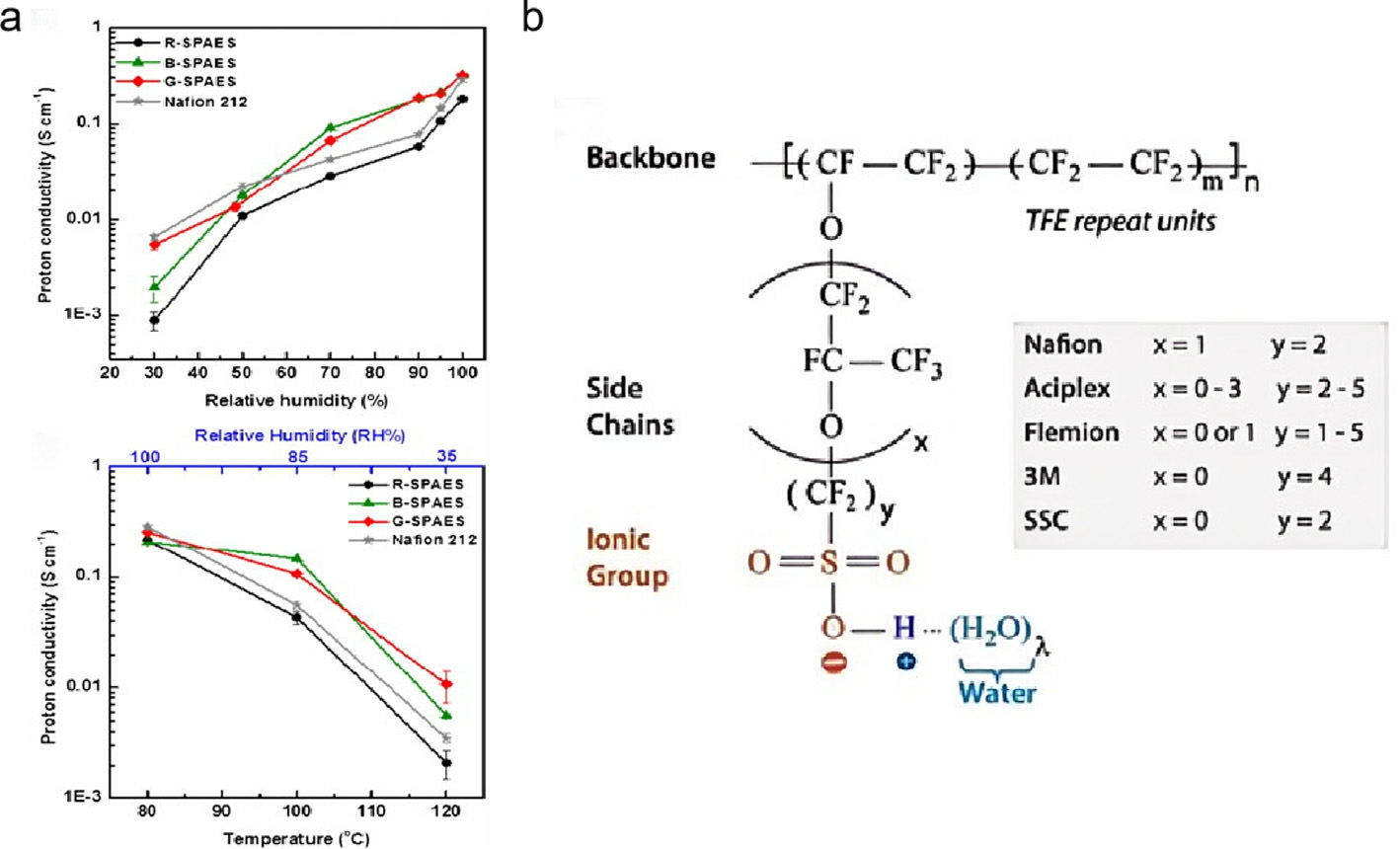
Fig. 3. (a) Relationship between proton conductivity and temperature and humidity for SPAESs and Nafion212 at 80 ° C Reprinted (Adapted) with permission. [59] Copyright 2013, Elsevier; (b) PFSA polymer structures with different side chain lengths Reprinted (Adapted) with permission. [92]Copyright 2017, American Chemical Society.
Functional groups such as nitrogen-containing heterocycles can also regulate proton-transport sites and enhance surface-type proton conduction. The nitrogen atoms in heterocycles such as imidazole or triazole act as proton acceptors, whereas their N–H moieties serve as proton donors. Proton transfer occurs through the form ation and cleavage of hydrogen-bond networks between heterocycles and sulfonic acid groups.Huang et al.[64] prepared an interpenetrating polymer network by combining a copolymer containing imidazole and hindered amine moieties, Polyallyl alcohol-vinylimidazole P(HA-co-VMZ),with a perfluorosulfonic acid(PFSA)matrix,as illustrated in Fig. 4b. In this system, continuous acid–base pairs formed between imidazole units and SO3H groups create proton-hopping pathways independent of water. The resulting composite membrane exhibited outstanding proton conductivity under low humidity, reaching 36 mS cm 1 at 50% RH and 12 mS cm 1 at 30% RH, significantly outperforming Nafion 211. Thermal Gravimetric Analyzer(TGA)and differential scanning calorimetry(DSC)analyses revealed that the strong hydrogen bonding between imidazole and sulfonic acid groups, together with the interpenetrating network structure, enhanced thermal stability and restricted segmental chain motion.These characteristics ensured both efficient proton transport and structural integrity under low humidity and fluctuating temperatures.
Xu et a l. [65] developed a Nafion composite membrane incorporating highly branched polyamide (HBM)nanoparticles as cluster-like fillers to construct a‘‘cluster-network” proton-conducting structure. Unlike conventional fillers, HBM exhibits a high ion-exchange capacity (>2 mmol g 1 ) and a unique three-dimensional architecture that enables more efficient intramolecular proton transport than linear polymers. Acting as mimic ion clusters (m-ICs), HBM can maintain the continuity of proton-transport pathways under high-temperature and low-humidity conditions. Although HBM does not enhance the water retention of Nafion, its larger size compared with original ion clusters (o-ICs) allows it to preserve pathway connectivity during dehydration, as shown in Fig. 4 c. The HBM–Nafion composite membrane prepared through a nondestructive swelling–filling technique showed superior performance: proton conductivity increased by 88% at 110 ° C and 60% RH, whereas the improvement at 30 ° C under fully humidified conditions was only 26%, highlighting the crucial role of m-ICs under dehydrated conditions. Carboxyl groups at the termini of HBM also formed hydrogen bonds with Nafion, enhancing membrane stability. Under optimized conditions(110 ° C and 20% RH), fuel cell performance increased by approximately 30%, demonstrating strong potential for wide-temperature-range applications.
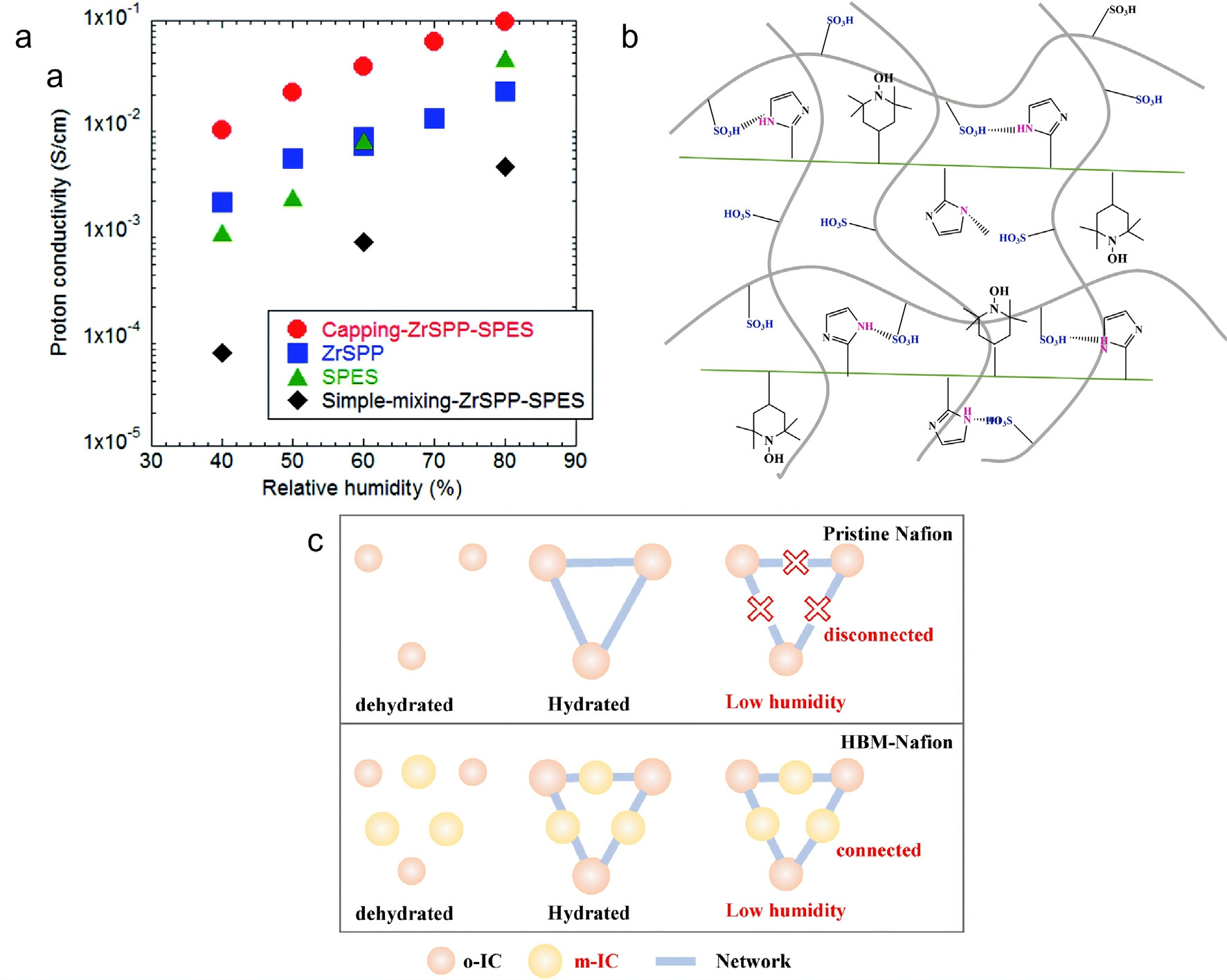
Fig. 4. (a) Proton conductivity of different materials at 90 ° C and various relative humidity levels Reprinted (Adapted) with permission. [63] Copyright 2014, Royal Society of Chemistry; (b) Interpenetrating polymer network structure of PFSA and P(HA-co-VMZ) copolymers Reprinted (Adapted) with permission.[64] Copyright 2023, Elsevier; (c) Proton conduction mechanisms of Nafion and HBM-N afion under different humidity conditions Reprinted(Adapted) with permission. [65] Copyright 2024, Elsevier.
Engineering specific proton-conducting sites reduces the reliance on bulk water by enabling surface-mediated hopping. However, the proton mobility via these surface sites is generally lower than that in bulk water,and achieving a high density of active sites without chemically destabilizing the polymer backbone remains a synthetic hurdle.
Overall, incorporating hydrophilic fillers, constructing confined domains, and applying hydrophobic surface coatings have proven effective in mitigating water loss and extending the operating temperature range of sulfonated PEMs. However, constrained by the boiling point of water and the relatively low glass-transition temperature of common sulfonated polymers, the maximum operating temperature of these water-mediated systems is generally limited to approximately 130 ° C. While operation at this temperature significantly alleviates water management issues, it remains insufficient to fully address the stringent requirements for impurity tolerance (e.g., CO poisoning)and rapid electrode kinetics demanded by heavy-duty transportation and stationary power generation. These inherent limitations motivate the necessity to move beyond water-mediated mechanisms and develop waterindependent PEMs capable of stable operation at substantially higher temperatures, as discussed in the following section.
3 Water-independent PEMs
Achieving efficient proton conduction in waterindependent proton exchange membranes over wide temperature ranges requires overcoming the limitations imposed by proton carriers under varying temperature and humidity conditions. A common challenge is the leaching of nonaqueous proton carriers at low temperatures and high humidity, which leads to the failure of proton transport. Research efforts aimed at addressing this issue generally follow two main approaches. The first involves enhancing the retention of nona queous proton carriers through strategies such as material compositing,construction of confined structural domains, and multilayer membrane designs. The second focuses on reducing the dependence of proton transport on a single carrier by constructing multi–proton-carrier systems, thereby maintaining stable conduction across diverse environmental conditions.
3.1 Enhancing interactions with proton carriers
For phosphoric-acid-doped proton exchange membranes, various inorganic materials such as TiO2, sepiolite,montmorillonite, zeolites, and palygorskite exhibit strong interactions with PA. Incorporating these materials into polymer matrices can significantly enhance PA retention.Lobato et al. [66] investigated the effect of TiO2 particles on the stability of PBI composite membranes. Compared with pristine PBI, the PBI-TiO2 membrane exhibited substantially improved durability during a 165-hour constantcurrent discharge test, with the rate of ohmic resistance increase reduced to 0.041 mΩ cm2 h 1 , nearly five times lower than that of pure PBI (0.191 mΩ cm2 h 1 ). This impr ovement was attributed to the enhanced PA retention provided by TiO2; even after hot-water immersion at 80 °C, the composite membrane preserved five PA molecules per repeating unit—five times that of pristine PBI. Building on this strategy, Wang et al. [67] introduced mesoporous TiO2 nanoparticles into PBI and further modified the structure through ionic-liquid-assisted silane coupling.The high-surface-area mesoporous TiO2 particles, together with the ionic liquid, enhanced PA storage and suppressed PA leaching. Combined with proton-transfer pathways facilitated by siloxane-bonded TiO2 structures (Fig. 5a),the resulting membrane exhibited a high proton conductivity of 0.092 S cm 1 at 140 ° C, saturated electron transfer,and exceptional PA retention. Under 140° C operation, the membrane demonstrated excellent long-term stability for more than 110 h and delivered a maximum power density of 668 mW cm 2. When the robust PBI backbone was coupled with hydrogen-bonded proton-transport channels,a high-temperature PEM capable of operating across a broad range of 80–200 ° C without external humidification was achieved.
In the presence of water, PA retention in PA-doped PEMs is strongly correlated with the interaction strength between PA molecules and the polymer backbone.Strengthening these interactions helps mitigate PA leaching at lower temperatures and higher humidity [68]. Lee et a l. [69] synthesized a series of quaternized poly(arylene imidazolium) polymers (PQx-4-IM) featuring different aromatic units (binaphthyl BN, terphenyl TP, and biphenyl BP) through superacid-catalyzed polycondensation followed by methylation. Among them, the PQBN-4-IM membrane containing bulky twisted BN groups exhibited pronounced microphase separation and a high fractional free volume (FFV), which facilitated continuous protontransport pathways and strengthened PA–polymer interactions. As a result, the membrane achieved a conductivity of 90.26 mS cm 1 at 180 ° C and delivered a peak power density of 802.5 mW cm 2 under the same condition.Strong ion-pair interactions and well-defined microphase separation also endowed PQBN-4-IM/PA membranes with excellent PA retention under 80° C/40% RH and 40°C/60%RH conditions(Fig. 5b). Zhu et al.[70] prepared a series of gel-state PBI membranes with flexible alkylsulfonic acid side chains via a PPA sol–gel process combined with in sit u ring opening of sultone. The resulting membranes formed self-assembled layered porous structures(Fig. 5c), where flexible alkylsulfonic acid chains generated additional acidophilic and hydrophilic sites. These sites facilitated high PA uptake and enabled multiple protonconduction pathways involving PA, alkylsulfonic acid groups, and imidazole moieties. The optimized membrane achieved high proton conductivities of 0.069, 0.162, and 0.358 S cm 1 at 25, 80, and 200 ° C, respectively, without external humidification. Fuel cell tests further demonstrated excellent wide-temperature-range performance:the symmetric MEA delivered 93 mW cm 2 at 25 ° C,which increased to 496 mW cm 2 at 220 ° C and further to 1165 mW cm 2 when asymmetric electrodes were employed. The gel-state sulfonated PBI membrane exhibited stable proton transport and operational flexibility across 25–240 ° C, offering a promising materials platform for next-generation wide-temperature-range PEM fuel cells.
Strengthening interactions between the polymer matrix and proton carriers significantly mitigates carrier leaching at low temperatures. Nevertheless, a balance must be struck; excessively strong binding interactions can immobilize protons, thereby increasing the activation energy for detachment and reducing the overall proton conductivity.
3.2 Constructing confined structural domains
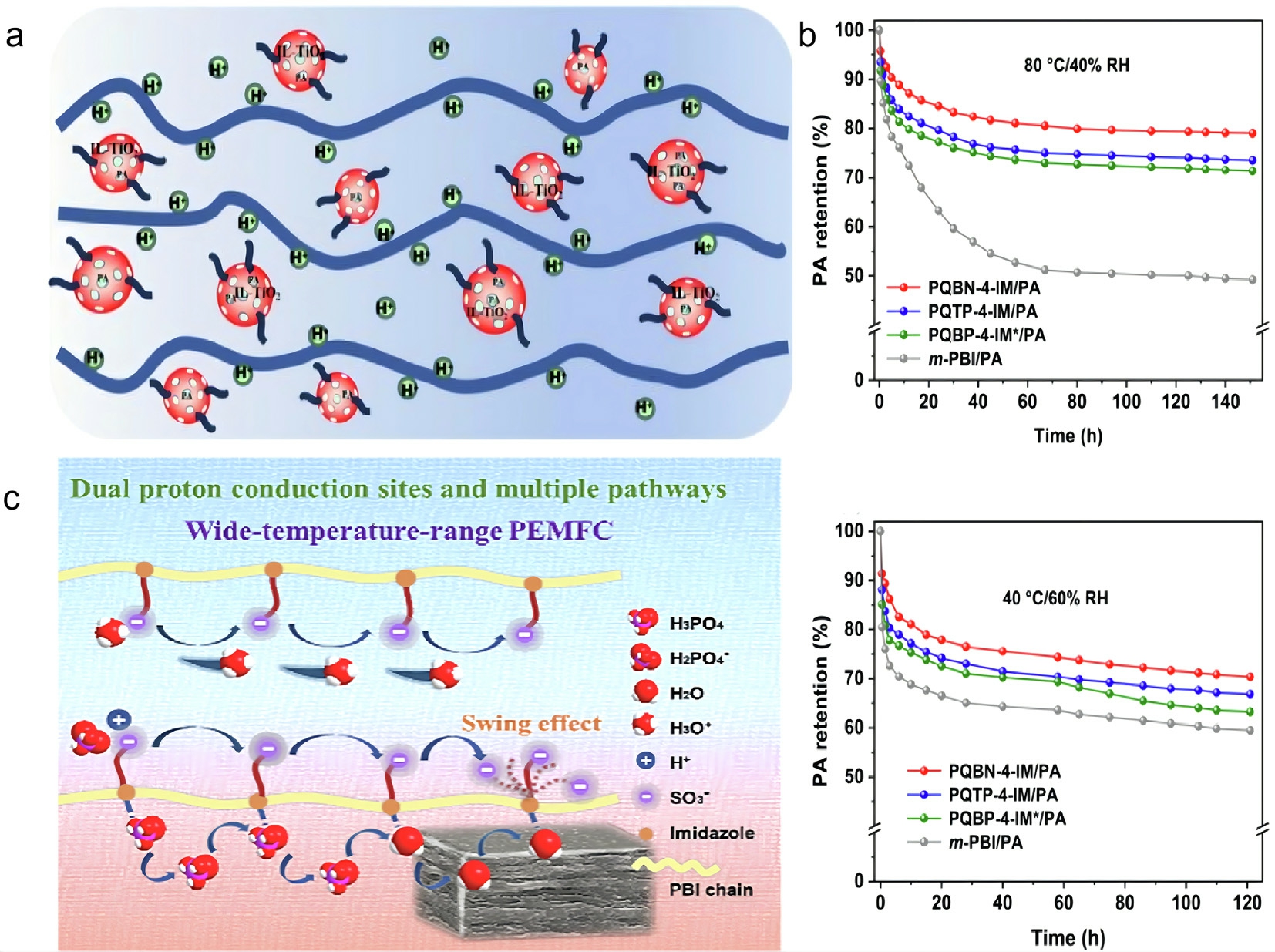
Fig. 5. (a) Schematic diagram of IL-TiO2NPs doped PBI structure Reprinted(Adapted)with permission.[67] Copyright 2025, Elsevier; (b) In situ stability of PA-doped PQx-4-IM and m-PBI membranes under different conditions (PA retention) Reprinted (Adapted) with permission. [69] Copyright 2024,Elsevier; (c) Schematic diagram of gel-state polybenzimidazole (PBI) proton exchange membrane structure Reprinted (Adapted) with permission. [70]Copyright 2023, Elsevier.
Regulating the microphase structure of polymer membranes offers an effective route to constructing confined domains capable of retaining nonaqueous proton carriers.Zhang et al. [71] proposed and validated a confinement strategy based on the design of acidophilic–hydrophobic microphase-separated structures. In these membranes,the ion-cluster regions serve as spatial domains that can‘‘store” PA, thereby substantially improving PA retention.By comparing imidazole-grafted poly(phenylene oxide)(PPO-g-Az-x) with different side-chain lengths and mainchain poly(benzimidazole ether) (OPBI), the authors revealed that side-chain architecture regulates the distribution of PA within the membrane and forms PA clusters away from the polymer backbone. The number and size of ionic clusters strongly influence PA retention. Precisely tuning the side-chain length enables the formation of welldefined acidophilic micr odomains that confine PA molecules away from the main chain. As illustrated in Fig. 6a, the side-chain-type PPO-g-Az-x polymers can be viewed as structural isomers of OPBI. Molecular simulations and experimental analyses jointly confirmed that this confinement structure reduces the plasticization effect of PA while markedly enhancing retention. At 80 ° C and 40% RH, the PA-doped PPO-g-Az-6 membrane achieved a PA-retention rate of 89.7%, far exceeding that of PA/OPBI (69.8%). The optimized PA/PPO-g-Az-6 membrane exhibited excellent and stable proton conduction across 80–180 ° C, reaching 0.062 S cm 1 at 160 ° C, outperforming conventional OPBI. The corresponding fuel cell achieved a peak power density of 576 mW cm 2 at 160 °C and maintained stable operation during thermal cycling between 80 and 160 ° C, with stable high-frequency resistance. During accelerated degradation tests at 80 ° C and 100% RH, the membrane’s operational lifetime exceeded that of PA/OPBI by more than seven times, effectively addressing PA loss and plasticization challenges in PAdoped PEMs and demonstrating strong potential for fast start-up and wide-temperature-range operation.
Wei et al. [72] developed PIBS-xP membranes by grafting and crosslinking 1,3-bis(4-piperidinyl)propane onto a polyisobutylene (PIBS) backbone, forming pronounced hydrophilic–hydrophobic micro phase separation. Transmission electron microscopy (TEM) revealed worm-like ionic-cluster structures (Fig. 6b), with dark regions corresponding to piperidine-rich domains that enhance PA adsorption and proton transport due to their basicity.Crosslinking suppressed excessive swelling and improved mechanical robustness, while the rigid spiro-fluorene segments provided significant free volume, facilitating stable nanoscale proton-transport pathways. The membranes exhibited outstanding proton conductivity across an exceptionally wide temperature window, from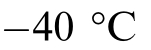 to 160 ° C, maintaining a conductivity of
 even at
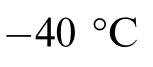 and 80% RH, demonstrating strong promise for wide-temperature-range PEM applications.
Confined-domain engineering can also be achieved by designing polymers wi th intrinsic microporosity. Tang et al.[73] developed a rigid intrinsic-microporous polymer membrane based on Tro¨ger’s base (TB) and a V-shaped bridged bicyclic diamine monomer. The membrane possessed an optimized ultramicroporous structure with a sub-nanometer pore radius of approximately 0.33 nm and a high fractional free volume. PA molecules were adsorbed through capillary condensation in these subnanometer pores, while acid–base interactions between PA and the TB units further enhanced retention and proton mobility. Even in highly humid environments, the membrane maintained substantial PA content. Under stringent conditions of 80 ° C/40% RH and 40 ° C/60%RH, PA-doped TB membranes demonstrated superior PA retention compared with conventional PA-doped m-PBI membranes. The PA-doped dimethylbiphenyl-TB(DMBP-TB) membrane retained 72.5% of PA after water-washing, and its proton conductivity reached 0.01 S cm 1 at ° C, more than three orders of magnitude higher than that of PA/PBI. The membrane maintained stable conduction from
 ° C to 200 ° C,underscoring its exceptional wide-temperature-range operational capability.
Confined structural domains serve as effective reservoirs for storing nonvolatile proton carriers. The primary limitation of this strategy lies in the trade-off between high carrier uptake and mechanical integ rity, as high local concentrations of dopants (e.g., phosphoric acid) can induce severe plasticization and creep deformation over long-term operation.
3.3 Multilayer membrane structure design
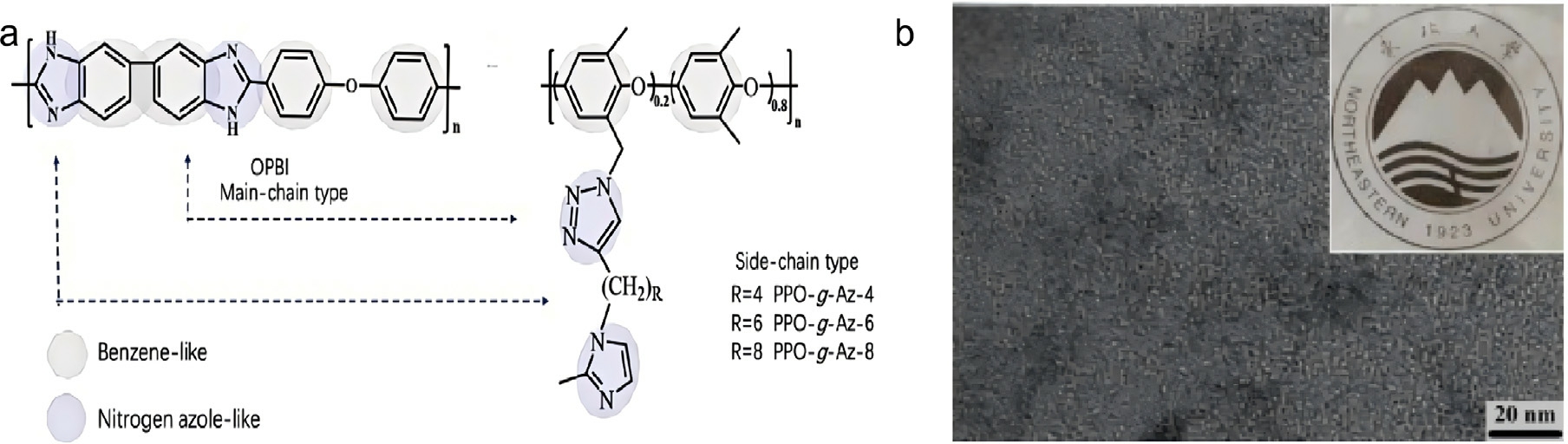
Fig. 6. (a) Molecular structure of main-chain type OPBI and schematic of side-chain type PPO-g-Az-x polymer molecules Reprinted (Adapted) with permission. [71] Copyright 2023, Wiley-VCH; (b) TEM images of PIBS-xP membranes Reprinted (Adapted) with permission. [72] Copyright 2023,Elsevier.
In addition to doping modification or tailoring the polymer molecular structure, constructing multilayer architectures or introducing dense interfacial layers between the membrane and the catalyst layer has proven to be an effective strategy for suppressing the outward migration and loss of PA in high-temperature proton exchange membranes. Zhao et al. [74] fabricated a multilayer composite membrane consisting of PVA, Kevlar nanofibers, and oxidized carbon nanotubes (OCNTs)using vacuum-assisted flocculation (VAF) and other advanced membrane-forming techniques, as shown in Fig. 7a. After PA doping, the membrane demonstrated stable and efficient proton conduction over a wide temperature window from  30° C to 160° C. At subzero temperatures, water exists as ice and PA molecules become the sole proton carriers. Upon heating, absorbed water molecules gradually participate in proton transport once the temperature rises above 0 ° C. The conductivity increased steadily up to 30 ° C and reached a balance between evaporation and condensation at approximately 50 ° C.A sharp decrease in conductivity was observed from 50° C to 70° C due to water evaporation; however, above 70 ° C, the σ value increased monotonically from 70 ° C to 160 ° C because accelerated PA mobility compensated for water loss and reduced proton-transport resistance (Fig. 7b).The membrane achieved proton conductivities of 2.80 10 2 S cm 1 at 30 ° C and 1.52 10 1 S cm 1 at 30 ° C. Even after ten thermal cycles between 30 ° C and 30 ° C, the membrane retained excellent structural integrity and stable conductivity, which even improved slightly. Remarkably,the membrane maintained a conductivity of 1.42 10 2 S cm 1 after 1900 h of continuous operation at 30 ° C, demonstrating outstanding lowtemperature durability and long-term operational potential.
Li et al. [75] developed an asymmetric PBI membrane comprising dense skin layers and a porous intermediate layer (Fig. 7c). Crosslinking between aminotrimethylene phosphonic acid (ATMP) and PBI generated a dense skin layer on the membrane surface, effectively preventing PA leakage and reducing gas crossover. ATMP also functions as an organic proton conductor and forms hydrogen bonds with PA, creating additional proton-transfer pathways. The crosslinked skin layer confined PA, while ATMP–PA interactions facilitated enhanced PA dissociation and accelerated proton transport. As a result, the p-OPBI-ATMP membran e exhibited a high proton conductivity of 0.112 S cm 1 at 160° C and achieved a peak power density of 0.98 W cm 2. Even with a relatively low PA doping level (156 wt%), the membrane maintained proton conductivity values of 0.033–0.13 S cm 1 across 80–220° C(Fig. 7d). Under anhydrous conditions, single cells based on p-OPBI-ATMP delivered peak power densities of 980 and 1170 mW cm 2 at 160 and 220° C, respectively, along with excellent durability. The voltage decay rate was only 5.46 μV h 1 during long-term stability testing. Notably,the operational temperature range of this porous membrane extended far beyond that of conventional PAdoped PBI systems.
More recently, Zhang et al. [76] constructed a dense SiO2 interfacial layer between the electrolyte membrane and the cathode catalyst layer (Fig. 7e) to effectively suppress PA migration toward the cathode. At elevated temperatures, SiO2 reacts chemically with PA to form a pyrophosphosilicate interlayer that not only exhibits proton-conducting capability but also acts as a barrier to PA diffusion. This mechanism is illustrated in Fig. 7c.Membrane electrode assemblies incorporating this SiO2 barrier demonstrated a 26.3% reduction in PA loss on the cathode side during high-current–density operation at 160° C (1500 mA cm 2 ). Even under challenging conditions at 30 ° C and 300 mA cm 2, the system remained stable for over 280 min, highlighting its excellent roomtemperature start-up and wide-temperature-range operational potential.
While multilayer and interfacial barrier designs provide a physical obstruction to carrier loss, they introduce structural complexity. The main challenge is the potential for interfacial resistance and the risk of layer delamination caused by mismatched thermal expansion coefficients during wide-temperature cycling.
3.4 Constructing multi-proton-conductor systems
Enhancing the dissociation and mobility of protons within nonaqueous proton exchange membranes can reduce dependence on high PA doping levels, thereby mitigating PA loss. Several emerging proton conductorsincluding heteropolyacids (such as phosphotungstic acid,phosphomolybdic acid, and silicotungstic acid), ionic liquids (ILs), and superprotonic solid acids exhibit protonconducting capabilities across wide temperature ranges.Although their intrinsic proton conductivities generally canno t rival that of PA over broad temperatures, these materials can form hydrogen-bonded networks with PA that not only help anchor PA molecules but also promote their dissociation. As a result, synergistic multi-conductor systems can create more efficient and robust protontransport pathways.
Zhang et a l. [77] prepared high-performance ABPBI/IL-SNR composite membranes by impregnating acidactivated sepiolite (SEP) with imidazolium-based ionic liquids followed by in situ polymerization to incorporate ionosilica networks into the ABPBI matrix. This hybrid design enhanced proton conductivity across a wide temperature range while significantly reducing the required PA doping level due to the presence of immobilized proton carr iers. The membrane exhibited dual proton-transport pathways (Fig. 8 a). Under hydrated conditions, proton conduction proceeded through a vehicle mechanism involving hydrated species such as H3O+ and H5O2+.Under anhydrous conditions, the Grotthuss mechanism dominated through ionic networks and H2PO4 species.Notably, the ABPBI/IL-SNR composite membrane containing only 5 wt% ionic liquid achieved impressive single-cell performance, delivering peak power densities of 0.15 W cm 2 at 80 ° C and 0.28 W cm 2 at 180 ° C,demonstrating its strong potential for wide-temperature PEMFC applications and reduced reliance on mobile PA molecules.
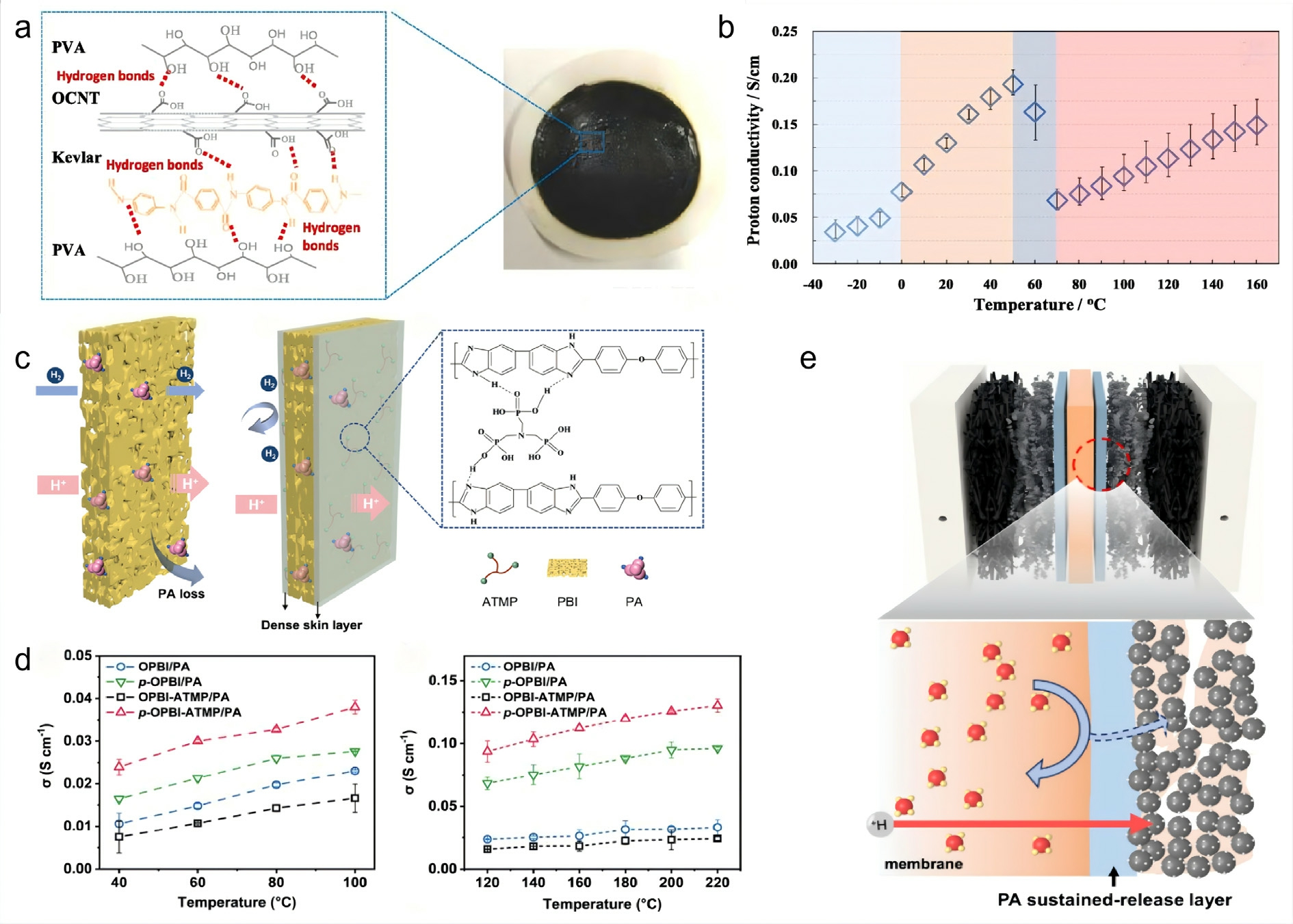
Fig. 7. (a) Schematic diagram of the (PVA/Kevlar/OCNTs) composite membrane structure Reprinted (Adapted) with permission. [74] Copyright 2022,Elsevier; (b) Proton conductivity of the (PVA/Kevlar/OCNTs) 3/85% PA membrane during heating from 30 ° C to 160 ° C Reprinted (Adapted) with permission. [74] Copyright 2022, Elsevier; (c) Schematic diagram of the p-OPBI-ATMP membrane structure Reprinted (Adapted) with permission. [75]Copyright 2023, Wiley-VCH; (d) Proton conductivity of the p-OPBI-ATMP membrane Reprinted(Adapted)with permission.[75] Copyright 2023, Wiley-VCH; (e) Schematic diagram of the SiO2 barrier layer structure design Reprinted (Adapted) with permission. [76] Copyright 2025, Elsevier.
Xiao et al. [78] developed a P-CNT/SOPBI composite membrane capable of operating across a broad temperature range by simultaneously constructing and regulating low- and high-temperature proton-transport pathways.Sulfonated OPBI (SOPBI), synthesized via block copolymerization to incorporate sulfonic acid groups, enhanced proton transport below 100 ° C through the PA-SOPBI netwo rk. Phosphoric-acid-functionalized carbon nanotubes (P-CNTs) served as nanofillers that improved mechanical strength and proton conductivity while suppressing CNT aggregation. By tuning the mono- and diphosphate functionalities on CNT surfaces and adjusting PA content within the membrane, proton transport channels were optimized for wide-temperature operation.Diphosphate-functionalized CNTs (2P-CNTs) significantly facilitated H3 O+ formation and transport under low-temperature/high-humidity conditions, and strengthened hydrogen bonding with PA to accelerate Grotthusstype transfer at high temperatures and low humidity. As a result, the 2P-C NT (6%)/SOPBI composite membrane achieved outstanding proton conductivities(131.8 mS cm 1 at 80° C and 90%RH,and 170.5 mS cm 1 at 180 ° C under anhydrous conditions), outperforming SOPBI and other composite membranes (Fig. 8b). Corresponding MEAs exhibited peak power densities of 378 mW cm 2 at 80 ° C/100% RH and 531 mW cm 2 at 160 ° C/0% RH, demonstrating the strong potential of engineered P-CNT/SOPBI membranes for widetemperature-range PEMFCs.
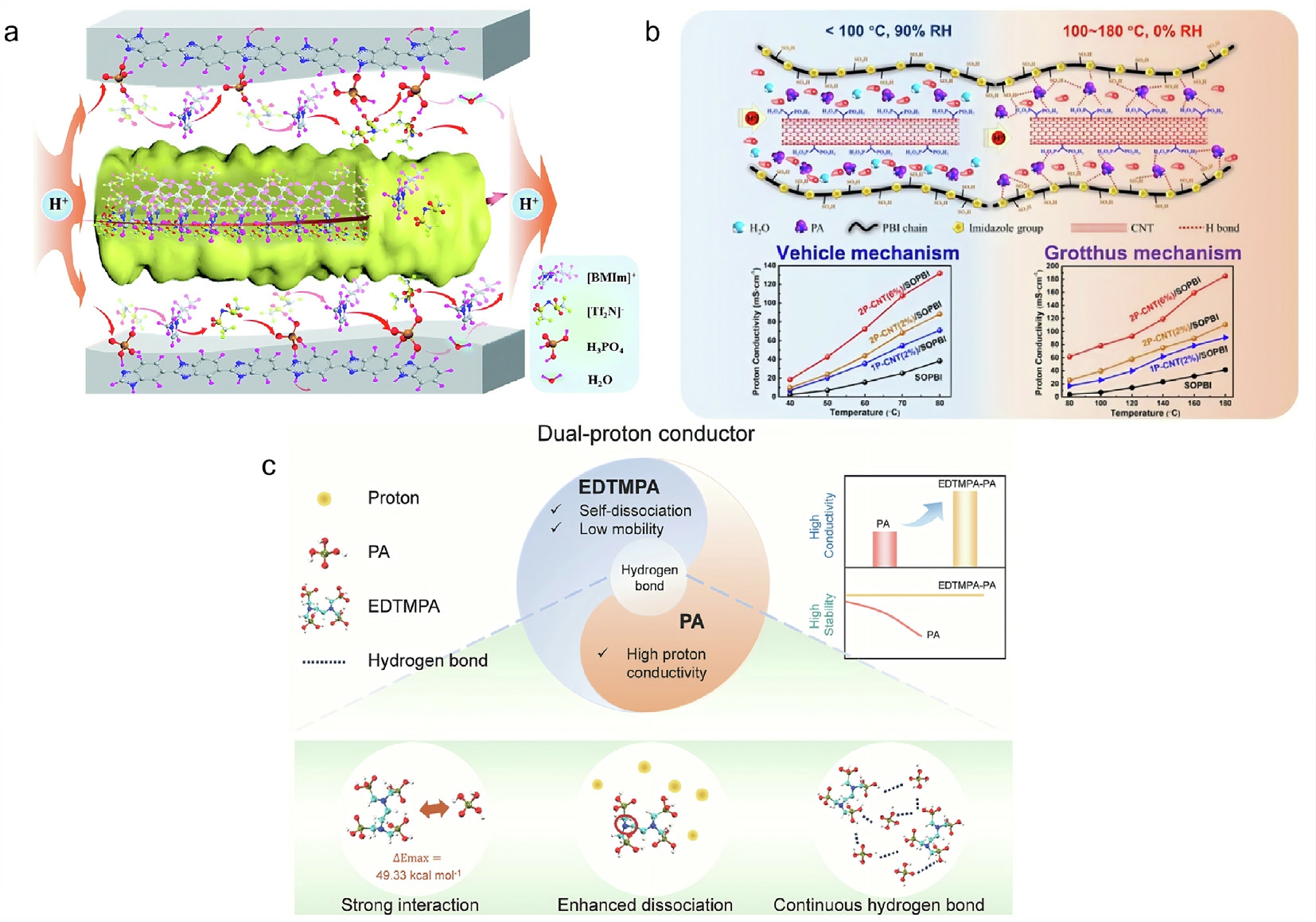
Fig. 8. (a) Schematic diagram of the conduction path of the ABPBI/IL-SNRs composite membrane Reprinted(Adapted)with permission.[77] Copyright 2019, Royal Society of Chemistry; (b) Conduction mechanisms of the P-CNT/SOPBI composite membrane in different temperature regions Reprinted(Adapted) with permission. [78] Copyright 2024, Elsevier; (c) Synergistic effect of dual proton conductors Reprinted (Adapted) with permission. [79]Copyright 2024, Wiley-VCH.
Lu et a l.[79] further demonstrated the benefits of dualproton-conductor systems by combining PA with ethylenediaminetetramethylenephosphonic acid(EDTMPA). Experimental studies combined with multiscale simulations revealed that PA and EDTMPA interact synergistically to enhance proton mobility (Fig. 8c). The dual-conductor membrane achieved a proton conductivity of 0.082 S cm 1 at 180° C, significantly higher than that of the PP/PA membrane containing only PA (0.036 S cm 1 ),representing an enhancement of approximately 1.28-fold.Solid-state NMR confirmed markedly improved proton mobility and diffusion. The composite membrane exhibited superior conductivity stability at 80 ° C/40% RH and at 160° C under anhydrous conditions. A single cell assembled with this membrane demonstrated exceptional durability,withavoltagedecayrateunder 160 ° C and 1.5 Acm 2operationthat was only one-thousandth of the decay rate observed in cells using PA alone. During long-term cycling at 80 ° C, the dual-conductor system retained approximately 80%of its peak power density after 250 cycles,far outperforming the PP/PA membrane(53%),confirming its outstanding operational stability and longevity.
Multi-proton-conductor systems reduce the dependence on high doping levels of a single acid by introducing synergistic carriers. However, ensuring the chemical compatibility of different conductors and maintaining the longterm stability of organic additives within the harsh acidic and oxidative environment of the fuel cell remain critical issues.
3.5 Proton transport via fixed carriers
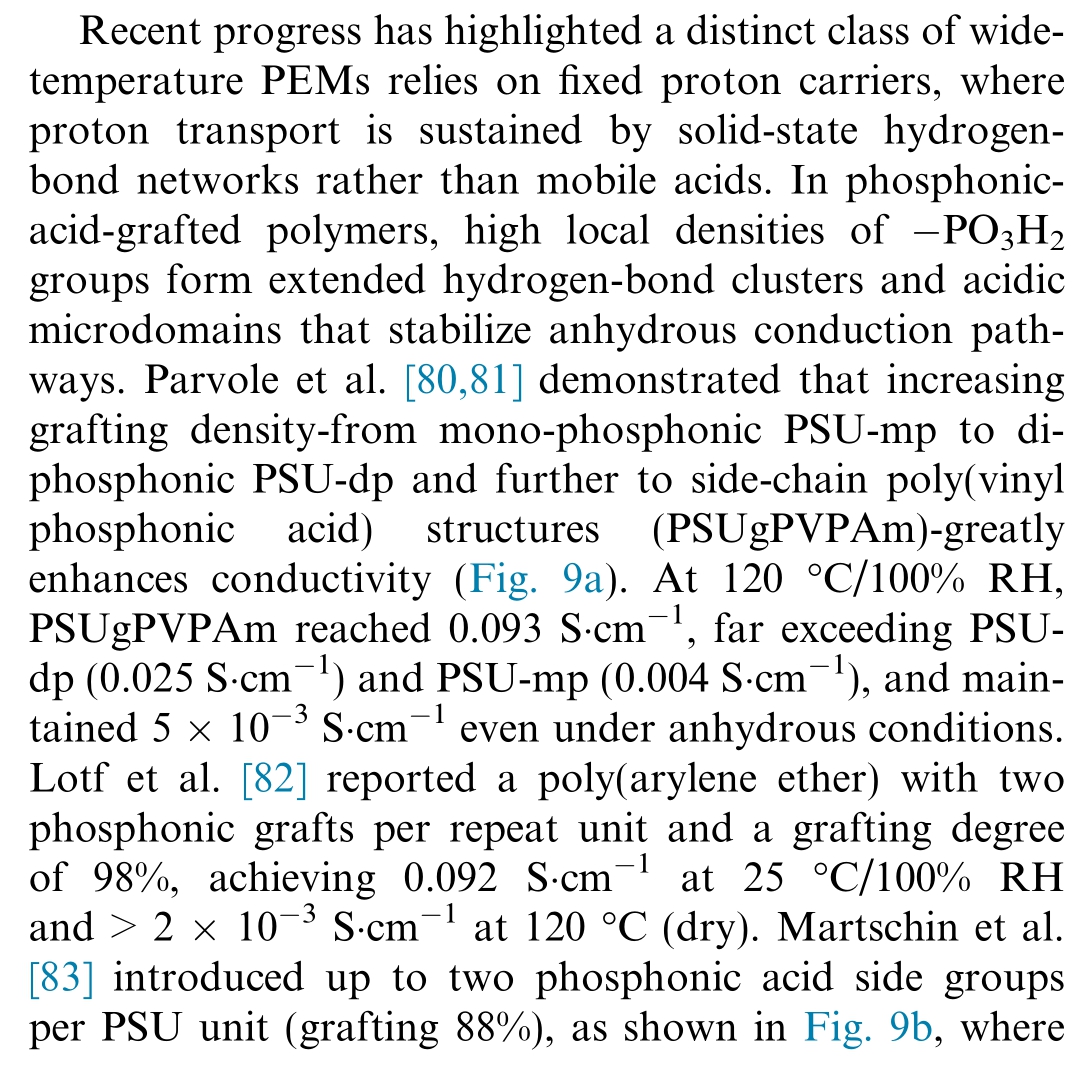
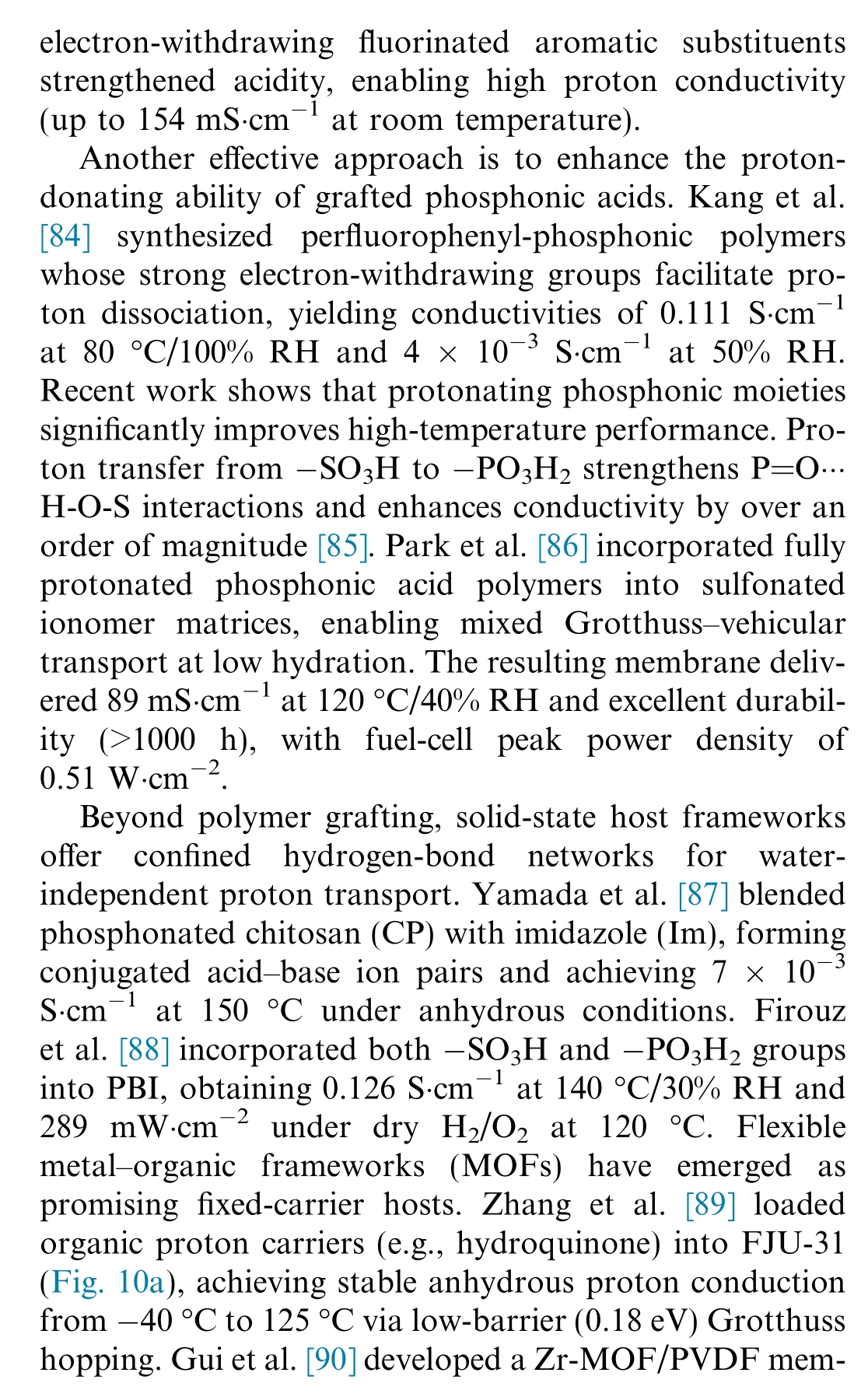
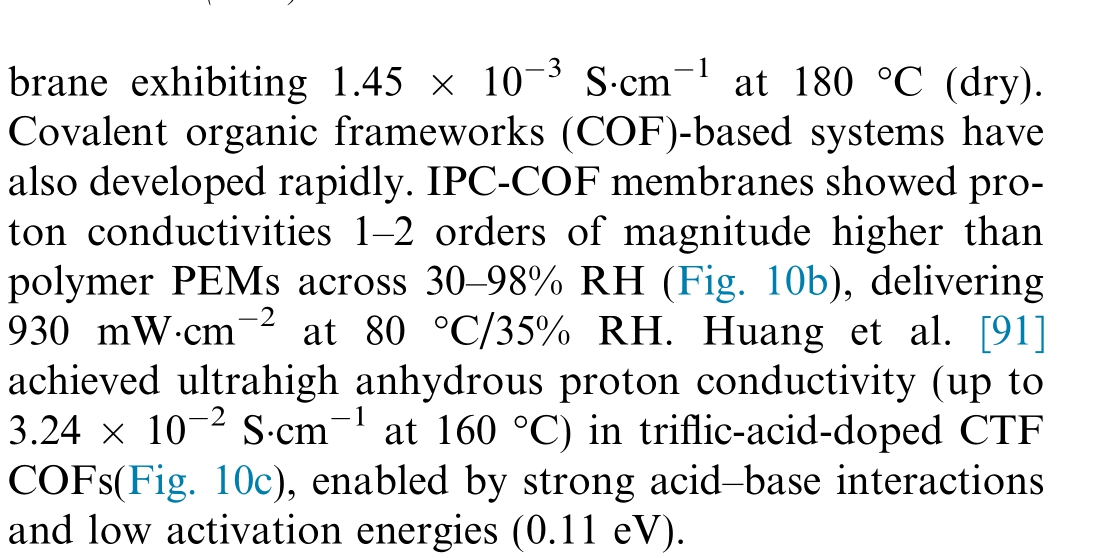
Despite their intrinsic stability, fixed-carrier PEMs still face challenges including relatively lower proton conductivity at intermediate temperatures, limited segmental mobility of hydrogen-bond networks, and mechanical brittleness arising from rigid frameworks. Future efforts should focus on balancing carrier immobilization with local structural flexibility, as well as improving processability and membrane-electrode integration. Addressing these issues is essential for translating fixed-carrier concepts into practical wide-temperature-range PEMFC systems.
Overall, water-independent proton exchange membranes enable wide-temperature-range operation primarily by enhancing proton-carrier retention and constructing stable anhydrous proton-transport pathways. Strategies such as strengthening polymer–acid interactions, designing confined microdomains, and introducing multilayer or interfacial barrier structures effectively suppress carrier leaching and sustain high conductivity at elevated temperatures. In parallel, multi–proton-carrier systems and fixedcarrier architectures provide alternative routes to reduce reliance on mobile acids and improve conductivity stability across varying temperature and humidity conditions. Nevertheless, most current systems still face trade-offs between proton conductivity, mechanical robustness, and longterm durability, particularly under humid or thermally cycled environments. Future materials design should therefore emphasize cooperative proton-conduction networks that integrate confined domains with fixed protondonating group s, aiming to achieve intrinsically stable,scalable, and durable water-independent membranes for practical wide-temperature-range PEMFC applications.
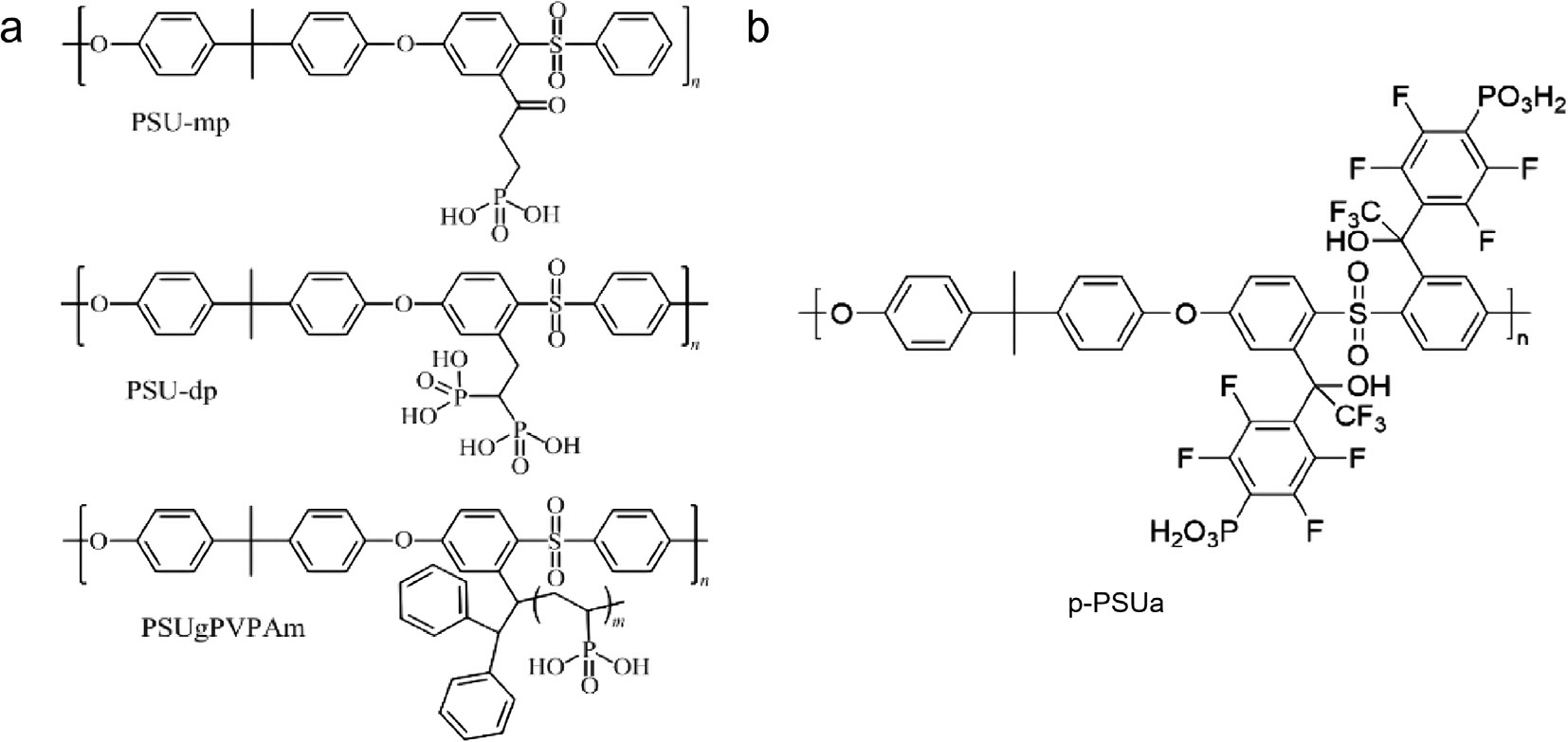
Fig. 9. (a) Chemistry; Several polymers grafted with side chains of phosphonic acid groups at different densities Reprinted(Adapted)with permission.[80]Copyright 2008, Royal Society of Chemistry, [81] Copyright 2008, American Chemical Society; (b) novel phosphorylated hydrocarbon polymers on a commercial polysulfone (PSU) backbone Reprinted (Adapted) with permission. [83] Copyright 2025, Royal Society of Chemistry.
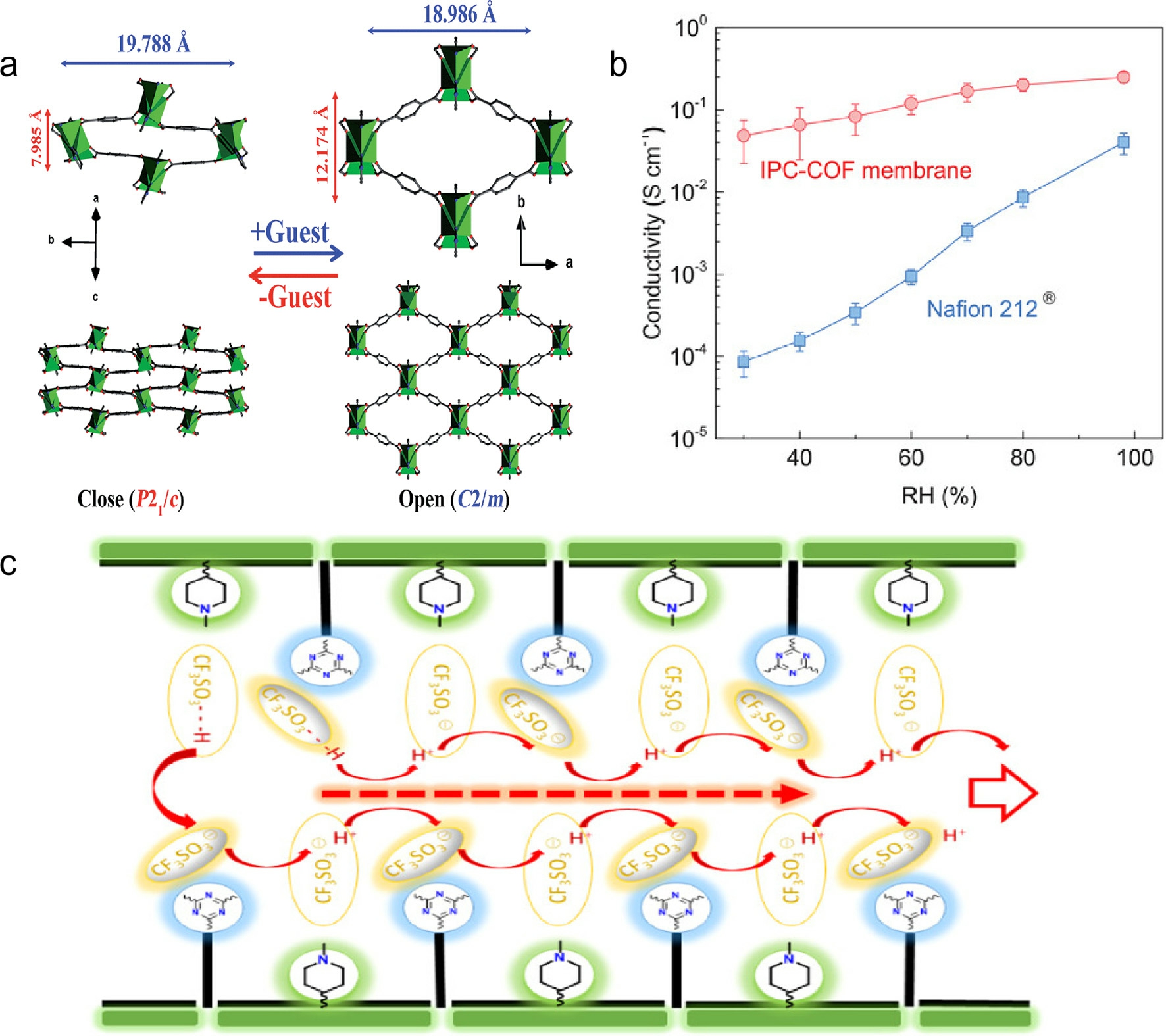
Fig. 10. (a) Perspective view of the evolution of FJU-31 rhombic one-dimensional channels during degassing treatment and the loading of organic hydroxyl guests Reprinted(Adapted)with permission.[88] Copyright 2016, Royal Society of Chemistry; (b) Proton conductivity of IPC-COF membrane s over a wide humidity range Reprinted(Adapted)with permission.[90] Copyright 2022, Wiley-VCH. (c) Schematic diagram of the doped structures of CTF and TFSA Reprinted (Adapted) with permission. [91] Copyright 2021, American Chemical Society.
4 Summary and outlook
Wide-temperature-range proton exchange membranes(WT-PEMs) are essential for enabling rapid start-up at low temperatures while also supporting efficient and stable operation at elevated temperatures. However, the intrinsic temperature depend ence of proton transport in existing membranes, which arises from water evaporation in water-mediated PEMs and phosphoric-acid loss in nonaqueous systems, restricts their ability to maintain high conductivity across a broad temperature window. This review has summarized the fundamental protontransport mechanisms and the recent materials-design strategies developed to address these limitations (Fig. 11).
For water-mediated PEMs, performance deterioration under high-temperature and low-humidity conditions is mainly caused by dehydration and the collapse of hydrogen-bond networks. Strategies such as incorporating hydrophilic fillers, engineering confined hydrophilic domains, introducing additional proton-transfer sites,and designing dynamic surface coatings have been shown to suppress water loss and reduce the dependence of proton transport on bulk water. These advances collectively extend the usable high-temperature range of sulfonated PEMs. Nevertheless, their operational limits are still constrained by the boiling point of water and by the relatively low glass-transition temperatures of PFSA and hydrocarbon-based matrices, which makes operation above approximately 130 ° C inherently challenging.
For water-independent PEMs, especially phosphoricacid-doped systems, excellent anhydrous proton conduction can be achieved at temperatures up to 200 ° C. However, the loss of phosphoric acid under humid or lowtemperature conditions continues to hinder reliable room-temperature start-up. Recent efforts that enhance interactions between phosphoric acid and the polymer matrix, create confined structural domains, construct multilayer architectures, and introduce barrier layers have significantly improved acid retention and mitigated conductivity decay during thermal cycling. Furthermore,multi–proton-carrier systems that combine phosphoric acid with heteropolyacids, ionic liquids, or organic phosphonates establish synergistic proton-conduction pathways. These hybrid networks help reduce the dependence on high phosphoric-acid loadings and contribute to more balanced performance across both low- and hightemperature regimes. In addition, emerging fixed-carrier PEMs, including phosphonic-acid-grafted polymers,metal–organic frameworks (MOFs), and covalent organic frameworks (COFs), provide water-independent proton pathways based on stable solid-state hydrogen-bond networks. These materials exhibit promising widetemperature-range conduction and structural tunability.However, several challenges remain, including the need to further improve anhydrous high-temperature conductivity, suppress condensation or degradation of acidic functional groups, and develop fabrication methods that yield large-area, mechanically robust, and defect-free membranes suitable for practical fuel-cell devices.
Overall, the advancement of WT-PEMs depends on the integrated optimization of proton-carrier stability, nanoscale confinement, polymer backbone robustness, and cooperative multi-mechanism proton conduction. Future research directions include:
Reducing the dependence on volatile or leachable proton carriers so that membranes maintain high conductivity under both humid low-temperature and dry high-temperature conditions.
Designing polymer architectures that couple confined nanochannels with adaptive proton-transfer networks.
Developing hybrid proton-conduction systems that integrate fixed carriers with nonaqueous proton donor s and acidic or basic polymer functionalities.
Establishing a deeper mechanistic understanding of proton diffusion under extreme conditions, particularly high-temperature and low-humidity environments, as well as the associated long-term chemical and mechanical degradation pathways.
Advancing scalable fabrication technologies that enable the production of large-area, dense, and mechanically robust membranes for widetemperature-range PEMFC applications.
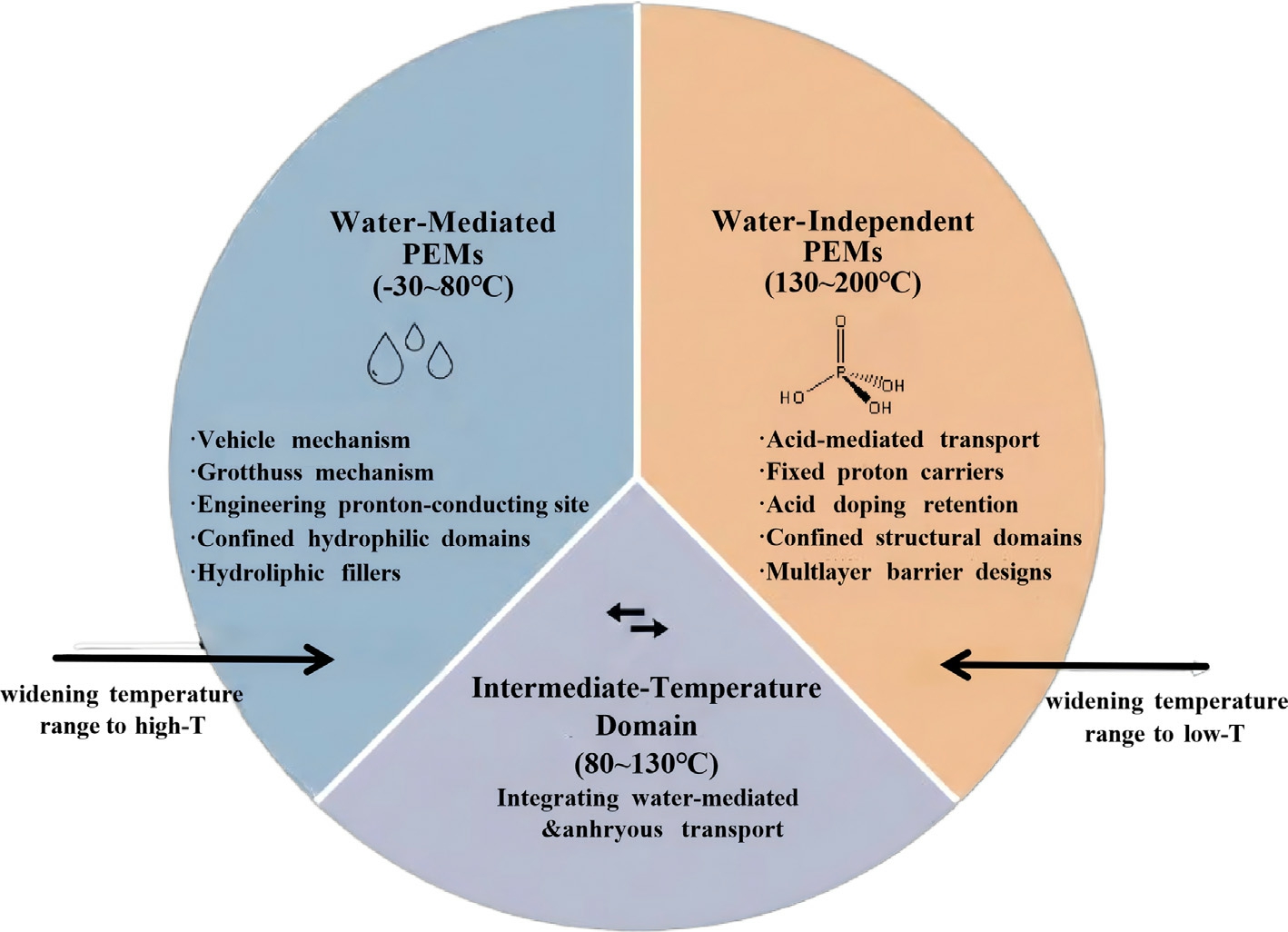
Fig. 11. Operating temperature windows of proton exchange membranes.
With continued progress in polymer chemistry,nanochannel engineering, multi-carrier conduction networks, and emerging solid-state proton conductors, WTPEMs are expected to play a key role in next-generation hydrogen energy systems capable of flexible and highefficiency operation across an extended temperature range.
CRediT authorship contribution statement
Yunjie Yang: Writing – original draft, Conceptualization. Junxin Chen: Writing – original draft, Conceptualization. Sai Liu: Writing – original draft, Conceptualization.Xiang Ao: Writing – review & editing, Writing – original draft, Conceptualization. Haoliang Feng: Writing – original draft. Le Shi: Writing – review & editing,Conceptualization.
Declaration of competing interest
The other authors declare that they have no known competing financial interests or personal relationships that could have appeared to influence the work reported in this paper.
Acknowledgments
This work was supported by the National Natural Science Foundation of China (52277225) and the Fundamental Research Funds for the Central Universities(xtr052024009).
References
[1]M.A. Aminudin, S.K. Kamarudin, B.H. Lim, E.H. Majilan, M.S.Masdar, N. Shaari, An overview: current progress on hydrogen fuel cell vehicles, Int. J. Hydrogen Energy 48 (2023) 4371–4388.
[2]X. Liu, Y. Zhang, S. Deng, C. Li, J. Dong, J. Wang, Z. Yang, D.Wang, H. Cheng, Semi-interpenetrating polymer networks toward sulfonated poly(ether ether ketone) membranes for high concentration direct methanol fuel cell, Chin. Chem. Lett. 30(2019) 299–304.
[3]I. Staffell, D. Scamman, A. Velazquez Abad, P. Balcombe, P.E.Dodds, P. Ekins, N. Shah, K.R. Ward, The role of hydrogen and fuel cells in the global energy system, Energ.Environ.Sci.12(2019)463–491.
[4]N. Wang, H. Xiang, L. Meng, C. Tang, Z.Dong,Y.Yang,L.Du,S. Ye, Accelerating the green hydrogen revolution: the synergy of pemwe and ai, Renewable Energy System and Equipment 1 (2025)61–66.
[5]M. Maximini, P. Engelhardt, M. Brenner, F. Beckmann, O.Moritz, Fast start-up of a diesel fuel processor for pem fuel cells,Int. J. Hydrogen Energy 39 (2014) 18154–18163.
[6]K. Schmidt-Rohr, Q. Chen, Parallel cylindrical water nanochannels in nafion fuel-cell membranes, Nat. Mater. 7 (2008)75–83.
[7]L. Zhang, M. Liu, D. Zhu, M. Tang, T.Zhu,C.Gao,F.Huang,L.Xue, Double cross-linked 3d layered pbi proton exchange membranes for stable fuel cell performance above 200° C, Nat.Commun. 15 (2024) 3409.
[8]P. Liu, S. Xu, A review of low-temperature proton exchange membrane fuel cell degradation caused by repeated freezing start,Int. J. Hydrogen Energy 48 (2023) 8216–8246.
[9]N. Shaari, Chapter 9 - polymer electrolyte membranes in fuel cell applications, in: M. Jeguirim (Ed.), Recent advances in renewable energy technologies, Academic Press, 2021, pp. 311–352.
[10]T. Yasuda, M. Watanabe, Protic ionic liquids: fuel cell applications, MRS Bull. 38 (2013) 560–566.
[11]Y. Zhai, H. Zhang, J. Hu, B. Yi, Preparation and characterization of sulfated zirconia(so42 /zro2)/nafion composite membranes for pemfc operation at high temperature/low humidity,J.Membr.Sci.280 (2006) 148–155.
[12]S.S. Araya, S.J. Andreasen, S.K. Kær, Experimental characterization of the poisoning effects of methanol-based reformate impurities on a pbi-based high temperature pem fuel cell, Energies (2012) 4251–4267.
[13]Q. Li, R. He, J.-A. Gao, J.O. Jensen, N.J. Bjerrum, The co poisoning effect in pemfcs operational at temperatures up to 200° c,J. Electrochem. Soc. 150 (2003) A1599.
[14]C. Yue, W. Zheng, Q. Wang, Z. Wang, B. Li, C. Zhang, P. Ming,Challenges in membrane electrode assemblies at elevated temperatures for proton exchange membrane fuel cells: a review,Energ. Environ. Sci. 18 (2025) 6934–6982.
[15]T. Qu, J. Hu, Q. Tan, Y. Liu, Y. Chen, J. Sun, Y. Liu, Effect of phosphoric acid-doped polybenzimidazole membranes on the performance of h+-ion concentration cell, Int. J. Hydrogen Energy 46 (2021) 4354–4364.
[16]Y.H. Jeong, J.H. Jung, E. Choi, S. Han,A.I.Begley,S.J.Yoo,J.H.Jang, H.-J. Kim, S.W. Nam, K.-Y. Lee, J.Y. Kim, Colorimetric determination of phosphoric acid leakage for phosphoric aciddoped polybenzimidazole membrane fuel cell applications, J.Power Sources 299 (2015) 480–484.
[17]S. Lang, T.J. Kazdal, F. Ku¨ hl, M.J. Hampe, Experimental investigation and numerical simulation of the electrolyte loss in a ht-pem fuel cell, Int. J. Hydrogen Energy 40 (2015) 1163–1172.
[18]Y. O¨ zdemir, N. O¨ zkan, Y. Devrim, Fabrication and characterization of cross-linked polybenzimid azole based membranes for high temperature pem fuel cells, Electrochim.Acta 245 (2017) 1–13.
[19]S. Lin, S. Zhao, H. Dou, G. Wei, Y. Li, S. Gao, J. Gao, Y. He,Mass-transfer mechanism of nafion proton-excha nge membranes in fuel cells—a review, Energ. Technol. 12 (2024) 2400164.
[20]T.J. Peckham, S. Holdcroft, Structure-morphology-property relationships of non-perfluorinated proton-conducting membranes, Adv. Mater. 22 (2010) 4667–4690.
[21]E. Spohr, Molecular dynamics simulations of proton transfer in a model nafion pore, Mol. Simul. 30 (2004) 107–115.
[22]R. Zeis, Materials and characterizatio n techniques for hightemperature polymer electrolyte membrane fuel cells, Beilstein J.Nanotechnol. 6 (2015) 68–83.
[23]Y. Zhao, G. Wang, W. Chen, Molecular dynamic simulations of proton and water transport mechanism in a nafion pore, Energ.Technol. 11 (2023) 2300328.
[24]M. Kim, H. Ko, S.Y. Nam, K. Kim,Study on control of polymeric architecture of sulfonated hydrocarbon-based polymers for highperformance polymer electrolyte membranes in fuel cell applications, Polymers (2021) 3520.
[25]P. Song, Y. Zhang, X. Zhang, J. Liu, L. Wu, A.C. Fisher, Q.-F.An, Recent progress on the development of non-fluorinated proton exchange membrane-a review, Green Energy Environ. 10 (2025)1863–1880.
[26]M. Eikerling, A.A. Kornyshev, A.M. Kuznetsov, J. Uls trup, S.Walbran, Mechanisms of proton conductance in p olymer electrolyte membranes, J. Phys. Chem. B 105 (2001) 3646–3662.
[27] S.J. Paddison, Proton conduction mechanisms at low degrees of hydration in sulfonic acid–based polymer electrolyte membranes,Annu. Rev. Mat. Res. 33 (2003) 289–319.
[28]C.H. Lee, H.B. Park, Y.M. Lee, R.D. Lee, Importance of proton conductivity measurement in polymer electrolyte membrane for fuel cell application, Ind. Eng. Chem. Res. 44 (2005) 7617–7626.
[29]D.E. Moilanen, I.R. Piletic, M.D. Fayer, Water dynamics in nafion fuel cell membranes: the effects of confinement and structural changes on the hydrogen bond network, J. Phys. Chem. C 111(2007) 8884–8891.
[30]L.K. Seng, M.S. Masdar, L.K. Shyuan, Ionic liquid in phosphoric acid-doped polybenzimidazole (pa-pbi) as electrolyte membranes for pem fuel cells: a review, Membranes (2021) 728.
[31]K.D. Kreuer, A. Fuchs, M. Ise, M. Spaeth,J.Maier,Imidazole and pyrazole-based proton conducting polymers and liquids,Electrochim. Acta 43 (1998) 1281–1288.
[32]R. Koyilapu, S. Singha, S.N.R. Kutcherlapati, T.Jana,Grafting of vinylimidazolium-type poly(ionic liquid) on silica nanoparticle through raft polymerization for construct ing nanocomposite based pem, Polymer 195 (2020) 122458.
[33]B. Lin, W. Yuan, F. Xu, Q. Chen, H. Zhu,X.Li,N.Yuan,F.Chu,J. Ding, Protic ionic liquid/functi onalized graphene oxide hybrid membranes for high temperature proton exchange membrane fuel cell applications, Appl. Surf. Sci. 455 (2018) 295–301.
[34]H.G. Herz, K.D. Kreuer, J. Maier, G. Scharfenberger, M.F.H.Schuster, W.H. Meyer, New fully polymeric proton solvents with high proton mobility, Electrochim. Acta 48 (2003) 2165–2171.
[35]K.-D. Kreuer, Proton conductivity: materials and applications,Chem. Mater. 8 (1996) 610–641.
[36]K.-D. Kreuer, S.J. Paddison, E. Spohr, M. Schuster, Transport in proton conductors for fuel-cell applications: simulations,elementary reactions, and phenomenology, Chem. Rev. 104(2004) 4637–4678.
[37]M.F.H. Schuster, W.H. Meyer, M. Schuster,K.D.Kreuer,Toward a new type of anhydrous organic proton conductor based on immobilized imidazole, Chem. Mater. 16 (2004) 329–337.
[38]R. He, Q. Li, G. Xiao, N.J. Bjerrum, Proton conductivity of phosphoric acid doped polybenzimidazole and its composites with inorganic proton conductors, J. Membr. Sci. 226 (2003) 169–184.
[39]Q. Li, R. He, J.O. Jensen, N.J. Bjerrum, Pbi-based polymer membranes for high temperature fuel cells – preparation,characterization and fuel cell demonstration, Fuel Cells 4 (2004)147–159.
[40]J. Lobato, P. Can˜izares, M.A. Rodrigo, J.J. Linares, J.A. Aguilar,Improved polybenzimidazole films for h3po4-doped pbi-based high temperature pemfc, J. Membr. Sci. 306 (2007) 47–55.
[41]Y.L. Ma, J.S. Wainright, M.H. Litt, R.F.Savinell,Conductivity of pbi membranes for high-temperature polymer electrolyte fuel cells,J. Electrochem. Soc. 151 (2004) A8.
[42]H.-C. Chien, L.-D. Tsai, C.-P. Huang, C.-Y.Kang,J.-N.Lin,F.-C.Chang, Sulfonated graphene oxide/nafion composite membranes for high-performance direct methanol fuel cells, Int. J. Hydrogen Energy 38 (2013) 13792–13801.
[43]A.K. Sahu, K. Ketpang, S. Shanmugam, O. Kwon,S.Lee,H.Kim,Sulfonated graphene–nafion composite membran es for polymer electrolyte fuel cells operating under reduced relative humidity, J.Phys. Chem. C 120 (2016) 15855–15866.
[44]W. Wu, Y. Li, J. Liu, J. Wang, Y. He, K. Davey, S.-Z. Qiao,Molecular-level hybridization of nafion with quantum dots for highly enhanced proton conduction, Adv. Mater. 30 (2018)1707516.
[45]C. Yin, J. Li, Y. Zhou, H. Zhang, P.Fang,C.He,Phase separation and development of proton transport pathways in metal oxide nanoparticle/nafion composite membranes during water uptake,J.Phys. Chem. C 122 (2018) 9710–9717.
[46]J. Niu, S. Zhang, Y. Li, X. Li, J. Zhang, S. Lu, Q. He, Effects of microstructure on the retention of proton conductivity of nafion/sio2 composite membranes at elevated temperatures: an in situ saxs study, Polymer 273 (2023) 125869.
[47]A.A. Wani, N. Shaari, S.K. Kamarudin, N.F. Raduwan, Y.N.Yusoff, A.M. Khan, S. Yousuf, Critical review on composite-based polymer electrolyte membranes toward fuel cell applications:progress and perspectives, Energy Fuel 38 (2024) 18169–18193.
[48]L.V. Nam, E. Choi, S. Jang, S.M. Kim,Patterned mesoporous tio2 microplates embedded in nafion®membrane for high temperature/low relative humidity polymer electrolyte membrane fuel cell operation, Renew. Energy 180 (2021) 203–212.
[49]I. Nicotera, L. Coppola, C. Simari, Novel nafion nanocomposite membranes embedded with tio2-decorated mwcnts for hightemperature/low relative humidity fuel cell systems, Mater.Renew. Sustain. Energy 13 (2024) 307–318.
[50]I. Nicotera, M.H.U. Rehman, V. Loise, M. De Bonis,C.Luigi,C.Simari, Enhanced electrochemical performance and thermomechanical stability of nafion/sulfonate d clay-carbon nanotube nanocomposite membranes for high-performance fuel cells under challenging conditions, Mater. Renew. Sustain. Energy 14 (2025) 48.
[51]Y.O. Al-Ghamdi, S.M.A.S. Keshk, Functionalized clay nanocomposites for enhanced proton conductivity in polyetherbased fuel cell membranes, Appl. Clay Sci. 278 (2025) 107999.
[52]W. Mabrouk, K. Charradi, R. Lafi, H.S.AlSalem,H.Maghraoui-Meherzi, S.M.A.S. Keshk, Augmentation in proton conductivity of sulfonated polyether sulfone octyl sulfonam ide using sepiolite clay,J. Mater. Sci. 57 (2022) 15331–15339.
[53]K. Charradi, W. Mabrouk, I.B. Kacem, N. Bellakhal, Y.O. Al-Ghamdi, R. Marzouki, S.M.A.S. Keshk, Incorporation of multilayered double hydroxides/sepiolite augments proton conductivity performance in low sulfonated polyether sulfone octyl sulfonamide, Mater. Renew. Sustain. Energy 13 (2024) 97–107.
[54]Q. Wang, Q. Zhang, X. Zhan, F. Chen, Structure and surface properties of polyacrylates with short fluorocarbon side chain:role of the main chain and spacer group, J.Polym.Sci.A Polym.Chem.48 (2010) 2584–2593.
[55]J. Li, M. Pan, H. Tang, Understanding short-side-chain perfluorinated sulfonic acid and its application for high temperature polymer electrolyte membrane fuel cells, RSC Adv. 4(2014) 3944–3965.
[56]X. Huang, S. Zhao, H. Liu, R. Wang, H. Tang, Hydrophilic channel volume behavior on proton transport performance of proton exchange membrane in fuel cells, ACS Appl.Polym.Mater.4 (2022) 2423–2431.
[57]D. Liu, Y. Xie, J. Zhong, F. Yang, J. Pang, Z. Jiang, High methanol resistance semi-crystalline sulfonated poly(ether ketone)proton exchange membrane for direct methanol fuel cell, J.Membr. Sci. 650 (2022) 120413.
[58]M.J. Park, K.H. Downing, A. Jackson, E.D.Gomez,A.M.Minor,D. Cookson, A.Z. Weber, N.P. Balsara, Increased water retention in polymer electrolyte membranes at elevated temperatures assisted by capillary condensation, Nano Lett. 7 (2007) 3547–3552.
[59]S.Y. Lee, D.W. Shin, C. Wang, K.H. Lee,M.D.Guiver,Y.M.Lee,A capillary water retention effect to improve medium-temperature fuel cell performance, Electrochem. Commun. 31 (2013) 120–124.
[60]A. Stassi, I. Gatto, E. Passalacqua, V. Antonucci, A.S. Arico, L.Merlo, C. Oldani, E. Pagano, Performance comparison of long and short-side chain perfluorosulfonic membranes for high temperature polymer electrolyte membrane fuel cell operation,J.Power Sources 196 (2011) 8925–8930.
[61]P. Guan, J. Lei, Y. Zou, Y. Zhang, Improved thermo-mechanical properties and reduced hydrogen permeation of short side-chain perfluorosulfonic acid membranes doped with ti3c2tx, Materials(2021) 7875.
[62]C.H. Park, S.Y. Lee, D.S. Hwang, D.W. Shin, D.H. Cho, K.H.Lee, T.-W. Kim, T.-W. Kim, M. Lee, D.-S.Kim,C.M.Doherty,A.W. Thornton, A.J. Hill, M.D. Guiver, Y.M. Lee, Nanocrackregulated self-humidifying membranes, Nature 532(2016)480–483.
[63]T. Ogawa, T. Aonuma, T. Tamaki, H. Ohashi, H. Ushiyama, K.Yamashita, T. Yamaguchi, The proton conductio n mechanism in a material consisting of packed acids, Chem.Sci.5(2014)4878–4887.
[64]H. Huang, X. Zeng, X. Zhang, J. Fan, H. Li, Proton exchange membrane based on interpenetrating polymer network structure for excellent cell performance and chemical stability, J. Power Sources 558 (2023) 232602.
[65]G. Xu, A. Ke, G. Xu, Y. Liu, Y. Zuo,X.Yang,Y.Dong,J.Wang,J. Zheng, J. Li, W. Cai, Enabling high-temperature application of nafion membrane via imitating ionic clusters in proton conduction channels, Int. J. Hydrogen Energy 56 (2024) 330–337.
[66]J. Lobato, P. Can˜izares, M.A. Rodrigo, D. U´beda, F.J. Pinar,Enhancement of the fuel cell performance of a high temperature proton exchange membrane fuel cell running with titanium composite polybenzimidazole-based membranes, J. Power Sources 196 (2011) 8265–8271.
[67]H. Wang, G. Pan, Z. Ji, Y. Ma, W. Shang, H. Li, F. Ruan, Q.Wang, J. Bao, Ionic liquid-modified tio2 to enhance polybenzimidazole for high-temperature proton exchange membranes, Chem. Eng. J. 515 (2025) 163442.
[68]A.S. Lee, Y.-K. Choe, I. Matanovic, Y.S. Kim, The energetics of phosphoric acid interactions reveals a new acid loss mechanism, J.Mater. Chem. A 7 (2019) 9867–9876.
[69]T. Guo, Y. Wang, G. Chao, X. Zhou, E.Yang,Z.Lv,J.Zheng,K.Geng, N. Li, Quaternized poly(aryl imidazolium)containing bulky binaphthyl group as proton exchange membrane for hightemperature fuel cells, Chem. Eng. J. 500 (2024) 157164.
[70]T. Zhu, D. Zhu, J. Liang, L. Zhang, F. Huang, L. Xue, Gel-state polybenzimidazole proton exchange membranes with flexible alkyl sulfonic acid side chains for a wider operating temperature range 25–240 ° C, J. Energy Chem. 85 (2023) 91–101.
[71]J. Zhang, S. Chen, H. Wei, J. Zhang, H. Wang, S. Lu, Y. Xiang,Proton conductor confinement strategy for polymer electrolyte membrane assists fuel cell operation in wide-range temperature,Adv. Funct. Mater. 33 (2023) 2214097.
[72]W. Wei, Y. Dai, S. Xu, J. Wang, X. Liu, R. He, Crosslinked poly(isatin biphenyl spirofluorene) membranes for proton conduction over a wide temperature range from 40 to 160° C, Int. J.Hydrogen Energy 48 (2023) 28150–28162.
[73]H. Tang, K. Geng, L. Wu, J. Liu, Z.Chen,W.You,F.Yan,M.D.Guiver, N. Li, Fuel cells with an operational range of –20° C to 200° C enabled by phosphoric acid-doped intrinsically ultramicroporous membranes, Nat. Energy 7 (2022) 153–162.
[74]J. Zhao, D. Song, J. Jia, N. Wang, K. Liu, T. Zuo, Q. Che,Constructing proton exchange membranes with high and stable proton conductivity at subzero temperatur e through vacuum assisted flocculation technique, Appl. Surf. Sci.585 (2022)152579.
[75]W. Li, W. Liu, J. Zhang, H. Wang, S.Lu,Y.Xiang,Porous proton exchange membrane with high stability and low hydrogen permeability realized by dense double skin layers constructed with amino tris (methylene phosphonic acid), Adv. Funct. Mater.33 (2023) 2210036.
[76]J. Zhang, J. Zhang, L. Luo, X. Wang, J.Yao,Q.Zhang,Z.Zhang,M. Wu, J. Zhang, H. Wang, Y. Xiang, S. Lu, Phosphoric acid sustained-release strategy boosting durability of high temperature proton exchange membrane fuel cells, Chem. Eng. J. 518 (2025)164518.
[77]X. Zhang, X. Fu, S. Yang, Y. Zhang, R.Zhang,S.Hu,X.Bao,F.Zhao, X. Li, Q. Liu, Design of sepiolite-supported ionogelembedded composite membranes without proton carrier wastage for wide-temperature-range operation of proton exchange membrane fuel cells, J. Mater. Chem. A 7 (2019) 15288–15301.
[78]Y. Xiao, H. Chen, X. Shen, Y. Li, L.Zhang,P.Cheng,H.Han,N.Tang, Construction of wide-temperatur e-range proton exchange membrane by regulating proton transfer channels based on phosphate-functionalized carbon nanotubes, J. Membr. Sci. 709(2024) 123077.
[79]W. Li, W. Liu, W. Jia, J. Zhang, Q.Zhang,Z.Zhang,J.Zhang,Y.Li, Y. Liu, H. Wang, Y. Xiang, S. Lu, Dual-proton conductor for fuel cells with flexible operational temperature, Adv. Mater. 36(2024) 2310584.
[80]J. Parvole, P. Jannasch, Poly(arylene ether sulfone)s with phosphonic acid and bis(phosphonic acid) on short alkyl side chains for proton-exchange membranes, J. Mater.Chem.18(2008)5547–5556.
[81]J. Parvole, P. Jannasch, Polysulfon es grafted with poly(vinylphosphonic acid) for highly proton conducting fuel cell membranes in the hydrated and nominally dry state,Macromolecules 41 (2008) 3893–3903.
[82]E. Abouzari-Lotf, H. Ghassemi, A. Shockravi, T.Zawodzinski,D.Schiraldi, Phosphonated poly(arylene ether)s as potential high temperature proton conducting materials, Polymer 52(2011)4709–4717.
[83]P. Martschin, T. Pro¨lß, A. Hutzler, S. Thiele, J. Kerres,Preparation of a new class of phosphonated hydrocarbon polymers based on polysulfone, Polym. Chem. 16 (2025) 879–890.
[84]N.R. Kang, T.H. Pham, H. Nederstedt, P. Jannasch,Durable and highly proton conducting poly(arylene perfluorophenylphosphonic acid) membranes, J. Membr. Sci. 623 (2021) 119074.
[85]K.H. Lim, A.S. Lee, V. Atanasov, J. Kerres,E.J.Park,S.Adhikari,S. Maurya, L.D. Manriquez, J. Jung, C. Fujimoto,I.Matanovic,J.Jankovic, Z. Hu, H. Jia, Y.S. Kim, Protonated phosphonic acid electrodes for high power heavy-duty vehicle fuel cells,Nat.Energy 7 (2022) 248–259.
[86]Y.S. Park, J. Jung, M.B. Koo, J.G. Kim, J. Gu, G.H. Choi, S.H.Kim, J.F. Kim, C.-H. Ahn, S.S. Hwang, H.T.Chung,A.S.Lee,All protonated phosphonic acid membrane and ionomers for high powered intermediate temperature proton exchange membrane fuel cells, Chem. Eng. J. 522 (2025) 167336.
[87]M. Yamada, I. Honma, A biopolymer composite material as an anhydrous proton-conducting membrane, Angew. Chem. Int. Ed.Engl. 43 (2004) 3688–3691.
[88]K. Firouz Tadavani, A. Abdolmaleki, M.R. Molavian, S.Borandeh, E. Sorvand, M. Zhiani, Synergistic behavior of phosphonated and sulfonated groups on proton conductivity and their performance for high-temperatu re proton exchange membrane fuel cells (pemfcs), Energy Fuel 31(2017)11460–11470.
[89]Y. Ye, X. Wu, Z. Yao, L. Wu, Z. Cai, L. Wang, X. Ma, Q.-H.Chen, Z. Zhang, S. Xiang, Metal–organ ic frameworks with a large breathing effect to host hydroxyl compound s for high anhydrous proton conductivity over a wide temperature range from subzero to 125 ° C, J. Mater. Chem. A 4 (2016) 4062–4070.
[90]L. Cao, H. Wu, Y. Cao, C. Fan, R. Zhao,X.He,P.Yang,B.Shi,X. You, Z. Jiang, Weakly humidity-dependent proton-conducting cof membranes, Adv. Mater. 32 (2020) 2005565.
[91]W. Huang, B. Li, Y. Wu, Y. Zhang, W. Zhang, S. C hen,Y.Fu,T.Yan, H. Ma, In situ-doped superacid in the covalent triazine framework membrane for anhydrous proton conduction in a wide temperature range from subzero to elevated temperature, ACS Appl. Mater. Interfaces 13 (2021) 13604–13612.
[92]A. Kusoglu, A.Z. Weber, New insights into perfluorinated sulfonicacid ionomers, Chem. Rev. 117 (2017) 987–1104.
Received 7 December 2025;revised 23 December 2025; accepted 26 December 2025
Peer review under the responsibility of Global Energy Interconnection Group Co. Ltd.
* Corresponding author.
E-mail addresses:1293209405@qq.com (Y. Yang), 3125304429@stu.xjtu.edu.cn (J. Chen), liusai_xj@163.com (S. Liu), xiang.ao@xjtu.edu.cn (X. Ao),Fenghl13525452103@163.com (H. Feng), le.shi@mail.xjtu.edu.cn (L. Shi).
https://doi.org/10.1016/j.gloei.2025.12.002
2096-5117/© 2026 Global Energy Interconnection Group Co. Ltd. Publishing services by Elsevier B.V. on behalf of KeAi Communications Co. Ltd.
This is an open access article under the CC BY-NC-ND license(http://creativecommons.org/licenses/by-nc-nd/4.0/).

Yunjie Yang received his B.S. degree from Yanshan University and his M.S. and Ph.D.degrees from Dalian University of Technology.He is currently working at XJ Group Company,Henan, China. His research interests include the development of core hydrogen energy technologies, including electrolyzers, solid-state hydrogen storage, and fuel cells.